

Donald Trump says he plans a “mic drop” moment at this year’s White House Correspondents’ Dinner. The branding is almost beside the point. Strip away the theatrical packaging, and what remains is something much more revealing: a president showing up to attack the press, refusing to participate in the traditions of accountability attached to the event, and leaving before he has to endure even the mildest discomfort.
That is not swagger. It is not strength. And despite the inevitable attempts to spin it as some kind of populist triumph over “elite media,” it is much closer to something darker.
Trump reportedly intends to use the dinner not as presidents historically have, as an awkward but important ritual in which political power submits itself, however briefly, to ridicule and scrutiny, but instead as a stage-managed grievance performance. He will go after outlets he believes have wronged him, which at this point effectively means any serious journalistic institution. Then he is expected to leave early, skipping the press awards and avoiding the rest of the evening.
The choreography tells the story.
Show up. Attack critics. Avoid criticism. Declare victory.
That is not a joke. That is a governing instinct.
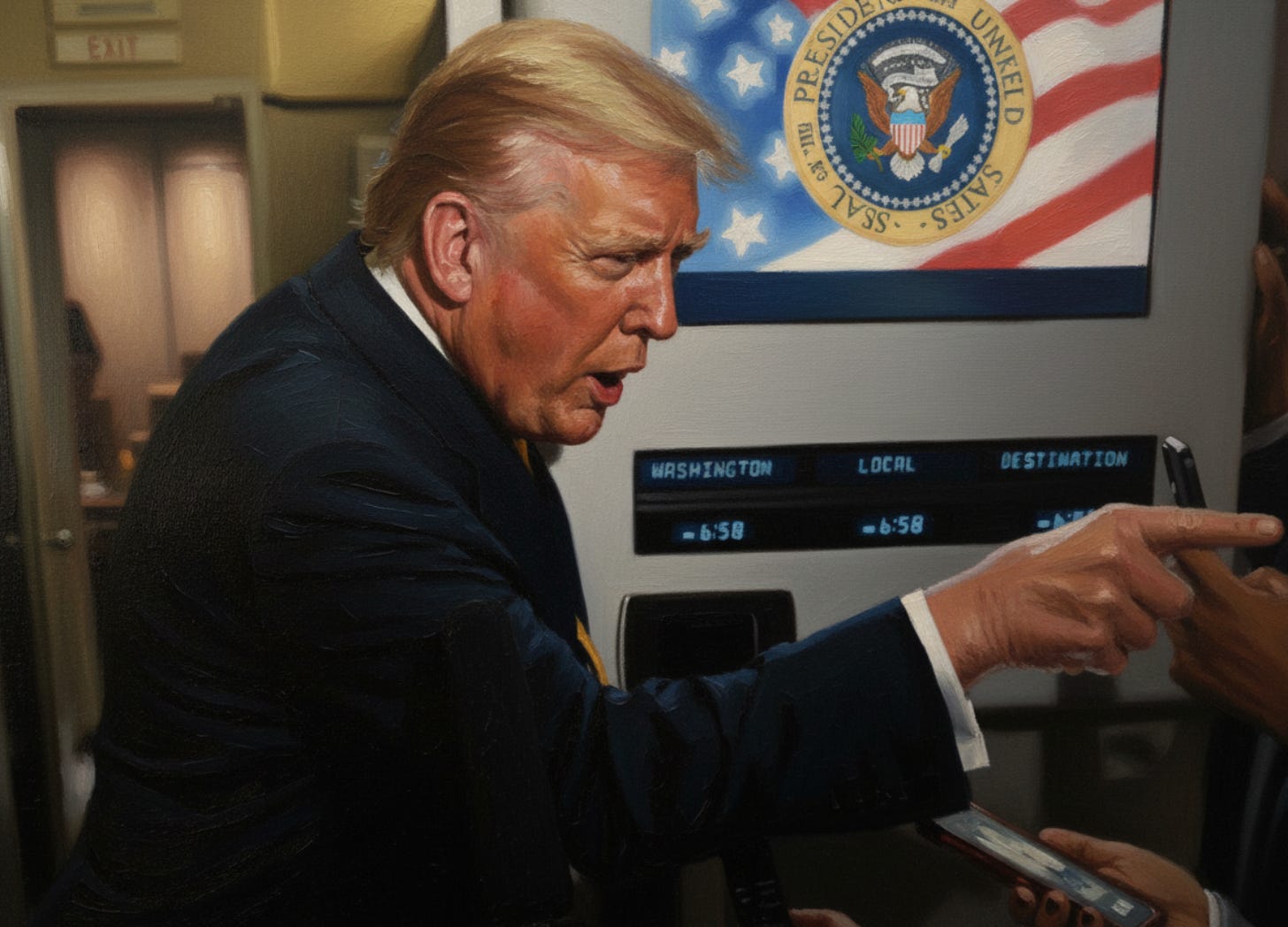
The constitutional role Trump keeps targeting
It is worth slowing down and remembering something basic, because in the constant churn of political spectacle, basic things can become strangely easy to forget.
There is one profession explicitly protected in the American Constitution: the press.
That matters.
A president treating journalists as enemies is not just another episode in the culture war. It cuts directly against a foundational democratic principle. The point of a free press is not to flatter power. It is to scrutinize power, challenge power, and when necessary expose abuses of power.
Trump has long inverted that idea. In his framework, any reporting critical of the administration becomes illegitimate by definition. Facts that complicate his narrative are cast as attacks. Investigations become conspiracies. Journalists become adversaries.
And legitimacy, in this worldview, is reserved only for those willing to function as propaganda.
That is not traditional conservatism. It is not even recognizably Republican in the historical sense.
It is authoritarian politics.
Even deeply flawed presidents, including ones I strongly opposed, generally understood there was some civic role for the press. There was tension, certainly. There was hostility at times. But there remained some recognition that journalists were part of the democratic system.
Trump’s approach is different. The hostility is not incidental. It is central.
Conditioning distrust
Once the public is conditioned to distrust journalism wholesale, a much larger political project becomes possible.
If people can be persuaded that all critical reporting is fake, then facts become easier to dismiss.
Investigations become easier to ignore.
Critics become easier to isolate.
And a leader can advance the oldest authoritarian proposition in the book: ignore what you see, ignore what you hear, trust only me.
That is the context in which this year’s Correspondents’ Dinner matters.
Traditionally, the event exposes the tension between government and press in a strange but healthy way. Presidents take criticism. Sometimes they get roasted brutally, but they sit there and absorb it.
In 2011, Barack Obama mocked Donald Trump directly from that stage. Trump did not like it, but he sat through it.
Now even that small ritual of mutual discomfort is being re-engineered around control.
No roast.
No exposure.
No unpredictability.
Control the setting. Control the message. Limit criticism.
That pattern is becoming familiar.
Why independent media matters more now
This is also why independent media matters more than ever.
When traditional outlets are treated as enemies and access itself becomes a political weapon, independent media becomes one of the few remaining ways to keep scrutiny alive.
And importantly, independent media operates differently.
It does not depend on invitations.
It does not depend on proximity to power.
It does not depend on approval from the people being covered.
It depends on evidence, direct communication, and maintaining independence from the institutions it scrutinizes.
That is precisely why authoritarian politics so often targets independent voices too. If something cannot be controlled, it becomes a threat.
And we are seeing that pressure.
Lawsuit threats aimed at journalists.
Investigations designed to intimidate.
Public attacks meant to delegitimize critics.
This is not hypothetical future stuff. It is already happening.
Which is why I keep emphasizing something that may have sounded abstract until recently: protecting independent channels of communication matters.
If platforms can throttle, suspend, or disappear creators at the whim of political or corporate pressure, then direct audience relationships are not a luxury. They are a safeguard.
That is why I have talked so much about owning the connection to the audience.
Because if the pressure escalates, that infrastructure matters.
Criticism is not disloyalty
One of the most corrosive ideas taking root in Trump-era politics is the suggestion that criticism itself is somehow unpatriotic.
That attacking the administration is attacking America.
That scrutinizing power is disloyal.
That journalists who investigate wrongdoing are somehow enemies of the nation.
That is exactly backwards.
The anti-American impulse is not questioning power. It is trying to insulate power from questioning.
The anti-American behavior is not an aggressive independent press. It is a president trying to make that press afraid.
And that is why this dinner is not really about one speech.
It is about a broader effort to redefine democratic dissent as betrayal.
That should concern everyone, regardless of ideology. Because once criticism becomes treason in the public imagination, democracy is already in trouble. And that is why this is so important. Not because of the theater of one night in Washington.
But because of what that theater reveals.
We’re reaching over 150 million people every month across YouTube, podcasts, Substack, and beyond. But algorithms can change. Platforms can fold. And when that happens, this newsletter is how we stay connected.
If you’re not yet a paid subscriber, please consider joining.
If you’re already paid on one platform, consider supporting us on both Substack and our website.
You can subscribe on our website and right here on Substack.
And if you’re really on fire, consider gifting a subscription—we’ve got thousands on our waiting list ready to read, watch, and fight back.
Let’s keep building.
—David
PS: Can’t contribute right now? No problem. You can support us for free by subscribing on YouTube, listening to our audio podcast on Spotify or Apple Podcasts, or become a free subscriber to this very Substack. Every bit counts.
When Trump gets up to speak everyone should turn their backs to him and take out their phones to play a game. That would be so cool!!!
The Dictator plans to whine about the 1st Amendment, and play the victim of "lunatic left" conspirators. The proverbial "Turd in the Punch Bowl" on full display!