

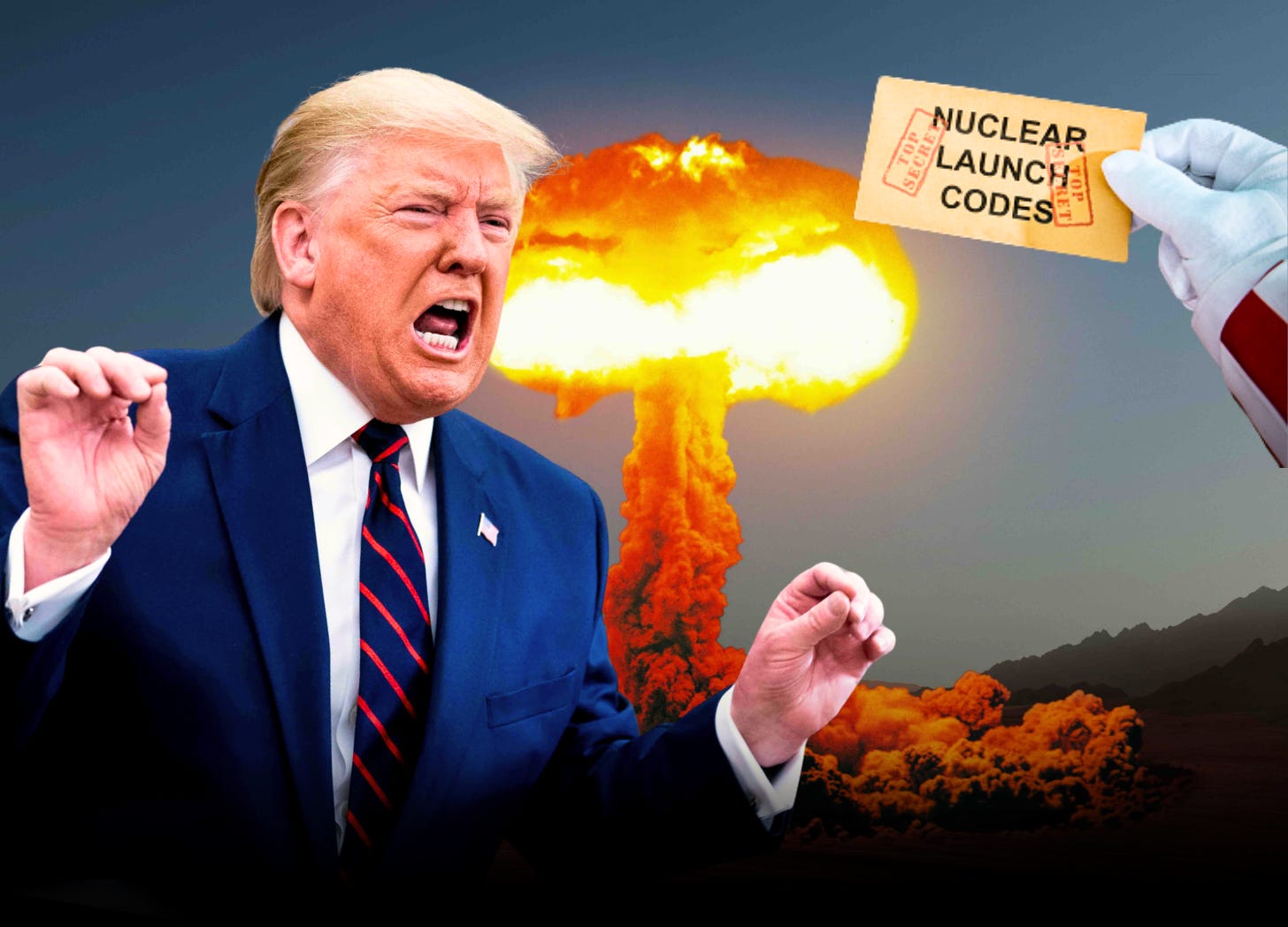
There is a new viral claim making the rounds that Donald Trump demanded the nuclear codes last weekend, allegedly with the intent of launching a nuclear strike on Iran, and that he was stopped by General Dan Kaine in a dramatic confrontation. It is the kind of story that instantly rockets across social media because, on its face, it sounds both extraordinary and, given everything else we’ve seen, disturbingly plausible.
But this is exactly where it becomes important to slow down.
One of the more difficult things in a political environment this chaotic is resisting the temptation to treat every alarming claim as true simply because it fits a broader pattern. And there is a broader pattern here worth discussing. There are credible, well-sourced reports that officials around Trump have at times imposed guardrails around national security decision-making, and that concerns about impulsive or destabilizing behavior have influenced how some sensitive matters have been handled.
That is a real story.
The viral nuclear codes story, at least as of now, is something different.
What we know and what we don’t
The claim appears to trace back to retired CIA analyst Larry Johnson, who reportedly stated this on a podcast. It is true Johnson once worked in intelligence. It is also true that he has not been an active intelligence official for decades and has, in more recent years, developed a reputation for pushing controversial and often unverified narratives, particularly around foreign policy.
That matters.
If an American president had actually attempted to initiate a nuclear launch and was physically or procedurally stopped by a military general, it is very difficult to imagine that remaining confined to a single, thinly sourced report. One would expect rapid corroboration from major outlets, multiple sourcing chains, and likely immediate political fallout.
As of the writing of this editorial, that corroboration does not exist.
And in a media environment where bad information often piggybacks on partially true information, that distinction matters enormously.
The confusion is coming from two stories being merged
Part of why this rumor has gained traction is that it is blending into a different story that is much more credibly reported.
There have been serious reports, including reporting involving figures like Bob Woodward, that officials have at times limited or structured Trump’s engagement in sensitive national security processes, including during the Iran rescue mission discussion referenced on the show. Those reports suggest concern, internal friction, and institutional guardrails.
That is not the same as saying Trump tried to launch nuclear weapons.
But when audiences hear “Trump was reportedly sidelined during national security decisions” and then hear “Trump demanded the nuclear codes and was stopped,” the leap can feel smaller than it actually is. The stories start to fuse together.
And once that happens, rumor can begin to borrow credibility it has not earned.
When plausibility is not proof
This is where a really important media literacy principle comes in: plausibility is not evidence.
A claim can feel believable because it is adjacent to other true things.
Trump behaving erratically? Plausible and heavily documented.
Officials trying to constrain risky decisions? Plausible and in some cases well reported.
Trump personally trying to trigger a nuclear launch and being blocked by a general? That is a much bigger claim, requiring much stronger evidence.
And right now, that evidence is missing.
This is not about being overly cautious or underreacting. It is about maintaining standards precisely when a story is emotionally irresistible. In fact, this is when standards matter most.
Because once people who value accountability start repeating weakly sourced sensationalism, they make themselves vulnerable to the very criticism they often level at propagandists and conspiracy peddlers.
The real story may already be serious enough
There is another irony here.
If credible reporting is showing senior officials felt the need to place guardrails around a president’s involvement in sensitive military matters, that is already a profound story. It does not need embellishment.
It is serious on its own.
And sometimes the rush to attach an even more explosive rumor to an already troubling fact can actually dilute the legitimate concern, because once the exaggerated claim collapses, critics use that to discredit the entire broader pattern.
That is often how misinformation protects power.
Why skepticism is not dismissal
None of this means the claim is impossible.
If Reuters, the Washington Post, or another credible outlet independently confirms new sourcing, then the analysis changes. And if that happens, it should be revisited immediately.
But skepticism in the absence of evidence is not denial. It is discipline.
And in a moment where “viral” increasingly gets mistaken for “verified,” that discipline is worth defending.
Because if we are going to criticize reckless information ecosystems, we have to avoid becoming one.
We’re reaching over 150 million people every month across YouTube, podcasts, Substack, and beyond. But algorithms can change. Platforms can fold. And when that happens, this newsletter is how we stay connected.
If you’re not yet a paid subscriber, please consider joining.
If you’re already paid on one platform, consider supporting us on both Substack and our website.
You can subscribe on our website and right here on Substack.
And if you’re really on fire, consider gifting a subscription—we’ve got thousands on our waiting list ready to read, watch, and fight back.
Let’s keep building.
—David
PS: Can’t contribute right now? No problem. You can support us for free by subscribing on YouTube, listening to our audio podcast on Spotify or Apple Podcasts, or become a free subscriber to this very Substack. Every bit counts.
Thank you, David, for your common sense.
What’s interesting to me in this latest story about Trump is that none of the stories mention trying to contact or verify with Gen Dan Caine. If anyone knows the truth, it would be him. One story I read stated they had emailed Larry Johnson for confirmation, but hadn’t gotten a response. I don’t care about Larry Johnson’s “confirmation.” He wasn’t there. Ask someone, like Caine, who was.