

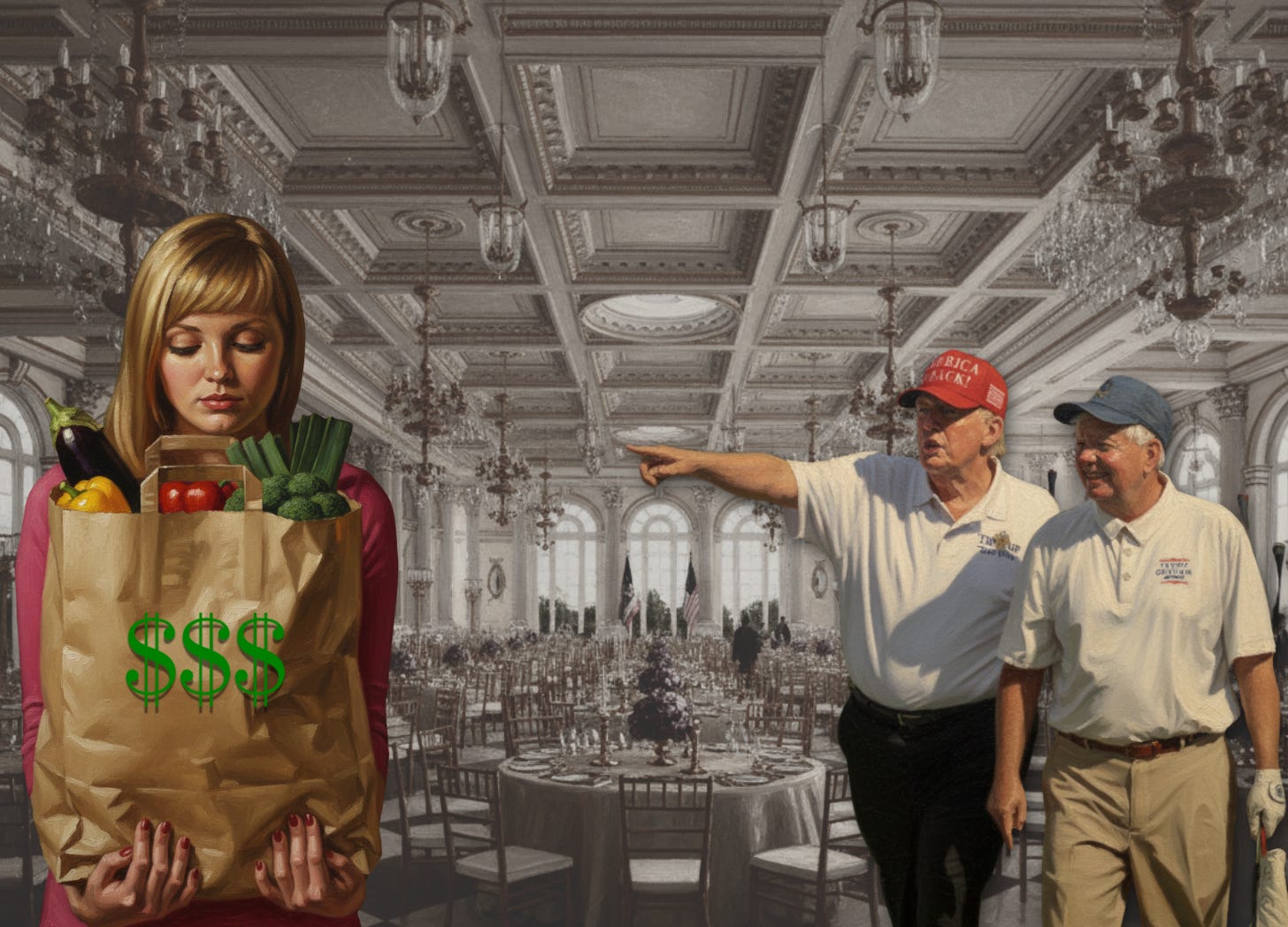
Senators led by Lindsey Graham have introduced a bill to fund Trump’s massive new ballroom at the White House. The price tag has now ballooned to roughly $400 million, and unlike earlier versions of the proposal, this one would be paid for by taxpayers.
That’s a significant shift from what we were originally told.
For months, the pitch from Donald Trump was straightforward: wealthy donors would cover the cost. Not only that, but we were told there would be money left over. The ballroom was framed as a privately funded enhancement, something that would not touch public finances.
Now, suddenly, taxpayers are on the hook.
The shifting story
If you track the trajectory of this project, the pattern becomes hard to ignore. The ballroom started as a $150 million idea. Then it became $200 million. Then $250 million. Then $325 million. Now we are at $400 million, and the funding model has flipped entirely.
That kind of escalation raises two basic questions. First, why does the cost keep increasing so dramatically? Second, if donors were always ready to pay, where did they go?
There has been no clear answer to either. Instead, what we are getting is a new justification. After the recent incident connected to the White House Correspondents’ Dinner, a coordinated message quickly emerged from Republican lawmakers: the ballroom is now a security necessity.
And I think that argument deserves a closer look.
The security argument does not hold up
The claim is that a new ballroom would allow large events to be held indoors at the White House, improving security. But even at face value, it doesn’t quite add up.
The White House Correspondents’ Dinner typically hosts around 2,500 people. The proposed ballroom would hold roughly 1,000. So even if it existed today, it would not replace that event.
There is also the basic fact that the Correspondents’ Dinner is not held at the White House to begin with. And at the Correspondents’ Dinner shooting, there were no injuries, and what could have been a tragedy was ultimately avoided.
So the idea that this particular project is an urgent security fix is, at minimum, questionable. What it does appear to be is a rapidly assembled justification for a project that already existed.
The economic backdrop matters
Now consider the timing. Gas prices are near multi-year highs. Grocery bills remain elevated. Many households are still dealing with rising utility costs and general affordability pressure.
At the same time, lawmakers are debating debt, spending priorities, and basic government operations. There are ongoing disputes about funding essential services. There have even been disruptions affecting agencies like the Department of Homeland Security.
And in that context, the push gains momentum for a $400 million ballroom funded by taxpayers.
Even some Republicans have acknowledged that this could come across as tone-deaf. Not necessarily because they oppose the idea itself, but because they recognize how it might be perceived by voters.
There is another piece of this that often gets overlooked: even if the ballroom had remained privately funded for construction, taxpayers would still be responsible for ongoing costs like maintenance, staffing, security, and utilities. Those expenses do not disappear.
So in reality, the public was always going to pay something. The only question was how much. What has changed is that the upfront cost is now being shifted as well.
Priorities and perception
The broader issue here is not just about one building project. It is about priorities.
When people feel financially squeezed, when there is ongoing debate about how to fund essential services, when basic affordability is a top concern, proposals like this land differently. They signal something about what leaders think matters right now.
And the speed of the shift is also notable. In other contexts, particularly after shootings, we are often told it is too soon to act, that decisions should not be rushed. In this case, the call to fund the ballroom came almost immediately.
That contrast is difficult to ignore.
Where this goes next
It is not clear that this proposal will pass in its current form. There are enough questions, both political and practical, that it may stall or be modified significantly.
But the fact that it was introduced this way, at this moment, with this price tag, tells us something important. It tells us how comfortable some lawmakers are with advancing ideas that seem disconnected from the day-to-day reality most people are dealing with.
And it raises a broader question about accountability. Because ultimately, decisions like this do not happen in a vacuum. They happen in a political system where voters have the final say.
So here’s the question I’ll leave you with:
Do you think most Americans would actually support spending $400 million in taxpayer money on a White House ballroom right now, or is this another one of those moments where Washington has completely lost the plot?
We’re reaching over 150 million people every month across YouTube, podcasts, Substack, and beyond. But algorithms can change. Platforms can fold. And when that happens, this newsletter is how we stay connected.
If you’re not yet a paid subscriber, please consider joining.
If you’re already paid on one platform, consider supporting us on both Substack and our website.
You can subscribe on our website and right here on Substack.
And if you’re really on fire, consider gifting a subscription—we’ve got thousands on our waiting list ready to read, watch, and fight back.
Let’s keep building.
—David
PS: Can’t contribute right now? No problem. You can support us for free by subscribing on YouTube, listening to our audio podcast on Spotify or Apple Podcasts, or become a free subscriber to this very Substack. Every bit counts.
He originally claimed that he was going to foot the bill. If he's not going to pay, then let him pay for the restoration of the building he illegally demolished. That lawsuit is still in play.
Does this remind you of the Mexico- funded border wall??🤔