

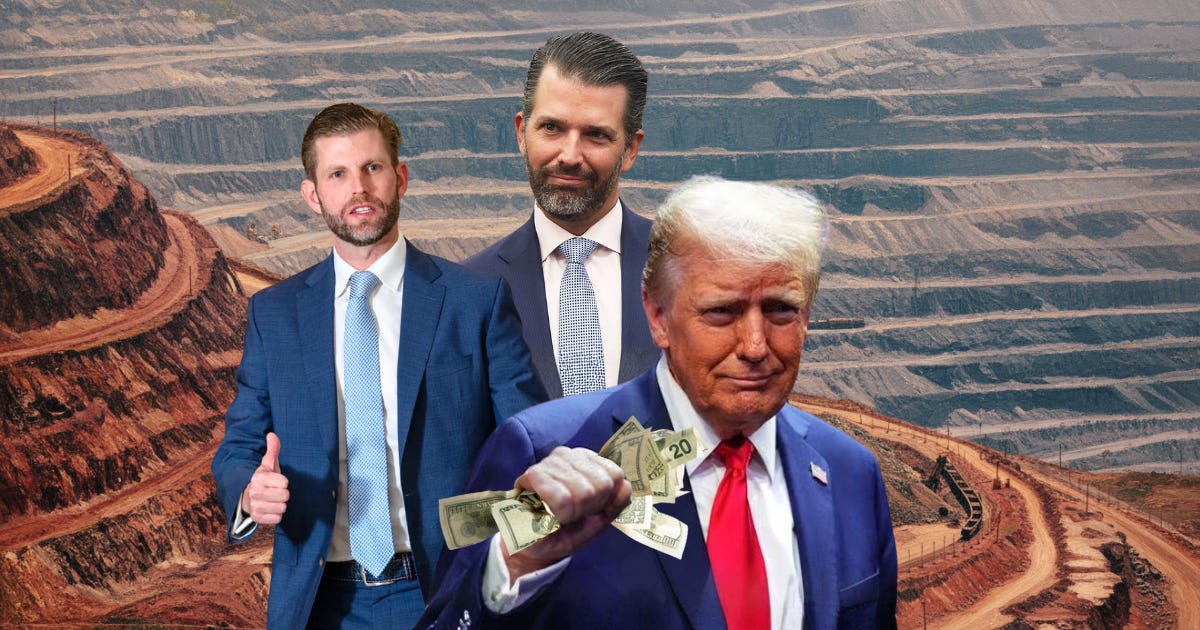
A new report reveals what could be one of the most staggering conflict of interest stories of Donald Trump’s presidency.
Considering Qatar gave Trump a $400 million plane, that’s not a claim I make lightly.
According to a new investigation by The New York Times, companies tied to Donald Trump’s family and Commerce Secretary Howard Lutnick’s family are connected to mining projects that have either received or are seeking nearly $9 billion in federal support.
Sometimes a number is so large you have to read it twice. Not $9 million. We are talking about $9 billion.
If the reporting is accurate, this could become one of the biggest conflict of interest stories of Trump’s presidency.
And yet, it has received surprisingly little attention.
The issue isn’t the policy
Let’s start with what this story is not about.
The Trump administration has made securing critical minerals a major priority. On its face, that’s a perfectly legitimate policy objective. The United States depends heavily on foreign sources, particularly China, for minerals used in semiconductors, advanced manufacturing, military equipment, and other strategically important industries.
The broader conversation about reshoring supply chains and reducing America’s dependence on geopolitical rivals is a real one. We saw during the COVID pandemic how vulnerable supply chains can become when so much manufacturing happens overseas. Whether you’re talking about pharmaceuticals, computer chips, or critical minerals, there are legitimate national security arguments for producing more of these materials domestically.
None of that is the problem.
The concern begins when the companies positioned to benefit from those government priorities are connected to the families of the very officials making the decisions.
Why this raises ethical questions
According to the reporting, companies tied to Donald Trump’s sons, along with companies connected to Commerce Secretary Howard Lutnick’s family, are involved in mining and mineral projects that have either already received federal assistance or are seeking it.
The number attached to those projects is staggering: nearly $9 billion in federal funding.
It’s important to be careful about what is being alleged here. The reporting does not claim that these projects are fraudulent. It does not say that every dollar has been improperly awarded. It does not argue that critical mineral investments themselves are inappropriate.
The question is much more fundamental.
Why are the families of senior government officials financially connected to projects that depend on decisions being made by that same administration?
That is exactly the kind of situation ethics rules are supposed to prevent.
Even if every individual decision could ultimately be justified on its merits, the public should never have to wonder whether policy decisions are being made because they’re in the country’s best interest or because they also happen to benefit the investment portfolios of people connected to those making the decisions.
Government simply isn’t supposed to work that way.
The double standard we can’t ignore
It’s also worth asking how this story would be covered if the political parties were reversed.
Imagine for a moment that Barack Obama had overseen an administration directing billions of dollars toward companies connected to members of his family.
Or imagine if Hunter Biden had financial interests in companies seeking billions in federal funding while Joe Biden’s administration was negotiating the very deals that would benefit those companies.
Republicans would have treated that as one of the biggest scandals in modern political history. Fox News would have devoted wall-to-wall coverage to it. Congressional hearings would have been scheduled almost immediately. Calls for investigations and special counsels would have dominated the news cycle for weeks.
In fact, Republicans spent years making accusations about the Bidens with far less evidence than what is being described in this reporting.
Yet when questions involve Trump, many of those same voices suddenly argue that there’s nothing to see here.
That inconsistency shouldn’t surprise anyone anymore, but it should still concern us.
Ethics rules exist for a reason
Sometimes people hear the phrase “conflict of interest” and assume it means someone has already been proven guilty of corruption.
That’s not what it means.
Ethics rules exist because public confidence matters. They’re designed to prevent situations where personal financial interests and government decision-making become so intertwined that the public can no longer tell where one ends and the other begins.
Americans shouldn’t have to wonder whether taxpayer dollars are being allocated because they’re the best investment for the country or because they happen to align with the business interests of politically connected families.
Even the appearance of that conflict can undermine confidence in government.
And then there’s another consequence that’s easy to overlook: Imagine you’re a company competing for one of these projects. How confident would you be that the process is fair if another bidder has financial ties to the president’s family?
Whether those connections ultimately influenced any decision or not, the perception alone can distort competition and discourage trust in the marketplace.
That’s why ethics safeguards exist in the first place.
Why this story deserves more attention
The scale of this story is what makes it so remarkable.
We’re not talking about an official accepting an expensive dinner or violating a minor $25 gift rule. We’re not talking about thousands of dollars or even millions.
We’re talking about nearly $9 billion in federal funding connected to companies tied to the families of some of the most powerful officials in the federal government.
Under almost any previous administration, that would have been one of the defining political stories of the week.
Instead, it risks disappearing beneath the endless flood of headlines. One day it’s conflict of interest allegations. The next day it’s another international crisis, another political spectacle, another controversy demanding everyone’s attention.
Perhaps that’s become one of the defining characteristics of this political era. The volume of extraordinary stories is so high that even stories involving billions of taxpayer dollars and serious ethical questions struggle to break through.
So I’m curious what you think. Has the constant stream of controversies made stories like this easier for the public to overlook, or should this be receiving far more attention than it is? Let me know in the comments.
We’re reaching over 150 million people every month across YouTube, podcasts, Substack, and beyond. But algorithms can change. Platforms can fold. And when that happens, this newsletter is how we stay connected.
If you’re not yet a paid subscriber, please consider joining.
If you’re already paid on one platform, consider supporting us on both Substack and our website.
You can subscribe on our website and right here on Substack.
And if you’re really on fire, consider gifting a subscription—we’ve got thousands on our waiting list ready to read, watch, and fight back.
Let’s keep building.
—David
PS: Can’t contribute right now? No problem. You can support us for free by subscribing on YouTube, listening to our audio podcast on Spotify or Apple Podcasts, or become a free subscriber to this very Substack. Every bit counts.
Rage overload is a thing. Keeping up with all the horrors, corruption, racism, bullying, lies of this regime is exhausting. But we keep on, we must keep on! As Glen Kirschner says, there will be a day after, when we can begin reconstruction and accountability. Until then RESIST and thank you for bringing the information we need. Support independent media and RESIST!
This whole administration and especially the President and his family have continually made billions of dollars from being involved in these types of things including their crypto accounts. These are all conflicts of interest, ethically wrong and I am not numb to the stories. I am sick of them and they need to be addressed. I am sick of the other media that kisses Trump's ass and won't address any of this but they certainly had issues with Biden and his family. So sick of all of this and trying to understand why this is not out there in every news media and I am thankful for you for addressing this issue along with so many others. They all need to be stopped from doing this.