

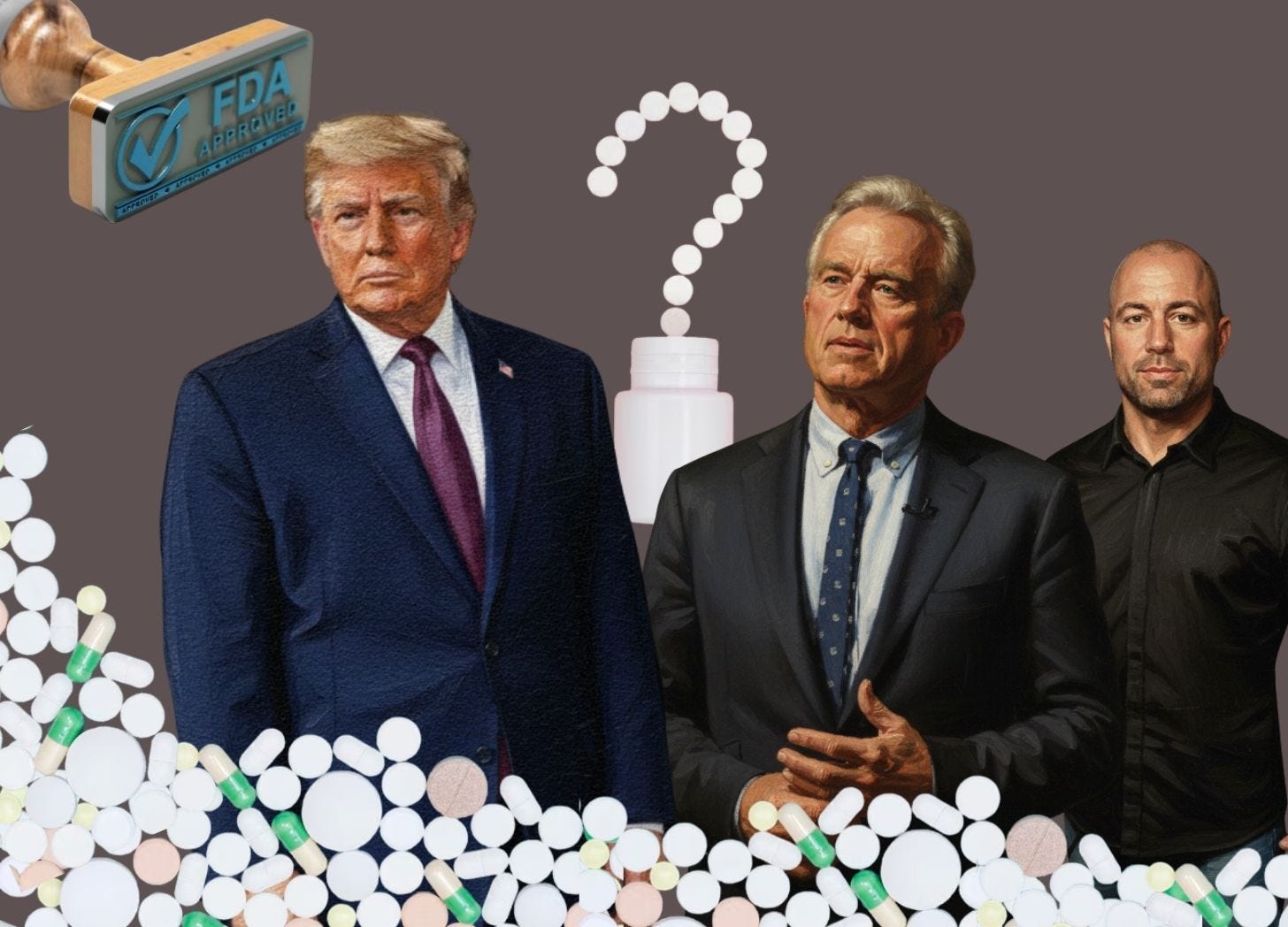
This week, FDA Commissioner Marty Makary resigned. At first glance, that might not sound like the kind of story that should set off alarms. Cabinet officials come and go. Administrations reshuffle personnel all the time.
But this one matters. A lot.
Because the circumstances surrounding Makary’s resignation tell us something much bigger about what is happening inside Trumpworld and the growing influence of the MAHA movement. The pressure campaign against Makary appears to have come from people who believed he was not moving aggressively enough in politicizing the FDA.
Think about how extreme that is for a moment.
Makary himself had already drifted significantly into the MAHA orbit. He was not exactly standing on the barricades defending traditional public health institutions from political interference. And yet, even he apparently was not “crazy enough” for the people now steering the conversation around health policy in Trumpworld.
That should concern everyone, regardless of political ideology.
The FDA is supposed to be independent
The FDA is not meant to function as a political loyalty machine. Its role is to evaluate evidence, regulate medications, assess safety, and maintain scientific standards insulated from partisan pressure as much as possible.
Of course, presidents influence agencies. That has always been true. No administration is completely hands-off.
But what we are seeing now is different.
There is a growing effort to treat the FDA as though it should simply deliver whatever outcome the president and his allies want. Faster approvals for favored treatments. Restrictions or revocations for politically disfavored medications. Decisions shaped less by scientific review and more by ideological alignment.
And over the last month alone, we have seen several examples pointing in exactly that direction.
The mifepristone pressure campaign
One of the clearest examples involves mifepristone, the medication used in more than half of abortion cases in the United States. It has been FDA-approved since 2000 and has decades of safety data behind it. It is also commonly used in miscarriage care.
Yet despite all of that, Republican Senator Josh Hawley and others have pushed to revoke its approval outright.
Notice what the argument is not.
The argument is not, “Let’s conduct additional long-term studies.” It is not, “Let’s reevaluate emerging evidence.” The push is ideological and political. The goal is to remove access to a medication despite overwhelming evidence supporting its safety profile.
That is not how scientific regulation is supposed to work.
RFK Jr., SSRIs, and the arowing anti-science movement
At the same time, the MAHA movement has escalated its attacks on SSRIs and psychiatric medications more broadly. These are medications taken by tens of millions of Americans, including drugs like Prozac, Lexapro, and Zoloft.
Now, to be clear, discussions about overprescription, side effects, pharmaceutical industry influence, or long-term impacts are completely legitimate. Those conversations should happen.
But that is not really what this is becoming.
Instead, we are increasingly seeing public health policy shaped by personalities, anecdotes, and conspiratorial thinking. RFK Jr. recently suggested that withdrawal from SSRIs can be harder than heroin withdrawal, essentially positioning his personal experience with addiction as evidence of expertise on psychiatric medications and FDA regulation.
That is not scientific rigor. That is vibes-based medicine.
And according to reporting by Reuters, there have already been discussions within the administration about ways to restrict some psychiatric medications, potentially even bypassing traditional FDA processes.
Again, whatever your opinion is on antidepressants generally, that should concern you.
Trump’s casual view of FDA approval
Then there was the Joe Rogan moment.
During a recent Oval Office visit, Rogan described texting Trump information about ibogaine, a psychedelic treatment being explored for opioid addiction. Trump reportedly responded with something to the effect of: “Do you want FDA approval? Let’s do it.”
That is an astonishing way for a president to talk about drug approval.
Not because presidents are entirely detached from agencies. They are not. But because it frames FDA approval almost like a political favor. Like something the president can personally arrange for friends, allies, or people he likes.
That is not how this is supposed to work.
Or at least, it is not how we are told it works.
The real fear is who comes next
One of the most important points here is that Marty Makary was not viewed by many as some rigid institutionalist standing in opposition to MAHA politics. He had already embraced several ideas popular in that movement.
And yet he still was apparently not enough.
Which raises the obvious question: who replaces him?
We have already seen this pattern elsewhere in Trumpworld. Sometimes the first choice is so chaotic or controversial that they flame out quickly. Then comes the replacement who appears calmer, more polished, more “reasonable,” but who is ultimately more effective at carrying out the underlying agenda.
That is what makes this moment dangerous.
The FDA regulates medications, treatments, warnings, and standards that affect virtually every American. These are not abstract bureaucratic decisions happening in the background. They shape real-world healthcare outcomes.
And if the expectation becomes that the FDA should simply produce whatever outcome is politically useful to the White House, then scientific independence collapses.
We actually need more independence, not less
It is important to say something else clearly here: the FDA has never been perfect.
There is a long history of criticism involving pharmaceutical influence, opioid approvals, and regulatory failures.
But the solution to those failures is not to replace scientific standards with partisan pressure campaigns and internet personalities.
The solution is more independence. More rigor. More transparency.
Not turning public health into another arena for loyalty tests and ideological crusades.
Because once people lose confidence that medications are being approved or restricted based on evidence rather than politics, the damage extends far beyond any single administration.
And rebuilding that trust is much harder than destroying it.
We’re reaching over 150 million people every month across YouTube, podcasts, Substack, and beyond. But algorithms can change. Platforms can fold. And when that happens, this newsletter is how we stay connected.
If you’re not yet a paid subscriber, please consider joining.
If you’re already paid on one platform, consider supporting us on both Substack and our website.
You can subscribe on our website and right here on Substack.
And if you’re really on fire, consider gifting a subscription—we’ve got thousands on our waiting list ready to read, watch, and fight back.
Let’s keep building.
—David
PS: Can’t contribute right now? No problem. You can support us for free by subscribing on YouTube, listening to our audio podcast on Spotify or Apple Podcasts, or become a free subscriber to this very Substack. Every bit counts.
Breathing has become weaponized. I so wish they would stop their weaponization of every department.
Becoming? Way past that, between the DOGE cuts and the senate’s approval of RFK Jr.
don’t get me started on food inspections and CDC not being able to find the source of outbreaks on 50% of cases in 2025. You’d think MAHA would want clean food. Guess not.