

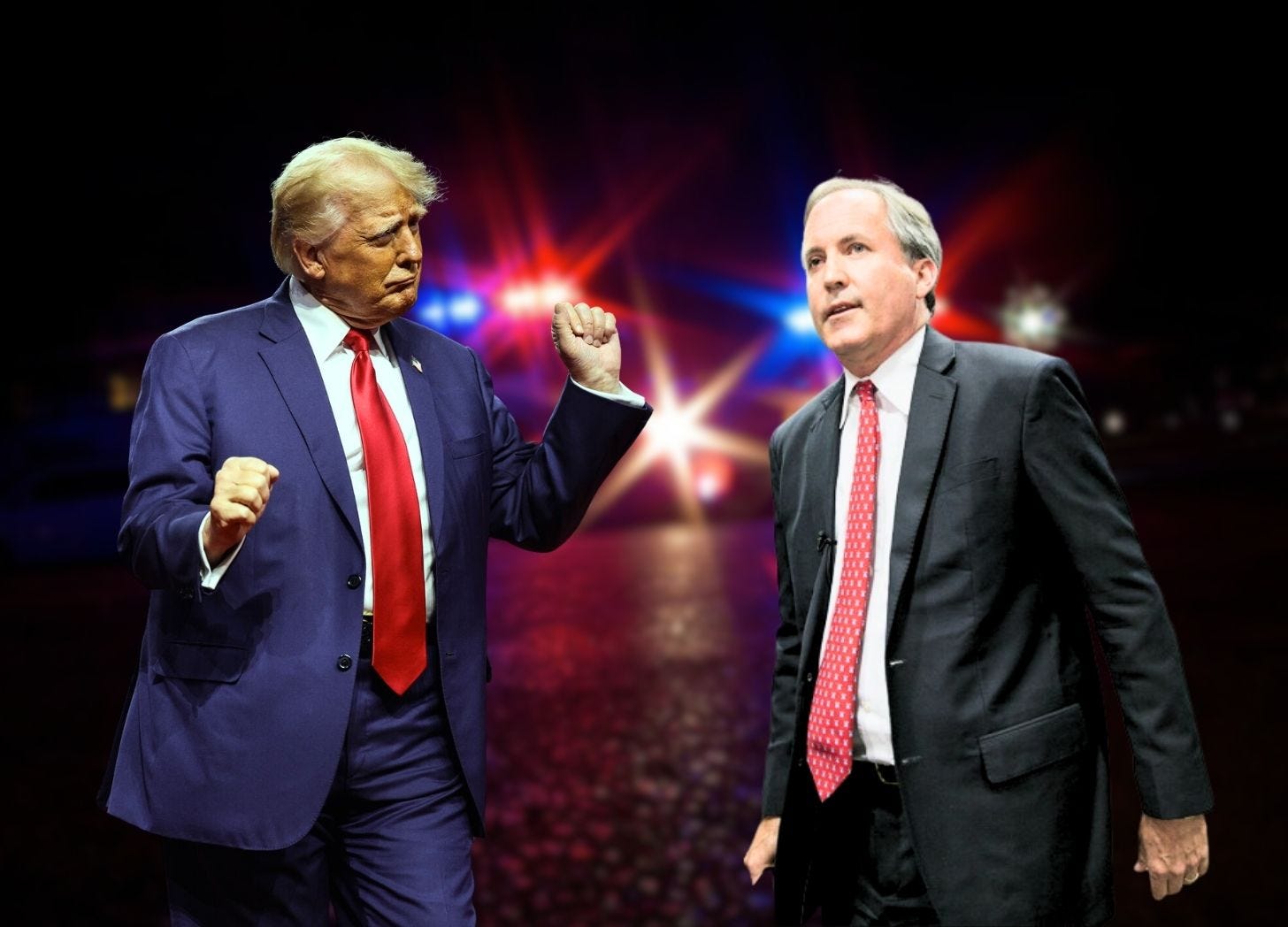
Crime is bad, right?
That has been one of the defining rhetorical pillars of Trumpism for years. Law and order, tough on crime, no tolerance for corruption, and no sympathy for criminals. We have heard the messaging over and over again, always delivered with the implication that Democrats are soft, permissive, unserious, or somehow complicit in social decay.
That is the branding.
The reality looks a little different.
Donald Trump himself is a convicted felon, found guilty on 34 counts of falsifying business records. And now Trump has thrown his endorsement behind Ken Paxton in the Texas Senate Republican runoff, a man whose political career reads less like a law-and-order success story and more like a running case study in alleged misconduct.
So naturally, the endorsement makes perfect sense in Trumpworld.
Trump waited until the winner looked obvious
One of the more predictable parts of this story is the timing.
After the initial Texas Republican primary failed to produce a candidate with more than 50 percent, a runoff was scheduled between incumbent Senator John Cornyn and Texas Attorney General Ken Paxton. Trump, naturally, teased an endorsement. He would decide soon, he said. Very soon. But not too soon.
Because Trump’s endorsement strategy has rarely been about conviction or principle. It is much more often about scoreboard management. He likes endorsements that become “wins,” which means waiting until the likely victor becomes clearer before planting the flag.
That appears to be exactly what happened here.
For weeks, the race looked competitive. Once Paxton increasingly appeared to have momentum, Trump finally made his move. Suddenly the endorsement arrived, wrapped in the usual language about loyalty, strength, and personal allegiance.
And that last part needs more attention.
Because if you strip away the branding, Trump’s political worldview remains remarkably simple: loyalty is the highest virtue. Not honesty. Not competence. Not ethics. Certainly not lawfulness.
Loyalty.
The “law and order” exception clause
Ken Paxton is not exactly an intuitive poster child for anti-corruption politics.
This is a man who was impeached by members of his own party over corruption allegations. Pause there for a second, because that is not normal. Republicans are not exactly known for eagerly purging their own over ethical concerns.
Paxton has faced felony securities fraud charges, whistleblower retaliation allegations, and additional scrutiny over other legal matters. The specifics almost become secondary to the larger pattern: this is not someone whose public image aligns with the supposedly uncompromising standards of “law and order” politics.
And yet none of that appears to matter. Because the anti-crime messaging has always had an implied asterisk.
Crime is unacceptable when committed by political enemies.
Ethical violations are disqualifying when committed by Democrats.
Corruption is intolerable until one of your own is involved.
Suddenly, we are told to be nuanced. Context starts to matter.
Investigations become political.
Indictments become witch hunts.
Convictions somehow stop counting.
This pattern has become so familiar that it barely surprises anyone anymore.
What this actually reveals
The endorsement is revealing not because it is unusual, but because it is entirely consistent. Trump did not endorse the candidate with the cleanest record. He did not endorse based on some coherent ideological principle. He endorsed the person most likely to win and the person most loyal to him.
That tells you almost everything.
And there is something else happening here that may actually matter politically.
For a long time, Texas Senate races have been treated as effectively locked in for Republicans. But the conversation around the general election has become more competitive than many would have expected, which raises a broader question about whether even deeply entrenched assumptions are beginning to shift.
Whether that translates into reality is another question entirely, but the bigger issue remains the contradiction.
If “law and order” is a genuine principle, it should apply consistently. If it only applies selectively, then it is not really a principle at all. It is simply branding.
And voters eventually have to decide whether they are comfortable with that distinction.
So what do you think: Do you think voters see the contradiction here, or has selective outrage simply become normalized in modern politics?
We’re reaching over 150 million people every month across YouTube, podcasts, Substack, and beyond. But algorithms can change. Platforms can fold. And when that happens, this newsletter is how we stay connected.
If you’re not yet a paid subscriber, please consider joining.
If you’re already paid on one platform, consider supporting us on both Substack and our website.
You can subscribe on our website and right here on Substack.
And if you’re really on fire, consider gifting a subscription—we’ve got thousands on our waiting list ready to read, watch, and fight back.
Let’s keep building.
—David
PS: Can’t contribute right now? No problem. You can support us for free by subscribing on YouTube, listening to our audio podcast on Spotify or Apple Podcasts, or become a free subscriber to this very Substack. Every bit counts.
This is true, especially when they include Ken Paxton in the fray.
Oh my gosh, ever since William Bennett and Oliver North and Rush Limbaugh we have been getting beaten over the head with hypocrisy and exceptionalism. It's nauseating now.