

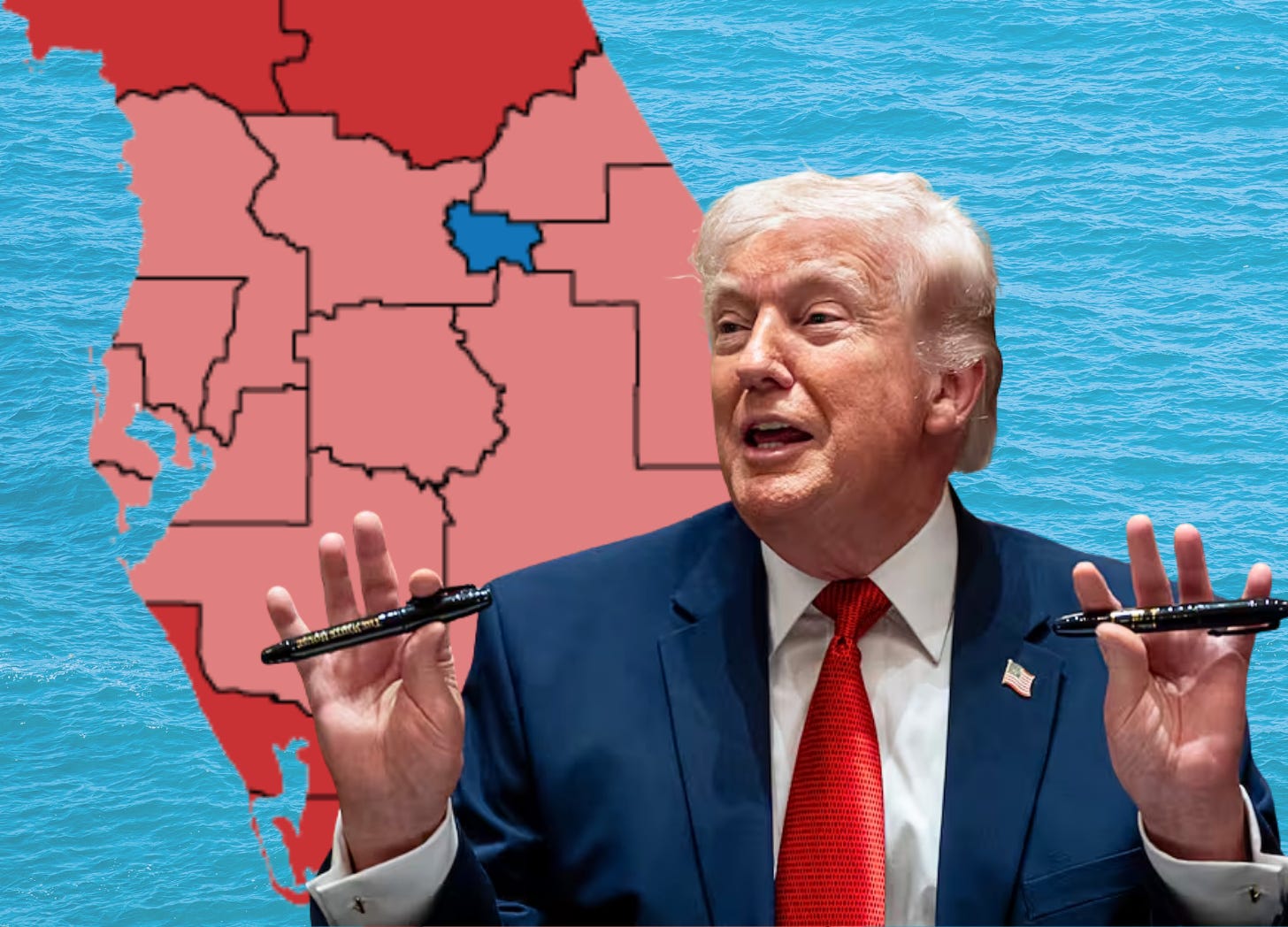
There are some stories where the headline undersells what is actually happening. This is one of them.
The Supreme Court of the United States has issued a 6–3 ruling that, on its surface, deals with a single congressional district in Louisiana. But if you stop there, you are missing the real story.
Because this is not about one district. It is about what comes next.
At issue is the continued unraveling of the Voting Rights Act, one of the most significant pieces of civil rights legislation in American history. A law that was designed to expand ballot access and prevent racial discrimination in elections. A law that, for decades, acted as a guardrail against exactly the kind of manipulation we are now seeing re-emerge.
That guardrail is now weaker. Maybe much weaker.
And when the rules change at the highest level, the consequences don’t stay contained. They cascade.
Florida has entered the chat.
Within an hour of the decision, Florida Republicans moved forward with a new congressional map aligned with Ron DeSantis’ preferred plan. The expectation is that it could net Republicans as many as four additional House seats.
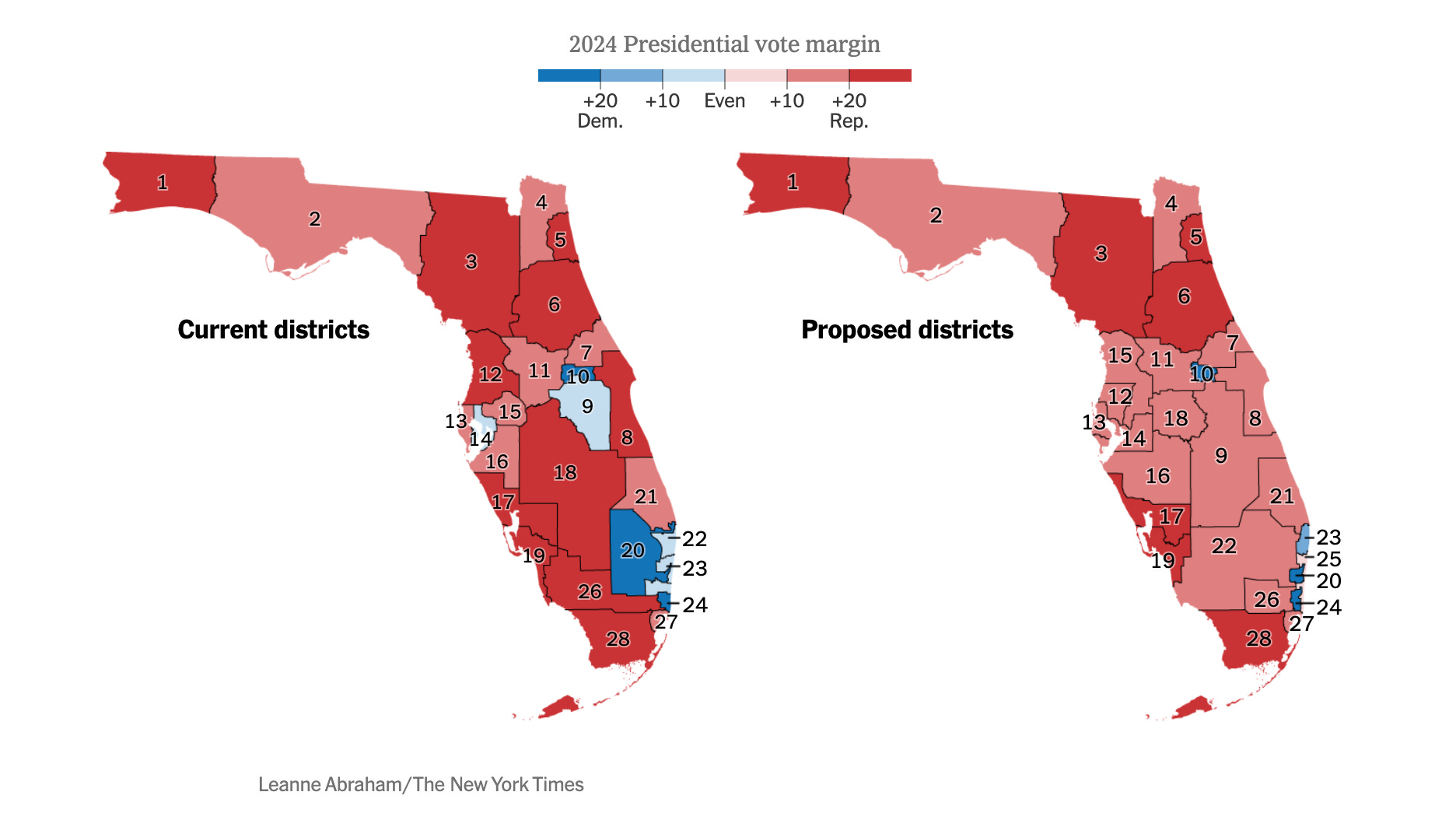
Four seats might not sound like much. But in a House that is often decided by razor-thin margins, it is the difference between control and opposition. It is the difference between what legislation gets a vote and what never even sees the floor.
So when we talk about whether elections are being “stolen,” we need to be clear about what that means. It does not necessarily mean ballot stuffing or hacked voting machines. It can look like something far more procedural and far less visible.
It looks like changing the maps.
It looks like changing the rules about how those maps are judged.
And it looks like doing it just in time to affect future elections.
The immediate impact on the next election cycle is still uncertain. Filing deadlines in many places have already passed. But longer term, particularly looking ahead to 2028, the implications could be substantial.
Because once a precedent is set, it does not stay confined to Louisiana. Other states can point to it. Other maps can be challenged. Other districts can be redrawn.
And that is where this becomes a national story.
So what do we do now?
There’s a lot of understandable panic and frustration around this decision. But I want to skip right to the practical answer, even if it’s not a particularly satisfying one.
We need to redraw the maps.
If Republicans are going to take advantage of this ruling to aggressively gerrymander in states they control, then Democrats have to do the same wherever they have the power to do it. Not because it’s ideal. Not because it’s how the system should work. But because sitting back and doing nothing just hands over a structural advantage.
And I’m not the only one saying this. Alexandria Ocasio-Cortez has made the exact same point. If they’re going to redraw districts in places like North Carolina and Texas, then we have to respond in kind in states where Democrats control the process.
Now, let me be very clear about something. This is a race to the bottom.
I don’t think this back-and-forth redistricting war is how you build a healthy or stable democracy. Over the long term, this is not going to improve ballot access or fairness. It’s just going to escalate.
But we also have to deal with the system as it exists right now, not the one we wish we had. A system where whichever party holds power in a given state redraws districts to entrench that power, and the other party does the same wherever it can. That is not a sustainable model for a functioning democracy.
And the reality is, there are better solutions. Independent redistricting commissions. Transparent, nonpartisan processes. Even algorithmic approaches that remove human bias from the equation. None of these are perfect, but they are all preferable to the current trajectory.
The problem is that moving toward those solutions requires agreement. And agreement is in short supply when one side benefits from the status quo.
So here we are.
A major Supreme Court decision that weakens a foundational voting rights protection.
Immediate political action to capitalize on that decision.
And a growing sense that the system itself is being reshaped in real time.
If you are wondering why this matters, it is because elections are not just about who votes. They are about how votes are translated into representation. Change that translation, and you change the outcome.
That is the story.
And the uncomfortable question it leaves us with is this:
If both parties start treating redistricting as a pure power game, with fewer and fewer constraints, what does a “fair” election even look like five or ten years from now?
We’re reaching over 150 million people every month across YouTube, podcasts, Substack, and beyond. But algorithms can change. Platforms can fold. And when that happens, this newsletter is how we stay connected.
If you’re not yet a paid subscriber, please consider joining.
If you’re already paid on one platform, consider supporting us on both Substack and our website.
You can subscribe on our website and right here on Substack.
And if you’re really on fire, consider gifting a subscription—we’ve got thousands on our waiting list ready to read, watch, and fight back.
Let’s keep building.
—David
PS: Can’t contribute right now? No problem. You can support us for free by subscribing on YouTube, listening to our audio podcast on Spotify or Apple Podcasts, or become a free subscriber to this very Substack. Every bit counts.
This is all so childish but what do we expect under the 'leadership' of a Toddler-in-Chief? I so look forward to the day when he removes his stench from the Oval Office. The Supreme Court is starting to look like a herd of old cows that just need to be put out to pasture.
This is frightening. Hoping everyone gets out to vote in all states and counties!