

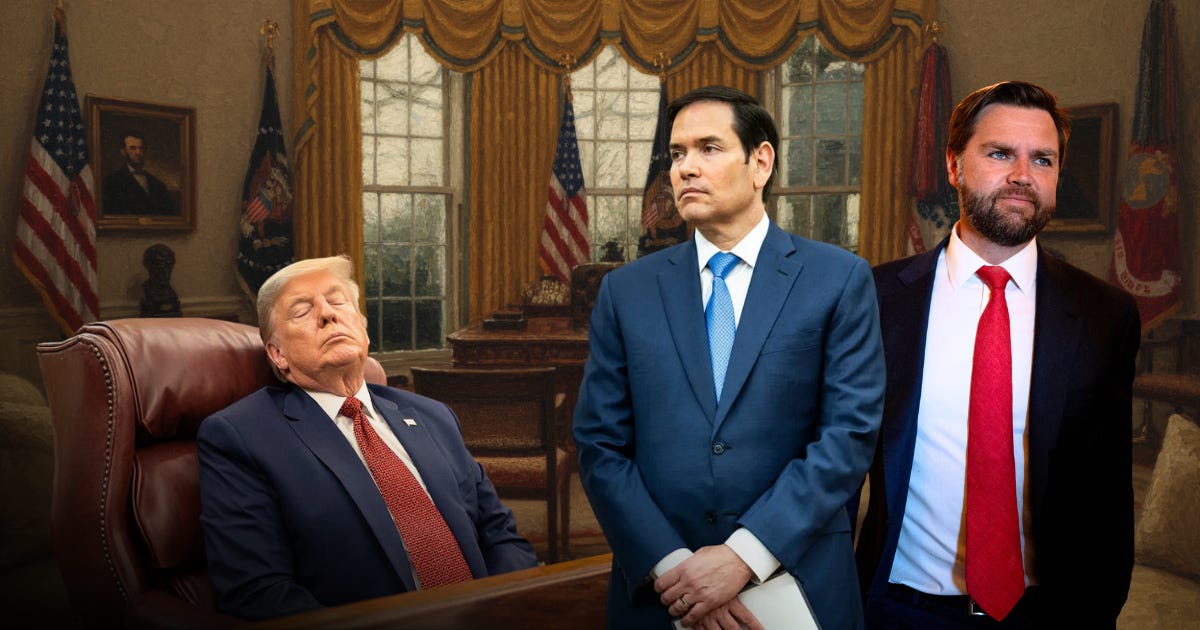
For much of Donald Trump’s second campaign and the early months of his presidency, there has been an expectation that the Republican Party’s future would largely be Trump’s to shape.
The thinking was straightforward: Trump wins in 2024, governs for four years, and eventually throws his support behind the candidate he wants to carry the movement forward.
Whether that would actually happen was always an open question. But over the last several weeks, Republicans have begun revealing something they would probably rather not emphasize publicly: there is no clear agreement about who inherits Trumpism once Trump is no longer on the ballot.
And perhaps more importantly, there is growing uncertainty about whether Trump will be able to settle that question himself.
JD Vance was supposed to be the obvious answer
For a long time, the conventional wisdom was that Vice President JD Vance was the heir apparent.
Trump chose him as his running mate. Members of Trump’s inner circle reportedly supported him. Vance positioned himself as a loyal defender of Trumpism and seemed to be following the familiar path from vice president to presidential frontrunner.
But lately, that picture has become much less clear.
Vance has increasingly been assigned some of the administration’s most politically difficult responsibilities. That is not unusual. Vice presidents are often handed assignments where success benefits the president and failure sticks to the vice president.
We’ve seen versions of this before. If things go well, the president takes credit. If things go poorly, someone else absorbs the damage. The arrangement is rarely complicated.
The risk of being the designated problem-solver
The recent negotiations involving Iran illustrate the challenge.
If negotiations succeed, the political rewards almost certainly flow upward. If they fail, attention shifts immediately to the person tasked with carrying them out.
That is exactly the position Vance finds himself in.
As criticism mounts from different factions within the Republican coalition, Vance is getting squeezed from multiple directions. Foreign policy hawks remain skeptical. Isolationists are not fully convinced either. Every controversial assignment creates another opportunity for criticism, and every stumble raises new questions about whether he is really the inevitable successor many assumed he would be.
The bigger issue is not any single diplomatic effort. The bigger issue is that inevitability is a fragile thing in politics. Once people start questioning it, it tends to disappear quickly.
Enter Marco Rubio
As doubts about Vance have grown, another name has started appearing more frequently in the conversation: Marco Rubio.
Rubio has been increasingly visible during major international events and administration initiatives. He often presents himself as a more traditional Republican figure, someone who appears competent, experienced, and familiar to establishment conservatives.
Different parts of the Republican coalition may be looking for different things after Trump, so Rubio’s distinction is even more clear.
Some donors appear interested in candidates who can maintain support among MAGA voters while also appealing to more traditional Republicans who never fully embraced Trump but remain within the party. Rubio potentially occupies that space in a way Vance may not.
Whether Rubio would actually succeed in pulling off that balancing act is another question entirely. But the fact that Republicans are openly discussing alternatives tells us something important.
The succession question is not settled.
History suggests Trump may not get the final word
One of the assumptions built into the MAGA worldview is that Trump will simply choose the next leader and everyone will follow.
History suggests it rarely works that way.
Presidents often discover that their influence weakens once everyone knows their time in office is limited. Political movements that seem disciplined and unified suddenly become much more independent. Governors, senators, donors, activists, media personalities, and party operatives all begin advancing their own preferred candidates.
The reality is that succession fights are usually messy because power attracts competition.
Everyone behaves as though there is a plan right up until the moment competing plans become impossible to hide.
The secret plan may be that there is no plan
This is why the most interesting possibility is also the simplest one. Because there may not be a secret successor at all.
There may not be a consensus candidate.
There may not even be agreement about what Trumpism should look like after Trump.
Instead, what we are seeing could be the early stages of a struggle that has already begun behind closed doors. Donors are making calculations. Political figures are positioning themselves. Different factions are imagining different futures. Publicly, everyone pretends the movement remains unified because admitting otherwise would reveal how much uncertainty exists beneath the surface.
But every time Vance struggles, every time Rubio gains visibility, every time another ambitious Republican starts testing the waters, that uncertainty becomes harder to conceal.
What happens after Trump?
One of the most persistent misconceptions in American politics is that everything automatically returns to normal once a dominant political figure exits the stage.
Political movements do not work that way.
The tensions inside today’s Republican Party will not simply disappear because Trump is no longer eligible to run. The factions, rivalries, competing ideologies, donor interests, and personality conflicts will still be there.
In some ways, the fight over who comes next may reveal more about the future of the party than Trump himself.
For Democrats, there may be political opportunities in that uncertainty. But before anyone starts planning for 2028, there is still a very consequential 2026 election to get through.
For now, the more interesting story is not who inherits Trumpism. It’s whether Trumpism can even agree on an heir.
And here’s the question: if Trump couldn’t personally choose the next Republican nominee, who do you think would emerge from the chaos, and would that person actually strengthen the party or expose even deeper cracks in it?
We’re reaching over 150 million people every month across YouTube, podcasts, Substack, and beyond. But algorithms can change. Platforms can fold. And when that happens, this newsletter is how we stay connected.
If you’re not yet a paid subscriber, please consider joining.
If you’re already paid on one platform, consider supporting us on both Substack and our website.
You can subscribe on our website and right here on Substack.
And if you’re really on fire, consider gifting a subscription—we’ve got thousands on our waiting list ready to read, watch, and fight back.
Let’s keep building.
—David
PS: Can’t contribute right now? No problem. You can support us for free by subscribing on YouTube, listening to our audio podcast on Spotify or Apple Podcasts, or become a free subscriber to this very Substack. Every bit counts.
For JD, he has the anchor of saying that he thought “Trump [is] America’s Hitler.” Rubio has photos on the Internet of him in oversized shoes. The opposition ads write themselves. The party is steeped in talking points and cliches, and has lost the ability to craft policies and convince large numbers of people to vote for them.
Vance has lost all credibility and honestly the 32% magabilly base is not going to vote for a cuban refugee, full stop.