

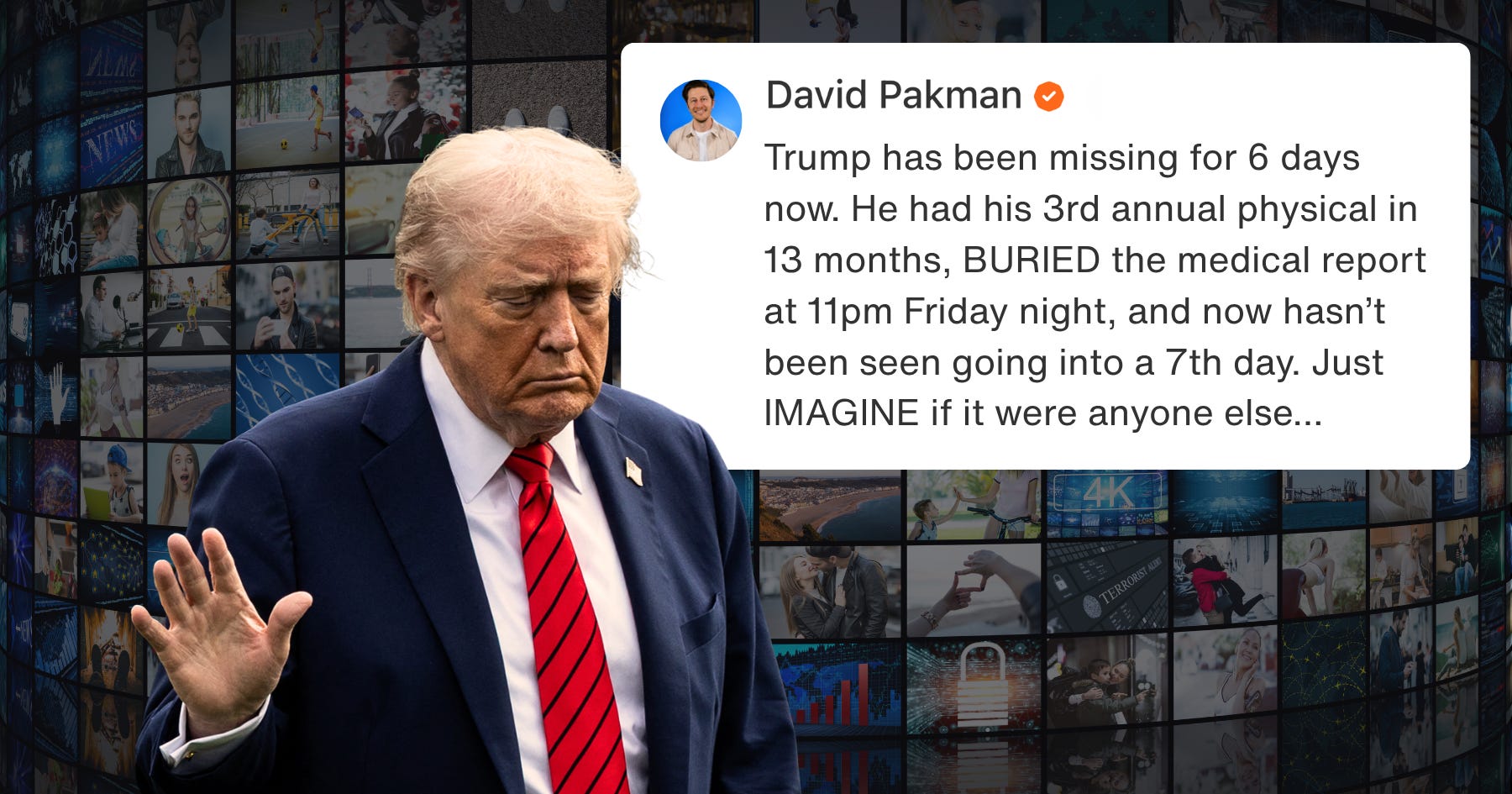
For years, Republicans insisted that the American public had a right to know everything about the health of the president.
Every stumble mattered. Every doctor’s visit mattered. Every medical report demanded scrutiny. Every unexplained absence generated a flood of questions. Transparency, we were told, was essential because the presidency is too important a job for Americans to be kept in the dark.
Now Donald Trump has provided a fascinating test of whether those principles were ever applied consistently.
If you strip away the names and look only at the facts, the reaction should have been explosive. But instead, it barely registered.
A familiar scenario with a different reaction
Trump recently underwent yet another physical examination, reportedly his third in just over a year. The White House initially suggested the report would be released quickly, but it wasn’t.
Instead, the medical report appeared days later, late on a Friday night, which is traditionally when administrations release information they hope receives minimal attention. The report itself portrayed Trump, who is approaching 80 years old, as being in remarkable health. Critics viewed it less as a medical assessment and more as a propaganda document.
At the same time, Trump largely disappeared from public view for roughly a week. That fact alone should have generated questions.
Not because there is proof that anything serious happened, and not because every absence signals a crisis. But because the same political movement that spent years demanding minute-by-minute transparency about Joe Biden established the standard that unexplained presidential absences deserve scrutiny.
If Biden had vanished from public view for seven days immediately after another physical examination, conservative media would not have treated it as a footnote.
It would have been the story.
The presidency is a visual job
One reason these questions arise is because the modern presidency is no longer conducted entirely behind closed doors.
Presidents are constantly visible. They board helicopters, greet foreign leaders, walk across tarmacs, and deliver speeches. They usually appear before cameras almost daily.
The White House understands this better than anyone. Trump’s team, in particular, has often embraced constant visibility as part of its political strategy. When Trump is active and energetic, cameras are rarely far away.
That is why when there is a sudden absence it becomes extremely noticeable.
The administration itself has trained the public to expect near-continuous visibility. When that visibility suddenly disappears after another physical examination, people naturally ask why.
Those questions are not inherently conspiratorial. They are the direct result of the standards that have already been established.
What people are seeing
When Trump eventually reappeared, observers immediately noticed that he looked tired and sounded fatigued. Many viewers also pointed to what appeared to be increased swelling around his right eye, something that has been discussed periodically by commentators for years.


None of this proves anything, of course.
Aging is real and stress is real. The presidency has visibly aged nearly every modern president who has held the office, that’s true.
You can simply look at photographs of Ronald Reagan, Bill Clinton, George W. Bush, Barack Obama, or Joe Biden before and after their presidencies. The physical toll is obvious.
However. The idea that any president, particularly one approaching 80 years old, would somehow be immune from that process is difficult to take seriously. That may be part of the problem.
The White House appears caught between two competing narratives. On one hand, they want voters to see Trump as tireless and unstoppable. On the other hand, reality eventually asserts itself. Nobody escapes aging, including presidents.
The double standard is the story
The most important question here is not whether Trump was sick.
We don’t know.
The most important question is why the rules seem to change depending on who occupies the Oval Office.
When Biden showed signs of aging, Republicans argued that transparency was non-negotiable. Every appearance was analyzed. Every verbal stumble became national news. Every medical question was framed as a matter of public concern.
Now, when similar questions emerge around Trump, many of those same voices suddenly discover the value of privacy, restraint, and waiting for more information.
The inconsistency is difficult to ignore. Either presidential health matters, or it doesn’t. Either unexplained absences deserve questions, or they don’t. Either transparency is a principle, or it is simply a tool used when politically convenient.
The standard we choose
Maybe nothing significant happened during those seven days. Maybe there is a perfectly ordinary explanation.
But the reaction (or more appropriately, lack of reaction) tells us everything.
The people who spent years insisting that Americans deserved complete transparency about one aging president seem remarkably uninterested in asking similar questions about another aging president.
And that leaves us with a broader question about politics itself.
Do we actually believe in consistent standards for our leaders, or have we reached a point where transparency only matters when it’s politically useful and disappears the moment our own side is the one being asked the questions?
What do you think: How much transparency do presidents actually owe the public when it comes to their health? Where would you draw the line? Let me know in the comments.
We’re reaching over 150 million people every month across YouTube, podcasts, Substack, and beyond. But algorithms can change. Platforms can fold. And when that happens, this newsletter is how we stay connected.
If you’re not yet a paid subscriber, please consider joining.
If you’re already paid on one platform, consider supporting us on both Substack and our website.
You can subscribe on our website and right here on Substack.
And if you’re really on fire, consider gifting a subscription—we’ve got thousands on our waiting list ready to read, watch, and fight back.
Let’s keep building.
—David
PS: Can’t contribute right now? No problem. You can support us for free by subscribing on YouTube, listening to our audio podcast on Spotify or Apple Podcasts, or become a free subscriber to this very Substack. Every bit counts.
Outrage? When he disappears, I'm too exhausted with him to feel anything but relief.
The ONLY outrage should be that it wasn't the 'permanent disappearance'.