

For years, Donald Trump benefited from something most politicians only dream about: a political coalition willing to give him the benefit of the doubt.
Scandals came and went. Controversies piled up. Predictions of political collapse repeatedly failed. Through it all, Republican voters remained remarkably loyal.
That is why the latest polling deserves attention.
The numbers Republicans usually never give
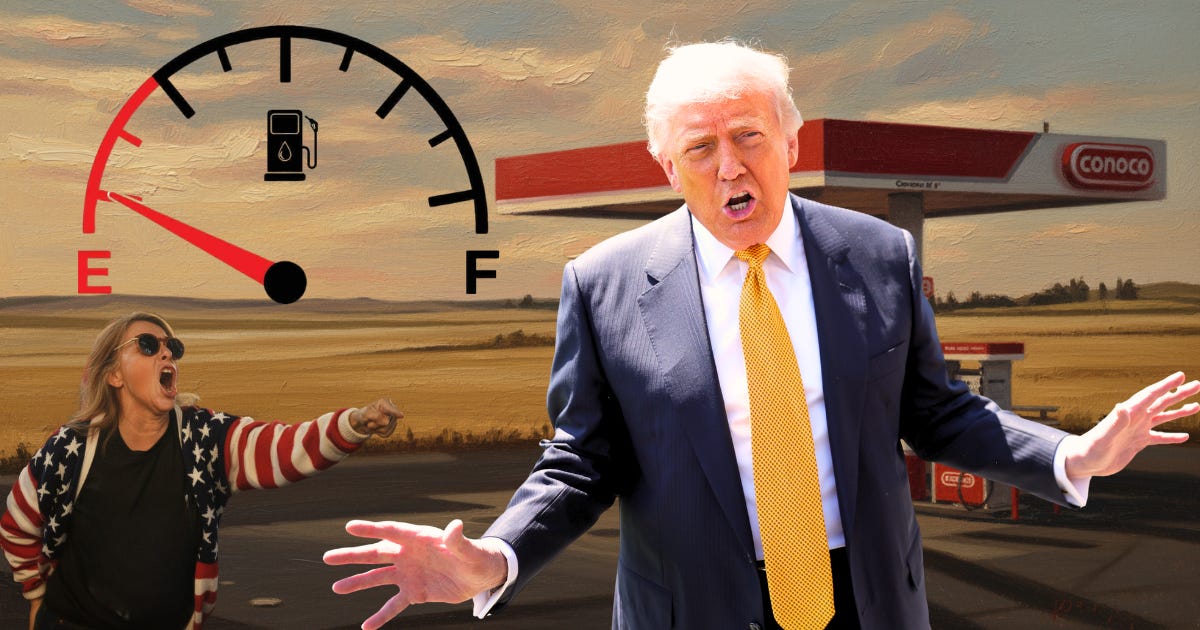
Recent polling highlighted by CNN’s Harry Enten shows a dramatic reversal on two of the issues Trump spent years claiming were his greatest strengths: inflation and fuel prices.
Among Republican voters, Trump once enjoyed overwhelming positive approval on inflation. During his previous presidency and throughout his 2024 campaign, Republicans largely trusted him to handle rising prices. Now, multiple polls show him underwater on the issue, including surveys from organizations that are not exactly known for being hostile to Republicans.
The same pattern appears on gas prices.
Again, these are not Democratic voters expressing dissatisfaction. These are Republicans increasingly questioning whether the promises they were sold are being delivered. When support begins slipping among the very people who are supposed to be the most committed members of your coalition, political analysts start paying close attention.
The reason is simple: presidents can survive opposition from the other party. They have a much harder time surviving disappointment from their own.
Economic reality eventually wins
One of the oldest lessons in American politics is that voters tend to care less about slogans than about their own experiences. A politician can tell people the economy is booming. A spokesperson can insist everything is moving in the right direction. Friendly media outlets can repeat the message all day long.
But if people are struggling to pay bills, carrying growing credit card debt, delaying major purchases, or worrying about housing costs, they tend to trust their own bank accounts more than political messaging.
This isn’t unique to Trump. It wasn’t unique to Biden, or to Clinton, Bush, Obama, or anyone else. Economic anxiety has a way of cutting through partisan narratives.
In fact, voters often become even more frustrated when leaders insist conditions are great while their daily lives suggest otherwise. Being told everything is wonderful while feeling financially squeezed can come across as dismissive rather than reassuring.
The promise gap
Part of what makes these numbers so politically dangerous is the contrast between expectation and reality. Trump did not campaign as a manager of gradual improvement. He campaigned as a transformational figure.
The promise was straightforward: prices would come down, the economy would improve, America would become stronger, and competence would replace chaos.
For many voters, particularly those who switched to Trump because of economic concerns, the question is no longer whether they like his rhetoric. The question is whether they feel materially better off. And when voters start asking that question, distractions become less effective.
And the distractions keep coming. There are bizarre cabinet meetings, discussions about conspiracy theories, claims about imaginary Social Security fraud, stories about aliens, and arguments over cognitive tests. None of it changes what people see when they fill up their gas tank or open a credit card statement.
The political danger emerges when voters begin connecting the daily chaos to the broader question of performance.
Why these polls matter
For much of Trump’s political career, controversial statements and unusual behavior often existed in a separate category from evaluations of his effectiveness. People might say, “That was strange,” and then move on. But what appears to be happening now is different.
Increasingly, voters seem to be evaluating the entire package together. They are looking at their financial situation, looking at the administration, and asking whether the promises matched the results.
That does not automatically mean electoral disaster. Polls move. Conditions change. Political recoveries happen.
But historically, presidents become vulnerable when economic frustration starts outweighing partisan loyalty. And when cracks begin appearing inside a president’s own coalition, those warning signs become much harder to dismiss.
The White House can argue that the polls are wrong. Supporters can claim the samples are biased. Commentators can debate methodology all day long. But when numerous polls point in the same direction, the broader trend becomes difficult to ignore.
Where does this go from here?
The bigger question may not be whether Trump’s approval numbers are falling. The data increasingly suggests they are. The question is whether this frustration eventually translates into political consequences.
Are voters simply expressing temporary dissatisfaction, or are we watching the early stages of a genuine backlash that could reshape the next election cycle?
What do you think: when voters feel financially squeezed, is there a point where party loyalty stops mattering, or do most people ultimately stick with their political team no matter what the economic reality looks like?
We’re reaching over 150 million people every month across YouTube, podcasts, Substack, and beyond. But algorithms can change. Platforms can fold. And when that happens, this newsletter is how we stay connected.
If you’re not yet a paid subscriber, please consider joining.
If you’re already paid on one platform, consider supporting us on both Substack and our website.
You can subscribe on our website and right here on Substack.
And if you’re really on fire, consider gifting a subscription—we’ve got thousands on our waiting list ready to read, watch, and fight back.
Let’s keep building.
—David
PS: Can’t contribute right now? No problem. You can support us for free by subscribing on YouTube, listening to our audio podcast on Spotify or Apple Podcasts, or become a free subscriber to this very Substack. Every bit counts.
GOP = Guardians Of Pedophiles
Please let the beginning of the end start sooner than later!!!