

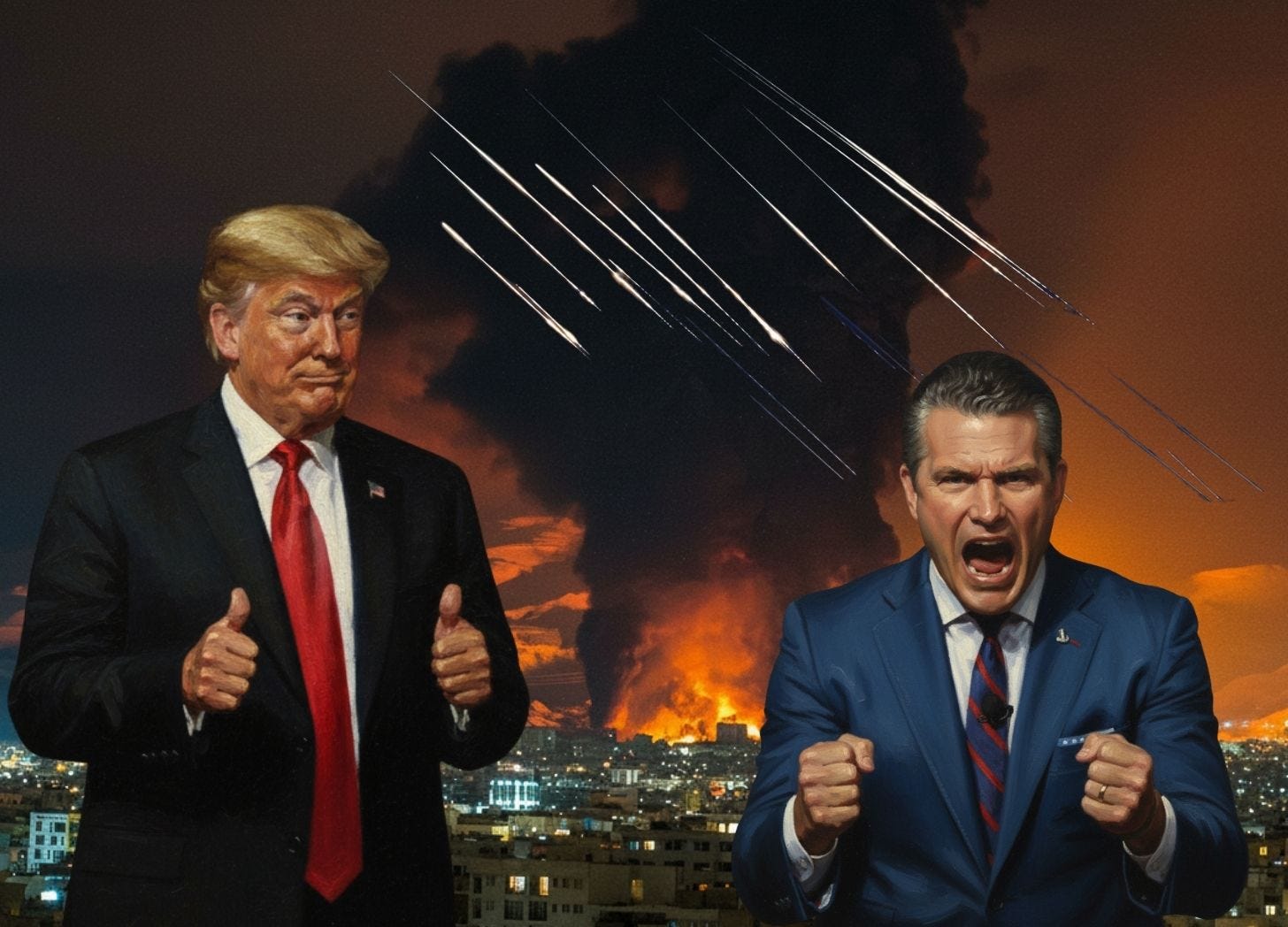
Donald Trump told Americans the Iran war would be quick.
Three to four weeks. Targeted. Controlled. Limited.
We are now in week eleven.
At a certain point, even people who supported the intervention start asking the obvious question: what exactly happened here? Was the administration unprepared? Did they misunderstand the situation on the ground? Were they misled by intelligence? Or did Trump simply say what sounded politically convenient at the time?
Now comes the newest explanation from Trumpworld, and it may be one of the strangest yet.
Apparently, according to Trump adviser Sebastian Gorka, the reason the war is dragging on is because the United States has been too successful.
The “winning too hard” argument
Gorka recently argued that the administration’s military strategy worked so effectively that it actually complicated ending the conflict.
Yes, really.
According to this theory, the United States and its allies were so successful at dismantling Iranian leadership structures that there is now nobody left capable of formally surrendering or negotiating an end to the war. The administration’s overwhelming effectiveness supposedly created logistical complications for peace talks. Think about how absurd that framing actually is.
Imagine a contractor telling you your kitchen remodel is taking six extra months because the renovation crew was simply too efficient. Or a football coach explaining a thirty-point loss by saying the strategy worked so well that the scoreboard became misleading. None of it makes sense because it is not designed to make sense. It is designed to preserve the image of infallibility.
And that has increasingly become the defining characteristic of Trump-era political messaging. Every outcome, including contradictory outcomes, must ultimately be reframed as proof that Trump was right all along.
If prices go up, that means the strategy is working.
If inflation rises, it is actually part of a necessary “transition.”
If a war lasts three times longer than promised, it means America was simply too dominant on the battlefield.
The conclusion is always predetermined: Trump succeeds by definition.
When reality becomes optional
There is a broader pattern here that extends far beyond Iran. For years, many figures on the right criticized what they described as “postmodernism” on the left. The accusation was that liberals supposedly believed objective truth did not matter and that any interpretation of reality was equally valid.
But look at what is happening now.
Gas prices going up can simultaneously be framed as economic pain and economic success. A prolonged military conflict can simultaneously be framed as proof that the war was short and controlled. Trump can announce victory repeatedly while the fighting continues anyway.
At some point, language stops describing reality and instead becomes a mechanism for protecting political identity.
That is why these explanations start sounding almost cult-like. The leader cannot fail. Therefore, if failure appears visible, the appearance itself must be reinterpreted. The stumble becomes choreography. The contradiction becomes strategy. The delay becomes evidence of strength.
And once political movements operate this way long enough, accountability becomes almost impossible because there is no measurable standard left. Whatever happens can simply be folded back into the narrative as proof of success.
The political danger for Trump
The problem for Trump is that voters eventually experience reality directly.
They pay for gas. They watch instability in oil markets. They notice when wars that were supposed to be “limited” begin stretching indefinitely into the background of daily life.
American history is full of examples where public patience for military conflicts collapsed once people concluded there was no clear endpoint. And this is particularly dangerous for Trump because part of his political brand was built around the idea that he was the anti-war candidate.
Trump and Tulsi Gabbard repeatedly framed themselves as opponents of endless foreign entanglements. The promise was competence, restraint, and fast resolution. Instead, Americans are watching an administration repeatedly declare victory while simultaneously explaining why the conflict continues. That contradiction becomes harder and harder to sustain over time.
And Gorka’s explanation may actually make things worse because it sidesteps the questions voters are naturally asking now:
What is the objective? What does victory actually look like? What is the timeline?
How does this end?
Instead of answering those questions, the administration’s defenders are effectively saying: “The war continues because Trump is too awesome at war.”
That may work for the most committed loyalists. But persuading exhausted swing voters is a different challenge entirely.
Especially when week eleven starts feeling suspiciously different from week three.
So what do you think? At what point do voters stop accepting “we’re winning” as an explanation when the situation around them keeps getting worse? Or does partisan loyalty now outweigh almost any contradiction?
We’re reaching over 150 million people every month across YouTube, podcasts, Substack, and beyond. But algorithms can change. Platforms can fold. And when that happens, this newsletter is how we stay connected.
If you’re not yet a paid subscriber, please consider joining.
If you’re already paid on one platform, consider supporting us on both Substack and our website.
You can subscribe on our website and right here on Substack.
And if you’re really on fire, consider gifting a subscription—we’ve got thousands on our waiting list ready to read, watch, and fight back.
Let’s keep building.
—David
PS: Can’t contribute right now? No problem. You can support us for free by subscribing on YouTube, listening to our audio podcast on Spotify or Apple Podcasts, or become a free subscriber to this very Substack. Every bit counts.
Why should anyone be surprised?
When a psychotic maniac surrounds himself with morons, crackpots, lunatics, stooges, knuckleheads, and sycophants, he’s going to get the advice that they think he wants to hear - if they know what’s good for them. Plus, he also needs a bench of fall guys whom he can blame and fire should his visceral instincts go south.
While posterity will denounce Trump as a loudmouth megalomaniac, they will reserve their harshest condemnation for us, the American people for allowing this clown to sit in the Oval Office.
According to Trump in the corporate criminals of the world, war is peace.