

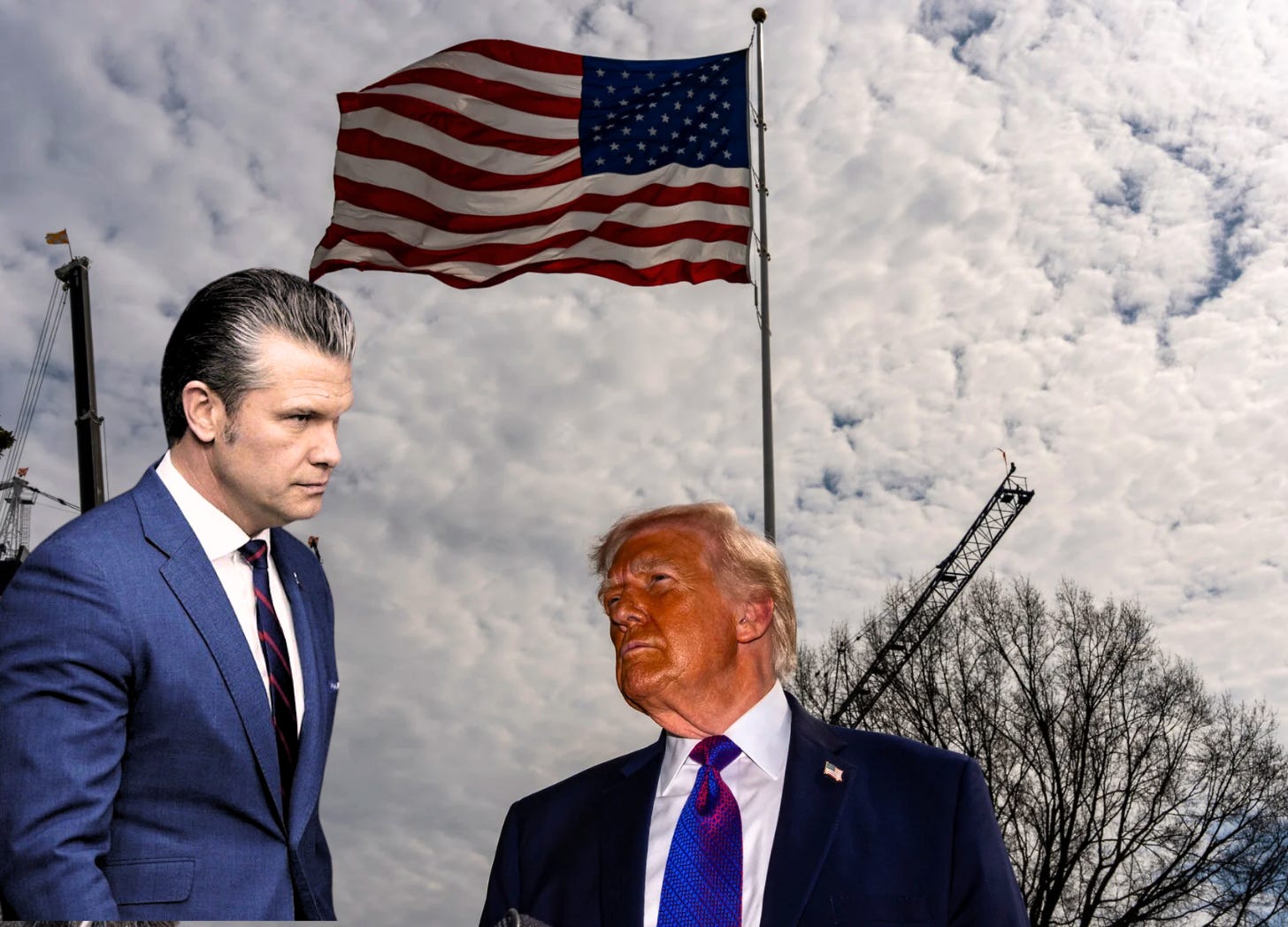
The Trump administration’s messaging about the war with Iran has reached a level of confusion that would be hard to parody.
Within the span of just a few hours, President Donald Trump declared that the war was essentially over and that the United States had achieved its objectives. Then Defense Secretary Pete Hegseth stepped to the podium and announced that the very same day would be the most intense day of U.S. strikes inside Iran since the war began.
Both statements cannot be true at the same time. And yet, both are now part of the official narrative.
The contradiction reveals something deeper about how this administration is operating. The messaging is chaotic because the strategy itself appears to be chaotic.
A war that is both ending and escalating
Trump’s message was clear. According to the president, the conflict is basically finished.
He claimed Iran’s capabilities had been wiped out. He said most of Iran’s naval forces were already sitting at the bottom of the ocean. He suggested the United States had effectively accomplished what it set out to do.
But almost immediately afterward, Pete Hegseth delivered the opposite message.
According to the defense secretary, March 10 would mark the largest day of strikes inside Iran since the conflict began. The most bombers, the most fighters, the most attacks. Intelligence is improving, he said, and the campaign is intensifying.
So which is it?
Is the war essentially over, as Trump claims? Or is it entering its most aggressive phase yet, as the Pentagon is saying?
At the moment, the administration appears to be trying to maintain both narratives simultaneously.
Messaging for every audience
The contradiction begins to make more sense once you consider who each message is designed for.
Trump’s version of events is aimed at markets and domestic politics. Declaring that the war is nearly finished helps calm investors and reassure voters who are watching gasoline and energy prices climb.
Hegseth’s message serves a different purpose. Telling the world that the United States is escalating its strikes sends a signal to Iran that the U.S. is not backing down.
One message is meant to project closure. The other is meant to project strength.
The problem is that when both messages are delivered at the same time, the result is confusion.
Expanding and containing the war at the same time
The contradictions did not stop there.
Hegseth also pushed back on media reports suggesting the war is expanding. He insisted the opposite is true. According to him, the conflict is actually contained.
That claim came moments after he described the day as the largest bombing campaign of the entire war.
So the conflict is both intensifying and narrowing. It is escalating and stabilizing at the same time.
This kind of messaging may work for a short news cycle, but it does not inspire confidence that the situation is under control.
Buzzwords and Bible verses
The defense secretary’s remarks also followed a familiar pattern.
The briefing was filled with a dense collection of military buzzwords about overwhelming force, precision operations, and decisive victory. Statements about crushing the enemy were delivered alongside declarations of technical mastery and relentless action.
Then the briefing took an unusual turn.
Hegseth concluded his remarks by quoting from Psalm 144, asking God to strengthen American troops and grant victory over their enemies.
The United States has a long tradition of civilian leaders thanking and honoring the military, but reading scripture at the end of a Department of Defense operational briefing is not exactly standard practice.
It underscored the unusual nature of the moment.
The consequences of political appointments
The broader issue is competence.
Pete Hegseth’s background before leading the Pentagon was as a television personality and weekend host on Fox News. That résumé would normally not be considered preparation for managing one of the most complex military institutions in the world.
And yet here we are.
The United States is currently involved in a rapidly evolving conflict, energy markets are reacting, and the public is being asked to interpret two completely different narratives about what is actually happening.
The war is supposedly ending.
It is also entering its most intense phase.
And the people responsible for explaining it appear to be improvising the story as they go.
We’re reaching over 150 million people every month across YouTube, podcasts, Substack, and beyond. But algorithms can change. Platforms can fold. And when that happens, this newsletter is how we stay connected.
If you’re not yet a paid subscriber, please consider joining.
If you’re already paid on one platform, consider supporting us on both Substack and our website.
You can subscribe on our website and right here on Substack.
And if you’re really on fire, consider gifting a subscription—we’ve got thousands on our waiting list ready to read, watch, and fight back.
Let’s keep building.
—David
PS: Can’t contribute right now? No problem. You can support us for free by subscribing on YouTube, listening to our audio podcast on Spotify or Apple Podcasts, or become a free subscriber to this very Substack. Every bit counts.
Hegseths "No Quarters" is illegal and was called out by Kelly.
War is more than bad enough, but war crimes? All the people in this administration should be in Guantanamo Bay—especially if tRump decides to go after Cuba next.