

Before we get into it: if you’re receiving this via email, thank you. You’re already subscribed. If you’re not, now is the time.
There is a behavioral shift in Donald Trump that almost no one is talking about, and it has nothing to do with forgetting names, mixing up dates, or falling asleep during public events.
There needs to be a discussion about how Trump responds to death, and what that shift tells us about his mental and emotional capacity.
The comparison that matters
In 2020, when Supreme Court Justice Ruth Bader Ginsburg died, Trump’s response was, by his standards, restrained and recognizably human.
He was informed of her death on camera and reacted with surprise. He acknowledged that she had lived “an amazing life” and called her “an amazing woman,” even though it was clear that they were political opponents. He did not celebrate her death or attack her. He understood, at least at a basic level, that the moment called for restraint.
At the time, even Trump’s critics noted that this was how a public figure is supposed to respond when a political adversary dies. There was emotional control, social awareness, and a sense of proportion.
Fast forward to 2025
Now compare that to Trump’s response five years later.
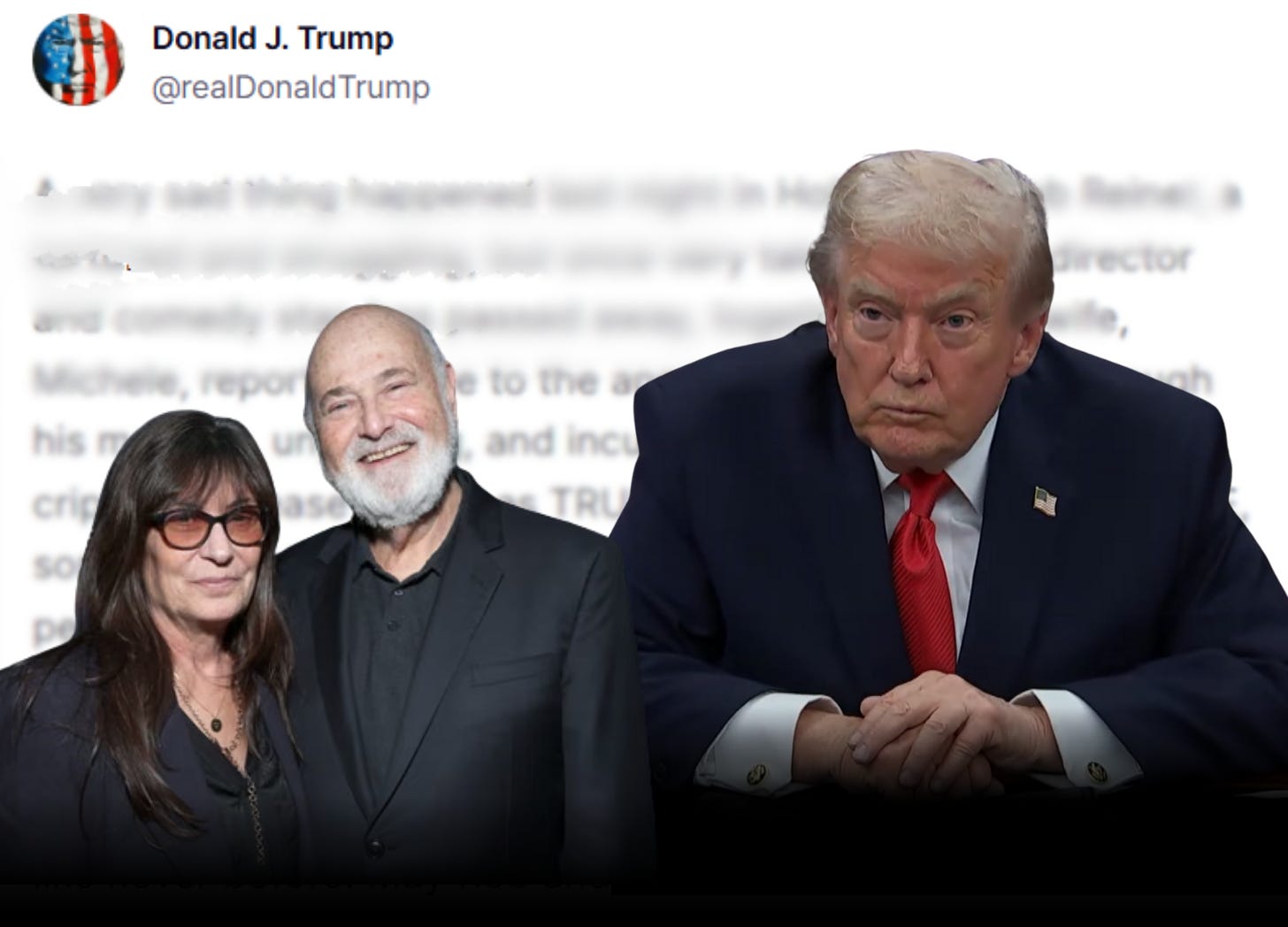
After filmmaker Rob Reiner and his wife were tragically killed, allegedly by their son, Trump posted a message on Truth Social that was openly cruel. Instead of acknowledging a horrific loss of life, he used the moment to insult Reiner, accuse him of suffering from “Trump Derangement Syndrome,” and relitigate old political grievances.
The post itself was disturbing but what followed was more revealing.
When asked about the backlash, including condemnation from Republicans, Trump did not express embarrassment or regret. He doubled down. He reiterated his animosity, dismissed Reiner as a “deranged person,” and showed no awareness that the moment demanded something very different.
There was no course correction, restraint, or recognition that the response was inappropriate.
Why this is a red flag
Cognitive decline does not always announce itself with obvious memory failures. One of the earliest and most well-documented signs is a loss of social judgment and emotional regulation.
This can show up as reduced inhibition, where the internal filter that once stopped you from saying something inappropriate simply fails. It can involve an inability to read the emotional context of a situation, inappropriate anger or cruelty, and impulsive reactions that override self-control.
Another key indicator is the inability to adjust behavior after receiving social feedback. You cross a line, people react negatively, and instead of pulling back, you double down.
That pattern is exactly what we see here.
This is not about strategy
It is important to understand that this behavior is not even politically useful for Trump.
If this were calculated, if it were strategic provocation, he would have walked it back once Republicans themselves began denouncing the post. Instead, he escalated. That tells us this was not messaging. It was impulse.
Even people who are cruel by nature generally understand social norms well enough to fake empathy when the moment requires it. They know when to put on the mask.
What is alarming here is that Trump increasingly appears unable to do even that.
What has changed
The Trump of 2020, as chaotic as he was, still seemed capable of recognizing that death, even the death of a political enemy, requires a certain level of decorum. The Trump of 2025 appears unable to stop himself, unable to read the room, and unable to regulate his response.
It’s clear that this is not a change in ideology, it’s a change in mental and emotional capacity.
It does not prove a medical diagnosis, and it is not a substitute for a clinical evaluation. But it is a pattern that aligns with documented early signs of cognitive decline, where emotional control erodes before memory does.
The bigger concern
Trump’s response to death has shifted from performative restraint to raw impulse. That shift should concern anyone who cares about judgment, stability, and the ability to handle moments that demand seriousness rather than grievance.
This is not about being polite or “presidential.” It is about whether someone seeking or exercising immense power still has the capacity to regulate themselves when it matters most.
That is the story hiding in plain sight.
We’re reaching over 150 million people every month across YouTube, podcasts, Substack, and beyond. But algorithms can change. Platforms can fold. And when that happens, this newsletter is how we stay connected.
If you’re not yet a paid subscriber, please consider joining.
If you’re already paid on one platform, consider supporting us on both Substack and our website.
You can subscribe on our website and right here on Substack.
And if you’re really on fire, consider gifting a subscription—we’ve got thousands on our waiting list ready to read, watch, and fight back.
Let’s keep building.
—David
PS: Can’t contribute right now? No problem. You can support us for free by subscribing on YouTube, listening to our audio podcast on Spotify or Apple Podcasts, or become a free subscriber to this very Substack. Every bit counts.
Well, thank that God Thing that YOU are writing about Trump's reaction to deaths. I'll look forward to how you write about HIS death. Nothing can stop this man--not the media, not the Congress, not even the bleeding heart of democracy itself.
Well written as usual and on the money. There is an ironic parallel here.
For years the Reiners knew they had and out of control son. I am sure they did not foresee the damage that was lurking right in front of them until it was too late.
Same same for Trump. His supporters have stood idly by watching his decline with very lttle pushback. In fact many gleefully apologize and encourage it. At what point is enough, enough?
There is no excuse for mean and ugly.