

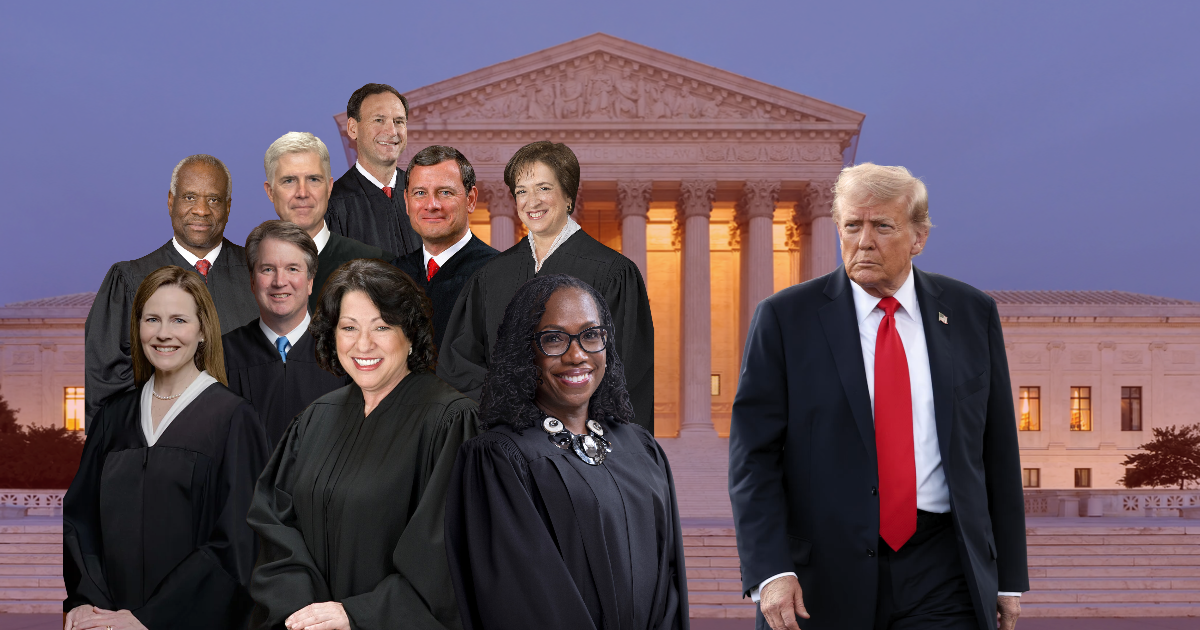
Donald Trump just suffered a major legal defeat at the Supreme Court, and with the midterm elections only weeks away, the timing could hardly be more significant.
The Supreme Court rejected the Trump administration’s emergency attempt to impose sweeping new Postal Service requirements on mail-in voting for the November election. Lower courts had already blocked the rules, and the administration went to the Supreme Court hoping the justices would intervene at the last minute and allow them to take effect while the litigation continued.
The court said no.
For anyone concerned about changing election procedures when voting is already getting underway, this is very good news.
What Trump wanted to change
The administration’s plan would have fundamentally changed the way states use the Postal Service to send mail-in ballots.
Under the new rules, ballot envelopes would need specific features, including specialized barcodes unique to individual voters. States would also have to submit voter information to the Postal Service and have their ballot envelope designs approved.
The consequences for failing to comply were serious. Mail that did not meet the requirements could be rejected and returned to the state rather than delivered to the voter.
Think about what that means in practice. States have already designed their ballots and envelopes. Election officials have already established procedures. In some parts of the country, the voting process is already underway. Then, just weeks before Election Day, the federal government wanted states to overhaul major pieces of that system.
Election officials, including Republicans, warned that trying to implement an entirely new Postal Service system this close to Election Day could create delays, mistakes and confusion.
There is some irony there. Trump and his allies have spent years claiming that mail-in voting is plagued by exactly those problems. Their proposed solution would have created a very real risk of introducing them into an election already in progress.
The Supreme Court shuts the door for 2026
Lower courts blocked the rules from taking effect, so the Trump administration asked the Supreme Court for emergency relief.
The justices declined.
The majority said the government was “unlikely to succeed on the merits” of its challenge to the preliminary injunction and that the other factors necessary to justify emergency relief did not favor the administration.
That leaves the lower court injunction in place. For the 2026 midterms, the practical result is straightforward: the Postal Service cannot implement the system Trump wanted, and the existing process remains in place.
There is an important bit of nuance here because this ruling does not permanently settle every legal question surrounding the Postal Service and election mail.
Justice Brett Kavanaugh wrote separately that he believes there is at least a possibility that the Postal Service has the statutory authority to create rules along these lines. But even Kavanaugh concluded that imposing them for the 2026 election would be arbitrary and capricious because state and local election officials simply do not have enough time to reasonably implement them.
I disagree with Kavanaugh on the broader question of Postal Service authority. Elections are administered by the states, and I do not believe the Postal Service should be inserting itself into state election administration in this way.
But on the immediate question, the conclusion is obvious. You cannot redesign a major component of election administration at the eleventh hour and expect 50 states, thousands of local election officials and millions of voters to simply figure it out.
Trump needed these rules now
The timing is also central to understanding why this defeat matters politically.
Trump’s immediate objective was to have these rules in place for the 2026 midterms. Whatever happens with the underlying litigation later, that opportunity is now essentially gone.
The ballots have been designed. The envelopes have been printed. The procedures are in place. Voting by mail is beginning in parts of the country.
Trump needed the Supreme Court to intervene immediately. He asked the justices to do exactly that, and they refused.
This was his last realistic opportunity to impose these requirements before November.
Samuel Alito and Clarence Thomas dissented, arguing that the administration should have been allowed to put the rules into effect while the case continued. They did not have enough votes.
So, practically speaking, the clock has run out.
The broader fight isn’t over
None of this means the underlying legal battle disappears after Election Day.
Future courts may still confront questions about how much authority the Postal Service has over election mail and where the boundary lies between legitimate postal regulation and federal interference with state-run elections. Those are consequential questions, and they will be worth watching even after the midterms are over.
But the immediate threat has been removed.
One potential source of chaos heading into November has been taken off the table. States will not suddenly have to redesign their mail-ballot systems weeks before an election. Voters will not have to wonder whether their ballot can be delivered because their state failed to satisfy a newly created federal requirement.
And Trump did not get the emergency intervention he needed from the Supreme Court.
Even if I disagree with parts of the reasoning offered by some of the justices, the outcome for this election is the right one. Election rules should not be rewritten at the last possible moment, particularly when election officials are warning that doing so could create the very confusion and disruption the administration claims it wants to prevent.
Trump can hurl ketchup at the walls until the cows come home. These rules are not going into effect for the 2026 midterms.
So what do you think? Was this simply the Supreme Court recognizing that it was far too late to overhaul the system, or does the Postal Service have no business playing this kind of role in elections in the first place?
We’re reaching over 150 million people every month across YouTube, podcasts, Substack, and beyond. But algorithms can change. Platforms can fold. And when that happens, this newsletter is how we stay connected.
If you’re not yet a paid subscriber, please consider joining.
If you’re already paid on one platform, consider supporting us on both Substack and our website.
You can subscribe on our website and right here on Substack.
And if you’re really on fire, consider gifting a subscription—we’ve got thousands on our waiting list ready to read, watch, and fight back.
Let’s keep building.
—David
PS: Can’t contribute right now? No problem. You can support us for free by subscribing on YouTube, listening to our audio podcast on Spotify or Apple Podcasts, or become a free subscriber to this very Substack. Every bit counts.
The Constitution is clear, States run their elections.
The Elections are supposed to be run by the States. The States may USE the U.S. Postal Service, as anyone can. But, the U.S. Postal Service is Federal, so it cannot be used by The Federal Gov’t to oversee or “manage” the ballots in any way, (other than delivering them as addressed, which is their job), because The Conduct of Elections is under States’ Authority, per the Constitution.