

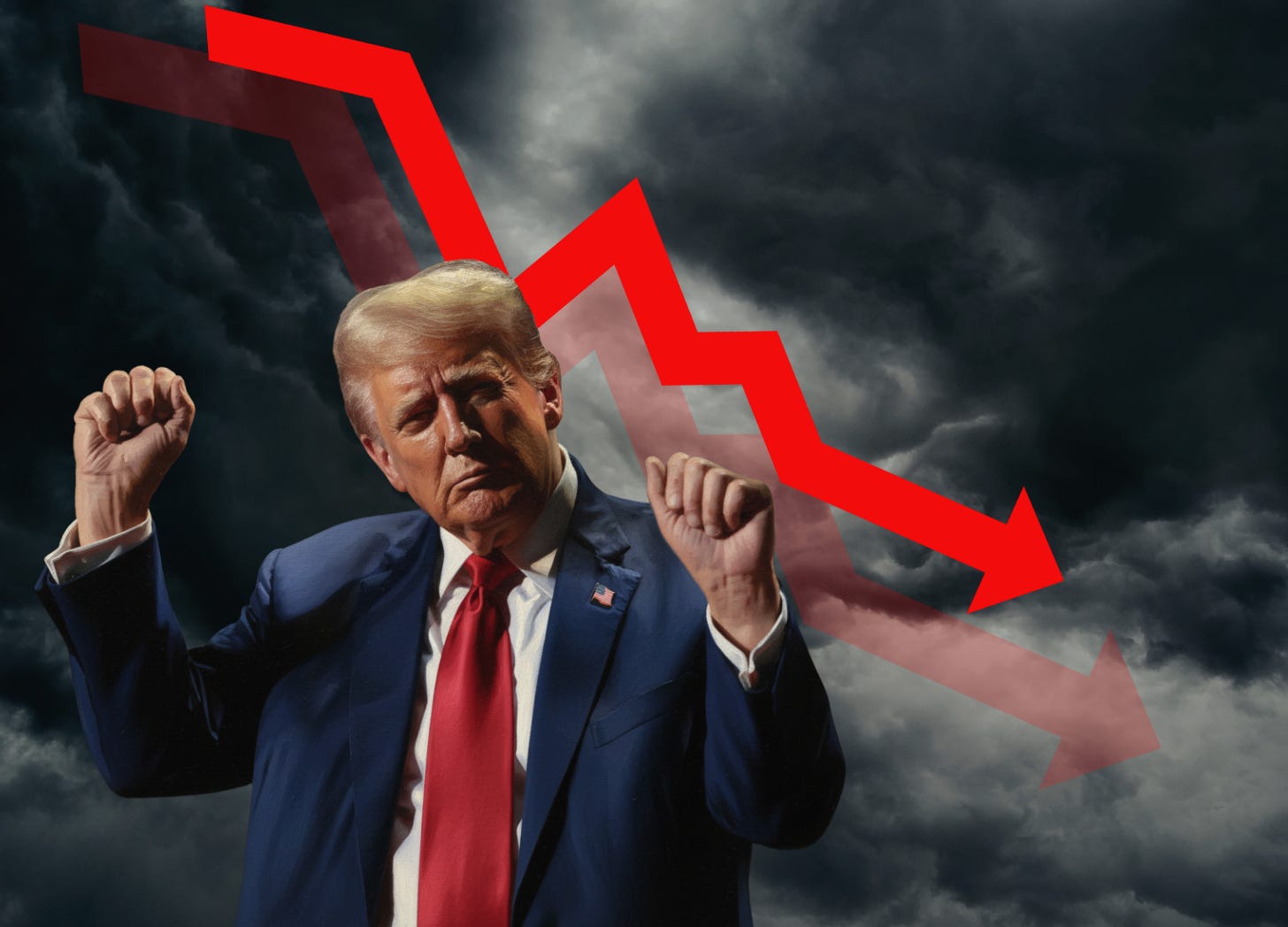
Donald Trump is now experiencing one of the sharpest polling collapses of any modern presidency, and it is by far the worst of his own political career.
According to new polling out of UMass Amherst, Trump’s approval rating has fallen to just 33 percent. That is not just low. It is the lowest of his presidency.
And the trend line is continuing to move in the wrong direction.
Last April, he was at 44 percent. By July, that dropped to 38 percent. Now he is at 33 percent. This is not a blip. This is sustained decline.
At the same time, his net approval has cratered to negative 17, making him the most unpopular president at this stage in office in the modern polling era.
This isn’t just polarization. It’s broad rejection.
There is always a baseline level of partisan opposition baked into American politics. That’s not what this is.
Once disapproval moves past 60 percent, you are no longer looking at simple partisan division. You are looking at a broad majority of the country that believes the president is failing.
And that is exactly where Trump is.
Seventy-one percent of Americans say he is failing on inflation. Sixty-one percent say he is failing on job creation. Sixty-four percent say tariffs have been a disaster. Ninety-two percent oppose putting boots on the ground in Iran.
Even immigration, historically one of Trump’s strongest issues, is now slipping away from him.
This is not just dislike of Trump as a person. This is rejection of the policies themselves.
The coalition is cracking
What makes this even more significant is where the erosion is happening.
Support is down among men. It is down among working-class voters. It is down among independents and moderates. Even non-MAGA Republicans are starting to peel away.
That matters.
Trump can remain popular within the MAGA base, but that group is not large enough to sustain national political success on its own. Once the broader Republican coalition begins to fracture, the electoral math changes quickly.
We are also seeing this play out in real time inside conservative media and political circles. Disagreements over the Iran conflict, economic dissatisfaction, and general disillusionment are no longer confined to the left. They are showing up within Trump’s own side.
When members of your own coalition start saying, “This is not what we signed up for,” that is when political damage accelerates.
Historically bad, historically consequential
To understand just how serious this is, it helps to look at history.
Presidents with approval ratings in the low 30s do not have good midterms. They get crushed.
Barack Obama faced a brutal midterm in 2010 with approval ratings in the mid-40s. Bill Clinton’s party suffered a wave election in 1994 under stronger conditions than Trump has now. Even Trump himself, during his first term, lost the House in 2018 while polling higher than he is today.
So what does it mean when Trump is sitting at 33 percent, with a negative 17 net approval, months before the midterms?
It means the warning signs are not subtle. They are flashing red.Midterms are about turnout, not persuasion
Presidential elections are often about persuasion. Midterms are different.
Midterms are about turnout.
If voters are enthusiastic, they show up. If they are discouraged, disappointed, or disengaged, they stay home.
Low presidential approval does not just hurt a party because people oppose the president. It hurts because it drains motivation from the president’s own voters.
If Republican voters feel that Trump is not delivering, they are less likely to turn out and support the candidates tied to him.
That is how midterm losses happen. Not through mass conversion of voters, but through uneven energy between the two sides.
This is no longer early-stage decline
At a certain point, you have to stop describing this as a temporary dip.
This is not early warning. This is not a rough week.
This is mid-stage political decline.
The numbers are bad, the direction is worse, and the structural conditions heading into the midterms are unfavorable.
Could things change? Of course. Approval ratings move. Events intervene.
But as of now, the trajectory is clear.
Trump’s support is shrinking beyond his core base, dissatisfaction is spreading across multiple issues, and the political consequences are beginning to take shape.
The opportunity in front of voters
If these trends hold, the implications are significant.
Control of the House is very much in play. And more than that, there is a real possibility of delivering a decisive electoral rebuke to the policies and decisions that brought the country to this point.
Elections are ultimately about choices.
And what the polling is showing right now is that more and more Americans are not just questioning those choices. They are rejecting them.
The question now is whether that sentiment turns into turnout when it matters most.
We’re reaching over 150 million people every month across YouTube, podcasts, Substack, and beyond. But algorithms can change. Platforms can fold. And when that happens, this newsletter is how we stay connected.
If you’re not yet a paid subscriber, please consider joining.
If you’re already paid on one platform, consider supporting us on both Substack and our website.
You can subscribe on our website and right here on Substack.
And if you’re really on fire, consider gifting a subscription—we’ve got thousands on our waiting list ready to read, watch, and fight back.
Let’s keep building.
—David
PS: Can’t contribute right now? No problem. You can support us for free by subscribing on YouTube, listening to our audio podcast on Spotify or Apple Podcasts, or become a free subscriber to this very Substack. Every bit counts.
Bring them down
👏Please Vote Blue in November! I hope he keeps failing! That’s not tough, he’s his own worst enemy. It’s natural because he doesn’t care about anyone!