

Donald Trump has triggered a global financial panic. Markets around the world are sliding, oil prices are surging, and the economic shock is spreading quickly. All of it is unfolding in the middle of Trump’s rapidly escalating war with Iran.
The problem is not only the conflict itself. The problem is that there appears to be no coherent strategy behind it. No clear objective. No defined exit.
And that uncertainty is now rippling through the global economy.
Markets are reacting fast
Look at what has happened across global markets in just the last few days.
Japan’s Nikkei index dropped roughly 7 percent in a single day. South Korea’s market fell about 8 percent, extending losses that had already begun the previous week. In the United States, the Dow has been sliding sharply as investors respond to geopolitical chaos.
At the same time, energy markets are experiencing a shock that analysts say could rival historic crises.
Brent crude oil jumped roughly 27 percent in a single day, reaching about $117 per barrel. That is the largest single-day increase since 1988. Gas prices in the United States have followed immediately, rising from around $2.94 per gallon to roughly $3.50 in about a week. That is a roughly 20 percent increase in a matter of days.
This is not a routine market fluctuation. Analysts are warning that it could become the largest oil supply shock since the energy crisis of the 1970s.
The Strait of Hormuz problem
Much of the disruption centers on the Strait of Hormuz, one of the most critical shipping lanes in the world. Roughly 20 percent of the global oil supply normally moves through that narrow waterway.
Right now, that flow has been severely disrupted following Iranian retaliation tied to the ongoing conflict. Shipping activity has slowed dramatically, and some routes have effectively shut down. On top of that, other oil-producing and refining countries are either voluntarily constraining supply or being forced to do so as the situation becomes more unstable.
The math here is simple: less supply combined with geopolitical uncertainty pushes oil prices higher. Higher oil prices translate into higher gasoline prices.
And higher gasoline prices ripple through the entire economy because transportation costs are embedded in nearly everything people buy.
The human cost is rising
While markets react to the economic shock, the human consequences of the conflict continue to grow.
Reports now indicate that at least seven or eight U.S. service members have been killed so far. Officials, including Defense Secretary Pete Hegseth, have warned that the number is likely to rise.
Investors and foreign policy analysts are asking a basic question: how long will this war last?
There is no clear answer.
Donald Trump has suggested the conflict might last four or five weeks. But it is not even clear what that timeline means. Does that mean four or five weeks total, or four or five weeks from now? We are already approaching two weeks into the conflict.
Many foreign policy experts believe the timeline could be far longer. Even if the White House decides the operation is finished, that does not mean Iran will simply agree that the war is over.
That uncertainty is part of what is driving the panic.
The economic reality for ordinary Americans
For most Americans, this situation is not an abstract geopolitical debate. It shows up immediately in everyday life.
Imagine being a working family in Arkansas, Michigan, or Tennessee. You may have a job. You may be managing your bills. But the cost of living has already been squeezing household budgets.
You are trying to figure out whether you can afford groceries, gasoline, or helping your kids with college. You are watching credit conditions tighten and wondering how much financial cushion you really have.
Then gasoline prices jump 20 percent in a week.
Transportation costs rise. Food costs follow. The price of everyday goods begins climbing again.
And if you are one of the many Americans who has a retirement account, maybe a 401(k), an IRA, or a 403(b), you may also be watching those balances drop as markets react to the crisis.
For ordinary households, this is not theoretical, this is immediate economic pressure.
A populist promise meets reality
This is where the political contradiction becomes impossible to ignore.
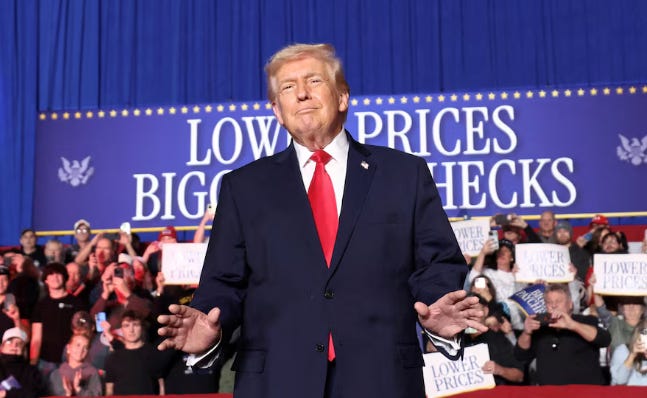
Donald Trump campaigned heavily on populist rhetoric. He portrayed himself as the defender of working families, the leader who understood economic pain, the president who would focus on affordability.
But starting a war that triggers an energy shock does the opposite.
Higher oil prices lead directly to higher gas prices. Higher gas prices push up the cost of almost everything else. The very voters who were promised economic relief are now facing another round of rising costs.
That is the economic reality of a geopolitical gamble.
The White House is already feeling the pressure
Reports from inside the White House suggest that the political pressure is already intense. There have been accounts of internal frustration and shouting over the surge in gasoline prices as the economic consequences of the conflict become clear.
My expectation is that the administration may soon try to find a way to step back from parts of this conflict while declaring victory.
That would follow a familiar pattern. Escalate quickly, then attempt to redefine the outcome as a success once the economic or political costs begin to mount.
Whether that is actually possible here remains an open question.
What we do know is that the global economy has already been shaken, the human cost is growing, and the consequences of this conflict are now reaching far beyond the battlefield.
And the biggest question facing both investors and ordinary Americans remains the same: how much worse could this get?
We’re reaching over 150 million people every month across YouTube, podcasts, Substack, and beyond. But algorithms can change. Platforms can fold. And when that happens, this newsletter is how we stay connected.
If you’re not yet a paid subscriber, please consider joining.
If you’re already paid on one platform, consider supporting us on both Substack and our website.
You can subscribe on our website and right here on Substack.
And if you’re really on fire, consider gifting a subscription—we’ve got thousands on our waiting list ready to read, watch, and fight back.
Let’s keep building.
—David
PS: Can’t contribute right now? No problem. You can support us for free by subscribing on YouTube, listening to our audio podcast on Spotify or Apple Podcasts, or become a free subscriber to this very Substack. Every bit counts.
Given the number of wars that have been fought of the getting of and using fossil fuels, it flabbergasts me that there is so little support for alternative fuels such as sun or wind. GIving up plastic would be a challenge to many people, I stopped buying anything made with fossil fuels several years ago and it was and remains a challenge. But it is doable. Canada has agreed to import EV cars from China putting them within my financial reach so when my 18 year old Toyota finally gives up the ghost after (as of today) 400K kilometers I will be able to go to all electric.
All this talk and concern about rising gas costs could be a thing of the past, neutralizing the stranglehold the Middle East and other oil rich countries have on those who need to import. And significantly reduce the excuses for war. period.
Americans aren't the only ones who are suffering from your President's senseless policies. All over the world, people wake up every morning to see what prices have suddenly shot up, what businesses have gone under, whose jobs have been lost, what country has been blown up.... Whatever allies the United States once had, let me tell you, they're fading damned fast.