

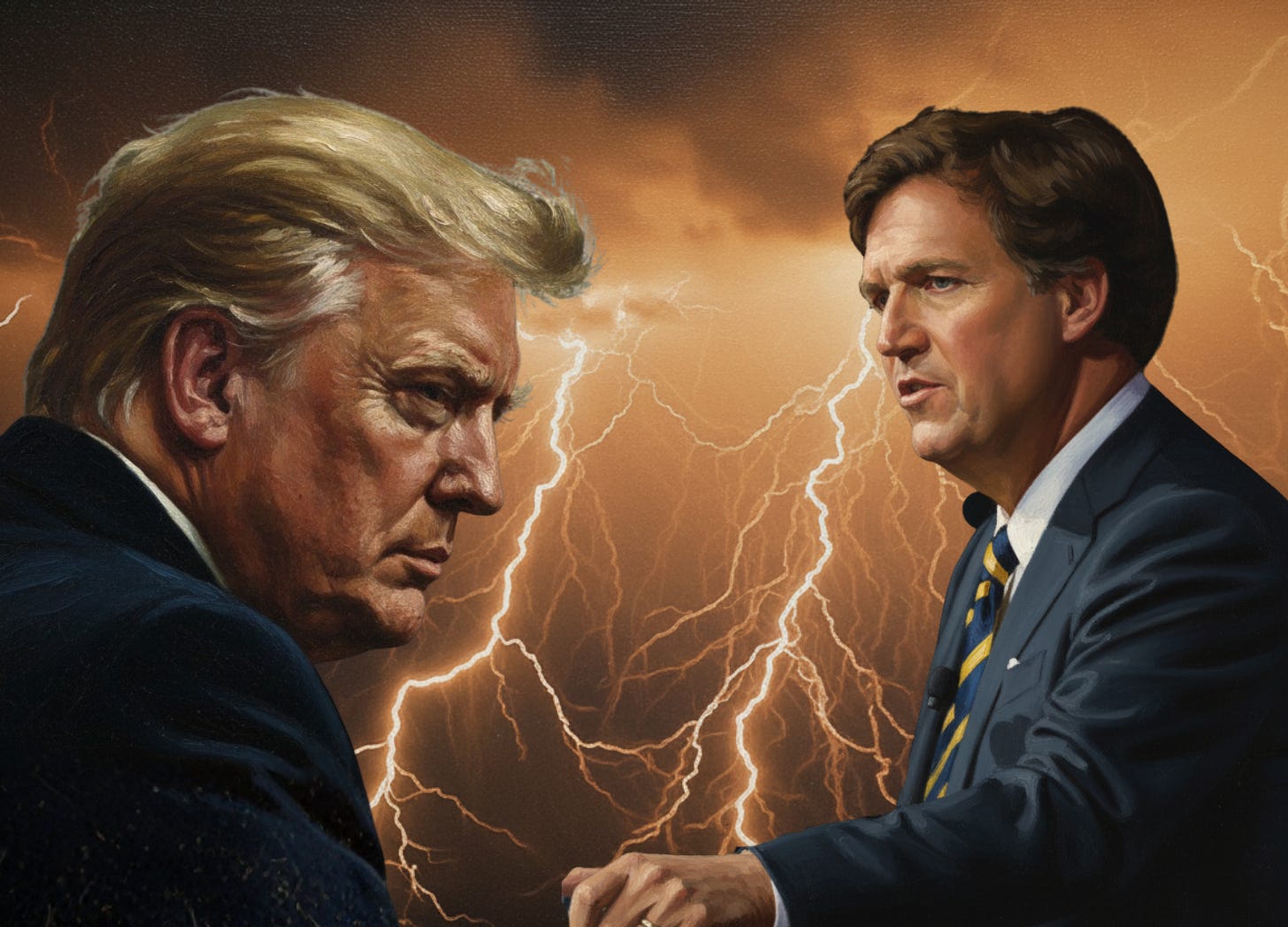
The idea of President Tucker Carlson sounds absurd. Additionally, it has that slightly nauseating, almost surreal quality to it.
And yet, it’s a question that keeps coming up. Sometimes jokingly, sometimes half-seriously, but increasingly, seriously enough that it’s worth actually examining.
Because once you move past the initial reaction, the real question is no longer whether it sounds weird. The question is whether it fits the direction American politics is already heading.
The media-to-politics pipeline is already here
If this were 20 or 30 years ago, the idea of a media personality jumping straight into a presidential run would have been fringe.
It isn’t anymore.
We’ve already lived through a reality television figure becoming president. We’ve watched podcasters, influencers, and online personalities accumulate real political power without ever holding office. Entire ecosystems of political creators now shape narratives, mobilize voters, and even help determine which candidates break through.
So when people bring up Tucker Carlson, they’re not really asking whether it would be strange. They’re asking whether it’s the logical next step in a pattern that is already well underway.
The feud that changes the calculation
What’s different now is that Carlson is no longer just operating inside the Trump-aligned ecosystem. He’s actively breaking with it.
After Donald Trump escalated rhetoric around Iran, Carlson publicly pushed back, warning about the consequences and even suggesting that officials should resist dangerous orders. In that context, calls to invoke the 25th Amendment started circulating more broadly, including from voices that used to be aligned with Trump.
Carlson himself went further, amplifying concerns about Trump’s behavior and rhetoric, which placed him directly at odds with the very movement he helped legitimize.
Trump’s response was immediate and predictably unrestrained. He lashed out at Carlson, dismissing him as a “low IQ person” and attacking his credibility.
That exchange matters.
Because once you move from being a media ally to a public critic, you are no longer just shaping the movement. You are positioning yourself as an alternative to it.
Carlson says he doesn’t want it. That still doesn’t settle it.
Carlson has repeatedly said he doesn’t want to run for president. He claims he’s not qualified, not interested, not built for it.
On its face, that sounds definitive.
But politically, statements like that often don’t mean very much.
We’ve seen this pattern before. People say they’re not running right up until the moment they are. Sometimes it’s genuine, other times it’s strategic.
So when Carlson says he’s not interested, it may lower the temperature in the short term, but it doesn’t close the door.
The infrastructure is already there
The more important point is that Carlson has already built something that looks a lot like a political base.
He has a massive audience. A loyal audience. People who don’t just watch him, but trust him. People who believe he understands what is “really going on.”
That relationship is not all that different from what modern campaigns are built on.
Donald Trump’s political success wasn’t driven by policy expertise. It was driven by emotional alignment, identity, and message discipline. Carlson operates in that same space. He communicates in a way that reinforces worldview and grievance.
That’s not traditional politics, but increasingly, it is politics.
Why he might still stay out
There are also very real reasons why someone in Carlson’s position might choose not to run.
Running for office means scrutiny: financial disclosures, personal exposure, and endless opposition research.
It also means giving up something valuable: flexibility.
Right now, Carlson has soft power. Politicians go to him. They want his audience. He influences the conversation without being constrained by governing.
Running for office means trading that for something far more rigid. Schedules, accountability, compromise, and decisions that can be directly challenged.
For many media figures, that trade simply isn’t worth it.
The line has collapsed
There was a time when American politics had a clearer boundary. Certain profiles didn’t translate into viable candidates.
That boundary is gone.
The skills that make someone successful in modern media, capturing attention, shaping narratives, creating emotional resonance, now translate directly into political viability.
Carlson has those skills. There’s no serious argument that he doesn’t.
And now, with a very public break from Trump, he also has something else: separation. A lane.
Where this is headed
So could Tucker Carlson run for president?
Yes, it’s plausible.
Could he win a Republican primary? That depends on who else runs and how fractured the field becomes.
But the more important takeaway is this: the question itself is no longer ridiculous.
We are in a political environment where influence, audience, and narrative control can matter as much as traditional credentials.
And Carlson is already operating at that level.
The recent feud with Trump doesn’t make a Carlson candidacy inevitable. But it does make it easier to imagine.
Because once you start publicly positioning yourself against the central figure of a political movement, you’re no longer just a commentator on that movement.
You’re a potential successor. Or a rival.
And in this political era, those two things are often separated by less than people think.
So the real question isn’t whether he could do it.
It’s whether he decides to.
What do you think? Could he run? Would he? And if he did, how far could he actually go?
We’re reaching over 150 million people every month across YouTube, podcasts, Substack, and beyond. But algorithms can change. Platforms can fold. And when that happens, this newsletter is how we stay connected.
If you’re not yet a paid subscriber, please consider joining.
If you’re already paid on one platform, consider supporting us on both Substack and our website.
You can subscribe on our website and right here on Substack.
And if you’re really on fire, consider gifting a subscription—we’ve got thousands on our waiting list ready to read, watch, and fight back.
Let’s keep building.
—David
PS: Can’t contribute right now? No problem. You can support us for free by subscribing on YouTube, listening to our audio podcast on Spotify or Apple Podcasts, or become a free subscriber to this very Substack. Every bit counts.
Tucker wants to run. I feel like watching James Talarico call things out using his faith gave Tucker the impetus to go with his. But he’s got SO much old Fox News footage showing him to be a LIAR.
That's revolting, to think that another clown at the helm, to finish destroying America...