

Most Americans have had the Ticketmaster experience.
You log on the moment tickets go on sale. You enter a virtual queue. You watch your place in line crawl forward. By the time you finally get through, the seats are gone, or the only options left are dramatically more expensive resale tickets. Then you discover that the same ticket may have changed hands multiple times, collecting fees at every step along the way.
It is one of the most universally disliked consumer experiences in the country.
But the story is much bigger than Ticketmaster.
This story is about what happens when laws exist on paper but enforcement becomes optional.
Before we dive in, if you prefer to watch or listen to political news commentary, I’ve got this entire story and more over on my YouTube. Below is the video I did on this very topic:
Okay, on with the written commentary.
Ticketmaster was never supposed to become this powerful
When Ticketmaster merged with Live Nation in 2010, it was controversial from the start. The merger only moved forward after Ticketmaster agreed to certain concessions intended to address monopoly concerns. The expectation was that safeguards would prevent the company from gaining overwhelming control over the live entertainment industry.
That is not what happened.
Today, Ticketmaster and Live Nation sit at the center of an enormous ecosystem. They influence ticket sales, concert promotion, venue relationships, artist access, and much of the infrastructure surrounding live events. The company controls more than 80% of live event ticket sales in the United States.
For consumers, the consequences are familiar. Long waits. Limited choices. High fees. Secondary markets that often seem to benefit the same companies that dominate the primary market.
The frustration is not theoretical. Millions of people experience it firsthand.
The government finally acted. Then almost settled.
After years of complaints, the Department of Justice filed an antitrust lawsuit against Ticketmaster in 2024. For many observers, it felt overdue.
The government had spent years building a case that the company was operating as an illegal monopoly. At long last, there appeared to be a serious effort to hold one of the country’s most powerful corporations accountable.
Then something strange happened.
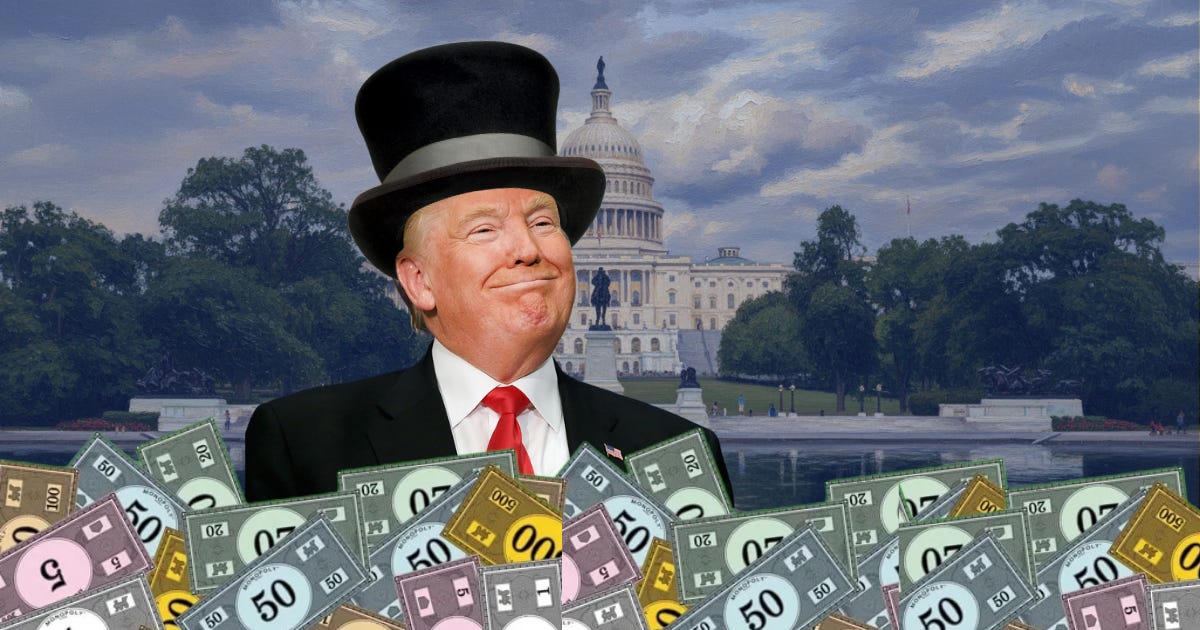
In 2026, Trump’s DOJ reportedly offered a sweetheart settlement that would have allowed Ticketmaster to continue operating largely as it had before. The deal was rejected by 33 states, which chose instead to continue pursuing the lawsuit. Shortly afterward, a court ruled that Ticketmaster was, in fact, a monopoly.
The central allegation that critics had raised for years was validated.
Now the question is not whether a monopoly exists. The question is whether meaningful consequences will follow.
What is the point of a law that never gets enforced?
Imagine a driver who gets caught speeding every week for thirty years.
Eventually, penalties escalate. Fines increase. Licenses get suspended. Repeat violations lead to more serious consequences. That is how accountability is supposed to work.
Yet when it comes to monopolies, the pattern often feels reversed. Corporations grow larger, accumulate more market power, face investigations, negotiate settlements, and continue operating with relatively few changes.
The result is a growing disconnect between what the law says and what people see happening in reality.
In theory, the United States has antitrust laws designed to prevent excessive concentrations of corporate power. In practice, enforcement often appears inconsistent, delayed, or absent altogether.
Ticketmaster is only one example
What makes this story significant is that it extends far beyond concert tickets.
Google was ruled a monopoly in internet search and continues to fight that determination. Amazon faces ongoing questions about its dominance across retail, logistics, advertising, and cloud computing. Apple’s control of its App Store has generated years of scrutiny. Visa and Mastercard collectively dominate payment processing to a degree that many critics argue creates enormous barriers to competition.
Reasonable people can debate the specifics of each case. What is harder to debate is the broader trend: enormous concentrations of market power continue to emerge across industry after industry. And despite having laws intended to address those situations, enforcement often struggles to keep pace.
The problem hiding in plain sight
One reason this receives less attention than it deserves is that monopoly power can be difficult to see directly.
Modern antitrust enforcement frequently relies on what is known as the “consumer welfare standard.” Regulators often focus on proving that consolidation has directly increased prices or harmed consumers in measurable ways. That sounds reasonable in theory.
In practice, it creates a very high bar.
Most people intuitively understand that markets with multiple competitors generally produce better outcomes than markets dominated by a single company. If consumers have four internet providers competing for their business, prices are likely to be lower than if only one provider exists. Yet for many Americans, particularly when it comes to broadband service, consumers already know what it feels like to have only one or two realistic options.
The challenge is not recognizing the problem; it is proving it in court.
As a result, monopoly power can continue growing even when many consumers feel its effects every day.
Why this matters even if you love capitalism
This is where the conversation becomes larger than economics. Markets function because people believe the rules are real.
Competition only works if participants believe no company is too powerful to challenge and no corporation is above the law. When companies appear able to violate antitrust principles for decades, negotiate favorable outcomes, and continue operating without major consequences, public confidence begins to erode.
Even people who strongly support capitalism should be concerned about that.
Because once enough people conclude that markets are not genuinely competitive, they stop blaming individual companies and start questioning the legitimacy of the system itself. That is how faith in markets begins to weaken.
The bigger risk
There is an old phrase about banks being “too big to fail.”
Increasingly, some corporations appear to be approaching a different status: too big to meaningfully regulate.
The larger they become, the more resources they have to defend themselves. The more influence they accumulate, the harder they are to challenge. The harder they are to challenge, the larger they become.
It becomes a self-reinforcing cycle.
That is why the Ticketmaster story matters.
It is not really about concert tickets.
It is about whether laws that limit corporate power are actual rules or merely suggestions. It is about whether enforcement still matters. And it is about whether Americans can reasonably expect the same standards to apply to powerful corporations as everyone else.
So I’m curious what you think: if a company can be accused of monopoly behavior for years, eventually be ruled a monopoly, and still largely continue business as usual, what does that say about the state of enforcement in America today? And at what point do people stop believing the rules apply equally to everyone?
We’re reaching over 150 million people every month across YouTube, podcasts, Substack, and beyond. But algorithms can change. Platforms can fold. And when that happens, this newsletter is how we stay connected.
If you’re not yet a paid subscriber, please consider joining.
If you’re already paid on one platform, consider supporting us on both Substack and our website.
You can subscribe on our website and right here on Substack.
And if you’re really on fire, consider gifting a subscription—we’ve got thousands on our waiting list ready to read, watch, and fight back.
Let’s keep building.
—David
PS: Can’t contribute right now? No problem. You can support us for free by subscribing on YouTube, listening to our audio podcast on Spotify or Apple Podcasts, or become a free subscriber to this very Substack. Every bit counts.
Project 25! And no one paid attention, when they were told! and now they are paying the price for their ignorance and stupidity!
If we can’t enforce antitrust laws, where are we as a nation without laws? Where are the Congressional representatives who promised to protect us? If they can’t bother to uphold their oath or promise to protect us, we are truly a broken system.