

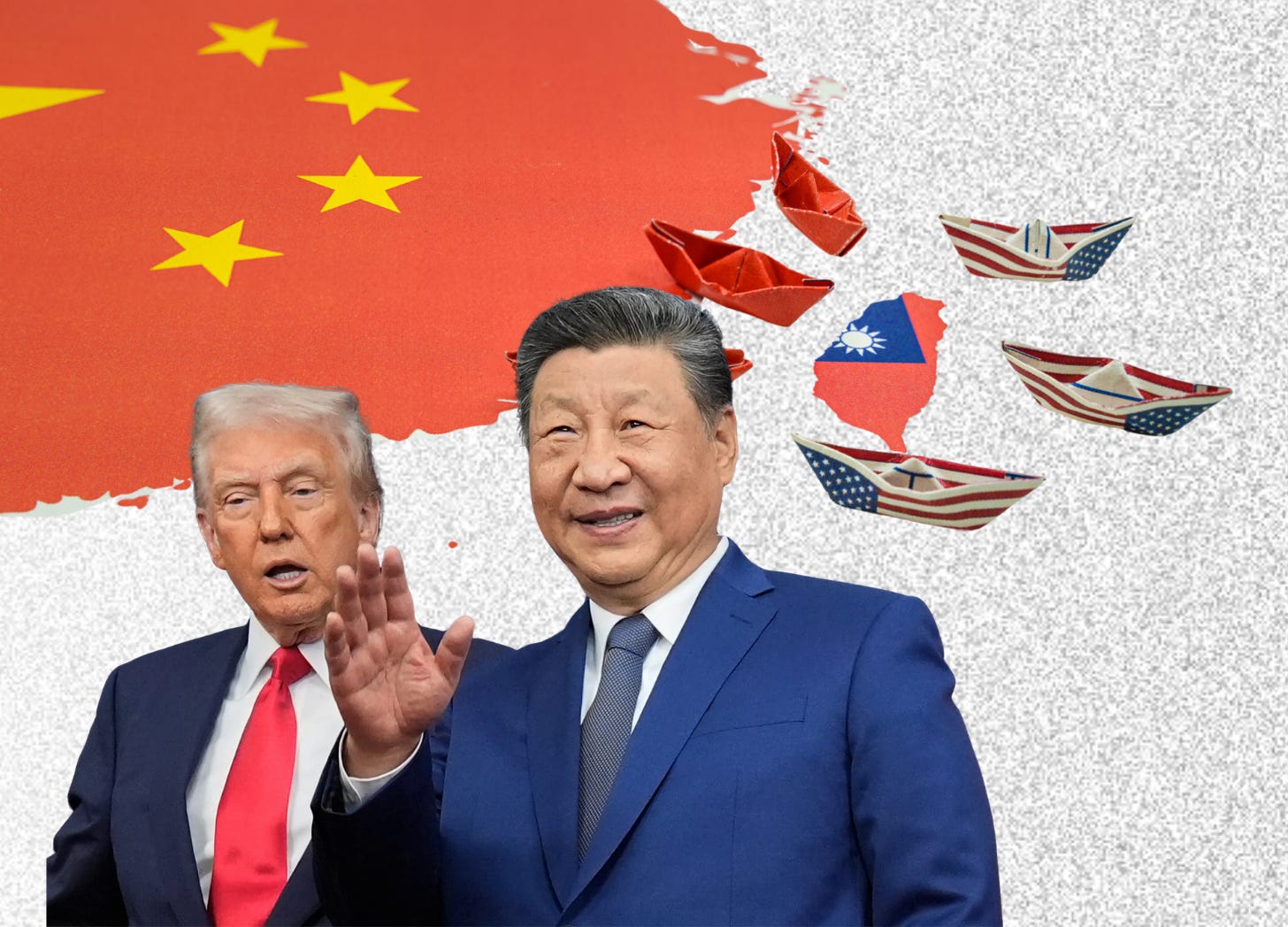
Donald Trump may have just received one of the most serious foreign policy warnings of his presidency, and I’m not sure he even realizes it.
On the surface, these diplomatic exchanges can look cordial, even friendly. There are smiles, ceremonial welcomes, public compliments, carefully scripted statements, and the usual imagery designed to project stability.
But diplomatic language is often about what is implied, not what is explicitly said.
And when it comes to China and Taiwan, the implications matter enormously.
Because while Trump appears to interpret these interactions as evidence of personal rapport, what may actually be happening is something much more dangerous: China drawing a clear red line while Trump mistakes the warning for friendship.
Taiwan is not just another policy disagreement
President Xi’s message, as framed in the diplomatic language of the meeting, was not subtle if you understand how these exchanges work. The warning was essentially this: if the United States interferes in a Taiwan conflict, China is prepared to escalate, potentially all the way to direct military confrontation.
That is what makes this so serious. Trump appears to interpret ceremonial diplomacy, smiles, and public cordiality as evidence that he has some kind of personal rapport with Xi. But diplomatic friendliness does not cancel strategic warnings. If anything, that is often exactly how those warnings are delivered. The red carpet and the photo ops are the presentation. The message underneath can be much darker.
From an American perspective, it can be tempting to interpret Taiwan as simply another foreign policy dispute. A tense issue, certainly, but one that belongs in the familiar category of international disagreements that get managed through negotiations, strategic pressure, and diplomacy.
That is not how China sees it.
For Beijing, Taiwan is not merely a geopolitical disagreement. It is bound up in questions of sovereignty, national identity, historical grievance, and regime legitimacy.
China views Taiwan as unfinished business from the Chinese Civil War. Reunification is not seen as optional. It is treated as an eventual necessity. And that is an important note because when one side sees an issue as negotiable and the other sees it as existential, the margin for catastrophic misunderstanding gets very small.
China has spent years preparing for exactly that possibility.
They have invested in military modernization, naval expansion, missile systems, cyberwarfare capabilities, and airpower development. Much of that planning has centered on the possibility of a Taiwan confrontation.
This is not theoretical posturing. This is strategic preparation.
The dangerous role of ambiguity
For decades, the United States has operated under what is often called strategic ambiguity.
The broad idea is straightforward: support Taiwan, provide defensive assistance, but avoid making totally explicit commitments about military intervention if conflict breaks out. The ambiguity is intentional. Its purpose is deterrence through uncertainty. China cannot assume the United States will stay out, while Taiwan cannot assume unconditional military backing.
It is an imperfect framework, but one that has helped preserve a fragile balance.
The danger comes when unpredictability stops being strategic and starts being reckless. That is where Trump becomes a serious concern. Trump does not approach foreign policy with consistency, doctrine, or even particularly coherent strategic principles. He often approaches it the way he approaches branding: transactional, improvised, personality-driven.
One day tariffs. Another day praise. One moment questioning whether an ally is worth defending. The next approving arms sales.
That is volatility, not strategic ambiguity.
Trump thinks these are friendships. They do not.
One of the enduring defenses of Trump’s authoritarian fascination has been the argument that his friendliness toward strongmen somehow lowers the risk of war.
The theory goes something like this: if Trump has a personal relationship with Vladimir Putin, Kim Jong Un, Recep Tayyip Erdoğan, or Xi Jinping, perhaps tensions can be managed informally. But that argument only works if both sides view the relationship the same way. There is little reason to think they do.
Trump often appears genuinely impressed by authoritarian leaders. Not just diplomatically engaged, but personally admiring. Leaders who rule without opposition, without democratic constraints, without the kinds of accountability that democratic governance requires. The admiration is obvious. But authoritarian leaders do not need admiration from Trump.
They expect flattery. They know how to use it. They are not participating in some mutual friendship project. They are pursuing state interests.
That is the actual danger here.
Trump may believe personal chemistry creates stability. The other side may simply see someone who is easy to manipulate.
A war over Taiwan would look nothing like America’s recent wars
If conflict over Taiwan ever became reality, this would not resemble Iraq. It would not resemble Afghanistan. It would not be another distant military intervention that can be compartmentalized from daily economic life.
Taiwan sits at the center of the global semiconductor supply chain. A massive share of the world’s advanced chip production runs through Taiwan. A conflict could freeze supply chains almost overnight.
Shipping lanes across Asia could become militarized.
Cyberattacks would be likely.
Regional escalation could draw in Japan.
American military involvement would immediately become a real possibility.
This would not be a contained geopolitical episode. It would be a global economic and military shock. Which makes the possibility of miscalculation especially alarming. And with Trump, “miscalculation” may actually be too charitable a word. Miscalculation implies a flawed strategic assessment. What we may be dealing with instead is a fundamental lack of understanding about the stakes.
The real question
Trump’s temperament has always raised legitimate concerns in moments requiring patience, discipline, consistency, and strategic restraint. Taiwan is exactly that kind of moment.
This is not a reality television negotiation where improvisation and personal instinct can substitute for policy knowledge. This is one of the most dangerous geopolitical flashpoints in the world. And if China has in fact sent a serious warning, the question is not simply whether Trump agrees with it.
The question is whether he even understands what was being communicated.
So what do you think, does Trump actually grasp the risk here, or are we watching someone smile through a warning he doesn’t even recognize?
We’re reaching over 150 million people every month across YouTube, podcasts, Substack, and beyond. But algorithms can change. Platforms can fold. And when that happens, this newsletter is how we stay connected.
If you’re not yet a paid subscriber, please consider joining.
If you’re already paid on one platform, consider supporting us on both Substack and our website.
You can subscribe on our website and right here on Substack.
And if you’re really on fire, consider gifting a subscription—we’ve got thousands on our waiting list ready to read, watch, and fight back.
Let’s keep building.
—David
PS: Can’t contribute right now? No problem. You can support us for free by subscribing on YouTube, listening to our audio podcast on Spotify or Apple Podcasts, or become a free subscriber to this very Substack. Every bit counts.
What's alarming about this is that Trump only cares about his own money and businesses and we are not sure whether the Chinese government did agree with him to make him richer in exchange for abandoning Taiwan. This scenario is very plausible.
Demented Don is weak, gullible, stupid, and delusional and has transformed our military and government into a sh*t show of a**clowns. China knows this is the perfect time to attack Taiwan, and it needs to be before the pedopresident is gone.