

We often describe moments like this as political crises. A constitutional crisis. A democratic crisis. A governance crisis.
But I’m not sure that is actually the most accurate description of where the United States is right now.
What we may be dealing with instead is something deeper: a trust crisis.
And if that diagnosis is correct, what comes next may be politically and economically uglier than many people are prepared for.
Part of the challenge is that this conversation makes some people uncomfortable, because it requires acknowledging two things at the same time. First, institutions are necessary. A country the size and complexity of the United States cannot function without them. Second, many of those same institutions have failed in visible and damaging ways over the last several decades.
Those two things are not contradictory.
Being a defender of institutions does not require pretending they have performed well.
The Iraq War was sold on false pretenses. The 2008 financial collapse was caused in significant part by the very systems that were supposed to prevent that kind of catastrophe. The opioid crisis was made dramatically worse by pharmaceutical companies, failures in the medical system, and weak regulatory oversight. The Trump administration’s handling of Covid during the first term was disastrous. Legacy media has repeatedly failed the public in meaningful ways. Government itself has often failed the people it was supposed to serve.
That does not mean every anti-establishment narrative is correct. It does not validate every conspiracy theory or every cynical right-wing talking point about institutional collapse. But it does help explain why so many Americans no longer trust that the people in charge know what they are doing, or even believe those institutions are operating in the public interest.
And once that kind of trust erodes, something rushes in to fill the vacuum.
Why conspiracy culture thrives
One of the easiest mistakes to make is assuming conspiracy culture is simply about ignorance or stupidity. Certainly, some of it is detached from reality in obvious ways. But I think there is something psychologically more complicated happening.
When enough systems fail, some people begin to prefer a sinister explanation over a chaotic one.
If everything is part of some hidden plan, then at least someone is in control. If events are staged, manipulated, or orchestrated by shadowy actors, then randomness becomes easier to emotionally process.
The alternative is accepting that institutions can fail, leaders can be incompetent, and genuinely bad things can happen without anyone being fully in control. That uncertainty is deeply uncomfortable. And so conspiracy culture becomes emotionally appealing.
The problem is that once this becomes the dominant framework, institutions lose the ability to recover credibility, even when they do something correctly. Evidence stops mattering. Corrections lose their impact. Accuracy becomes secondary to emotional engagement.
Digital platforms have made this exponentially worse.
The conspiracy ecosystem is now self-financing, algorithmically amplified, and largely immune to correction. It does not need to be accurate. It only needs to be compelling enough to keep people clicking, sharing, donating, and staying emotionally activated.
That ecosystem has become one of the forces fueling Trumpism.
The collapse of shared reality
A democracy does not require universal agreement.
It does require some shared understanding of reality.
And that may be one of the most troubling parts of where we are now.
A huge number of people have effectively checked out of news consumption altogether, not necessarily because they do not care, but because they no longer trust what they are seeing or do not understand how it connects to their lives. At the same time, people increasingly distrust anyone who gets their information from different sources than they do.
That means disagreement is no longer just about interpretation. It becomes disagreement about reality itself. When that happens, democratic persuasion becomes much harder.
Because persuasion assumes some shared set of facts. If those facts no longer exist, politics becomes much more about tribal loyalty and identity than about reasoned argument.
That is not a healthy place for a democracy to operate.
The economic consequences of distrust
Distrust does not remain neatly confined to politics. It has economic consequences too.
Confidence is not some abstract emotional metric. It is part of the infrastructure of a functioning economy. If people stop trusting financial institutions, markets become more fragile. If consumers distrust the system, behavior changes. Investment decisions shift. Borrowing patterns change. Participation in the broader economy becomes less predictable.
Researchers have described this dynamic as a kind of credibility recession. And you can see how it plays out in real time.
Take Donald Trump’s attacks on the Federal Reserve. There is obviously a political dimension to that story. But there is also an economic one.
Part of what gives the United States enormous economic leverage is trust in the relative independence of key financial institutions. Markets trust certain structures to operate above day-to-day political chaos. If that credibility erodes, the consequences are not theoretical.
Supply chains destabilize. Inflation risks grow. Investment becomes less predictable. Economic uncertainty deepens.
Trust is economic infrastructure, whether we describe it that way or not.
The right’s strategy and the left’s vacuum
The political right has recognized something useful about all of this.
Distrust can be monetized. Conspiracy can be monetized. Institutional collapse narratives can be turned into turnout tools and fundraising tools.
That machine has been remarkably effective, but it also creates its own long-term problem.
If you condition your political base to distrust everything, eventually they distrust governance itself. Compromise becomes betrayal. Expertise becomes suspect. Governing becomes dramatically harder because your own voters have been radicalized beyond the point of institutional legitimacy.
But it would be far too easy to tell this as a story where one side is broken and the other is prepared to step in with a compelling alternative.
The left has its own serious problems.
Part of the left wants an aggressive ideological transformation that many voters are simply not going to embrace. Another part offers a version of politics so cautious, incremental, and uninspiring that it is difficult to imagine it meaningfully addressing the scale of the problems facing the country.
And if I’m being honest, neither faction currently feels especially convincing.
I do not believe socialism is the answer.
I also do not believe tiny, carefully managed adjustments from establishment Democrats are enough. Which creates a different kind of vacuum.
Not necessarily a trust vacuum, but a leadership vacuum. A vision vacuum.
What happens next
That is why I think people may be underestimating how unstable the next phase of American politics could become.
As conversations shift toward what happens after Trump, what becomes of the Republican Party, what the midterms look like, or whether figures like Gavin Newsom or Alexandria Ocasio-Cortez become central to 2028, there is a deeper structural issue underneath all of it.
Political systems do not recover neatly when trust has been eroding for years.
The uncomfortable possibility is that things get uglier before they get better. Politically. Economically. Institutionally.
So what do you think: are we actually living through a political crisis, or is the deeper problem that too many Americans no longer trust enough of the system for normal politics to function at all?
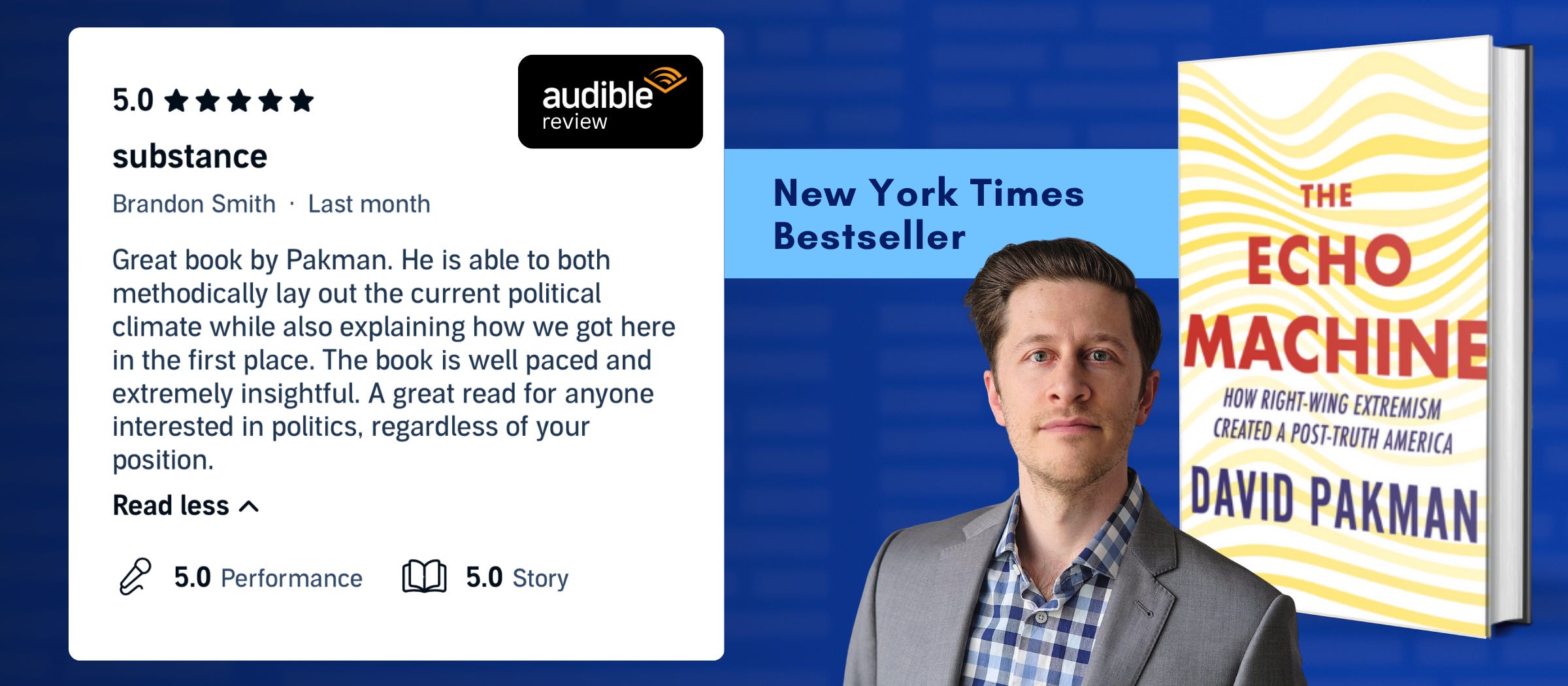
If topics like this are interesting to you, check out my book, The Echo Machine: How Right-Wing Extremism Created a Post-Truth America. In it, I examine how coordinated disinformation, media manipulation, and echo chambers have eroded shared facts and intellectual standards in modern US politics.
Get your copy at davidpakman.com/book
We’re reaching over 150 million people every month across YouTube, podcasts, Substack, and beyond. But algorithms can change. Platforms can fold. And when that happens, this newsletter is how we stay connected.
If you’re not yet a paid subscriber, please consider joining.
If you’re already paid on one platform, consider supporting us on both Substack and our website.
You can subscribe on our website and right here on Substack.
And if you’re really on fire, consider gifting a subscription—we’ve got thousands on our waiting list ready to read, watch, and fight back.
Let’s keep building.
—David
PS: Can’t contribute right now? No problem. You can support us for free by subscribing on YouTube, listening to our audio podcast on Spotify or Apple Podcasts, or become a free subscriber to this very Substack. Every bit counts.
I seem to be in the minority. I still have trust in the Democratic party and I have confidence that we can build a more equitable society.
We the people need to know who we vote for not party, sex, or monetary but for truth,Integrity, compassion and not old hateful greedy grifters.