

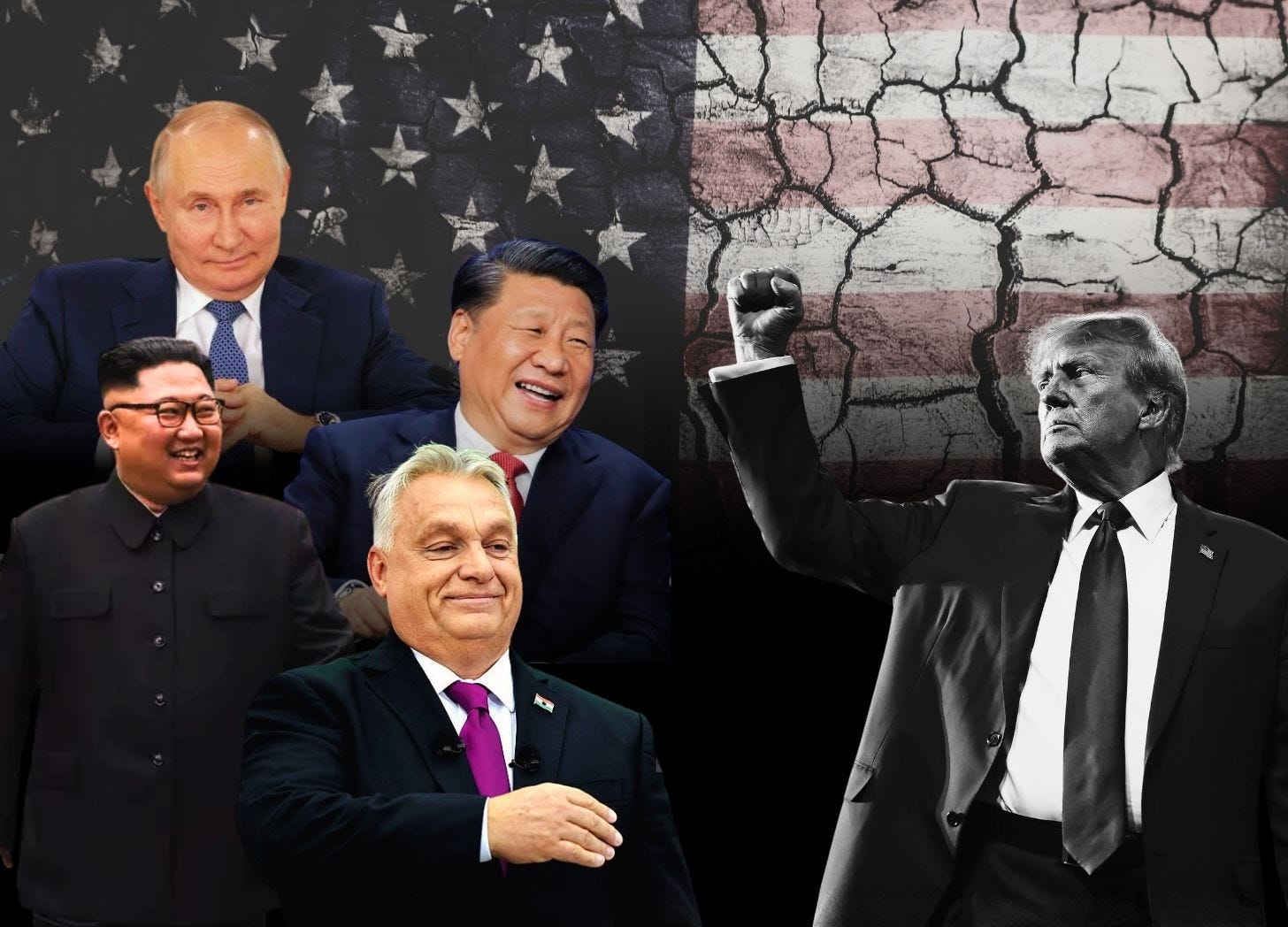
The United States has long operated with a certain assumption about itself. We are the global superpower. The dominant force. The country that projects strength, sets the agenda, and ultimately gets its way.
That assumption has been deeply embedded in American political culture for decades.
But it is worth asking whether that image still matches reality.
Because increasingly, the gap between how the United States sees itself and how much influence it actually commands seems to be be growing.
Strength as spectacle
Trump’s recent overseas posturing fits a familiar pattern. The message is always the same: America is feared, America has leverage, America is back in control.
The optics are carefully constructed. Ceremonies. Military imagery. Dramatic rhetoric. Threats. Motorcades. The theatrical choreography of strength.
But what are the actual outcomes?
Trump’s engagement with China produced no meaningful breakthrough for the United States. No major concessions. No strategic victory. No visible leverage gained. Instead, what emerged was the image of a president clearly susceptible to flattery from authoritarian leaders who understand exactly how to manipulate spectacle without offering anything tangible in return.
And that raises a broader question.
If the symbolism keeps increasing while the results keep shrinking, what exactly are we looking at?
The difference between image and power
Real power produces outcomes. It shapes negotiations, builds coalitions, creates stability, and it improves material conditions at home.
Performance power is different. Performance power relies on declarations.
“We are respected again.”
“Everyone fears us.”
But declarations are not outcomes. China did not suddenly bend to American pressure. Trump’s trade wars did not meaningfully rebuild American manufacturing. Iran did not quickly fold under pressure despite repeated expectations that escalation would force resolution.
And meanwhile, everyday Americans are not exactly living inside the promised golden age. Prices remain painful. Housing remains brutal. Debt pressure continues to rise. Consumers are increasingly squeezed from every direction.
It’s a glaring disconnect that matters.
Because if the rhetoric says “strength” while the lived experience says “fragility,” eventually people notice.
What declining powers often do
History offers an uncomfortable pattern. Empires at their most stable do not usually need constant theatrical reassurance. They do not endlessly insist on their dominance because dominance tends to be self-evident. The performance often becomes more aggressive when confidence starts slipping.
Nationalist imagery intensifies. Military symbolism becomes more central. Leaders become more emotional, more reactive, more obsessed with loyalty displays and public spectacle. Not because power is growing, but because anxiety about power is growing.
That does not automatically mean the United States is in terminal decline. History is rarely that neat. But it does suggest that spectacle can sometimes function less as proof of strength and more as compensation for insecurity.
The contrast with long-term strategy
None of this requires admiration for authoritarian governments.
Quite the opposite.
But objective analysis means acknowledging strategic differences. China’s leadership, whatever else one thinks of it, tends to project patience, long-term planning, and message discipline.
The United States under Trump projects volatility. Impulsiveness. Emotional decision-making. Policy by outburst.
And in global politics, stability itself can become a strategic asset. That represents a meaningful shift in perception.
Because American influence has historically depended not just on military power, but on institutional credibility, economic reliability, and the belief that U.S. leadership was relatively predictable.
That belief has taken serious damage.
Polling has consistently shown America’s international standing suffering under Trump compared to prior administrations. And whether Trump acknowledges that or not does not materially change it.
The harder question
The real danger may not be decline itself. The real danger may be believing decline is impossible.
Countries that remain convinced they are at peak power can make increasingly irrational choices because the self-image no longer matches reality.
Decision-making becomes emotional rather than strategic. Displays of strength replace substance. Leadership focuses more on loyalty theater than practical outcomes.
That is when mistakes compound.
The United States still possesses extraordinary military capability, enormous economic influence, and global reach that few nations can match. But superpower status is not just about having aircraft carriers and nuclear weapons. It is also about competence, credibility, institutional trust, infrastructure, economic resilience, and strategic patience.
And increasingly, those are exactly the areas where the warning signs are flashing.
So what do you think: are we watching a temporary period of dysfunction, or is America starting to confuse looking powerful with actually being powerful?
We’re reaching over 150 million people every month across YouTube, podcasts, Substack, and beyond. But algorithms can change. Platforms can fold. And when that happens, this newsletter is how we stay connected.
If you’re not yet a paid subscriber, please consider joining.
If you’re already paid on one platform, consider supporting us on both Substack and our website.
You can subscribe on our website and right here on Substack.
And if you’re really on fire, consider gifting a subscription—we’ve got thousands on our waiting list ready to read, watch, and fight back.
Let’s keep building.
—David
PS: Can’t contribute right now? No problem. You can support us for free by subscribing on YouTube, listening to our audio podcast on Spotify or Apple Podcasts, or become a free subscriber to this very Substack. Every bit counts.
So true; it didn't take him long to destroy our global standing.
Super power? Apart from bullying and subversion, when did they win without ally support. Now it's reality time!!