

A court has just dealt another major blow to Donald Trump’s blanket tariff plan, ruling them illegal.
Now, you might be saying: I thought the Supreme Court already decided that. I thought the tariffs were already ruled illegal.
Yes. But then the Trump administration went back and tried again with a different legal justification.
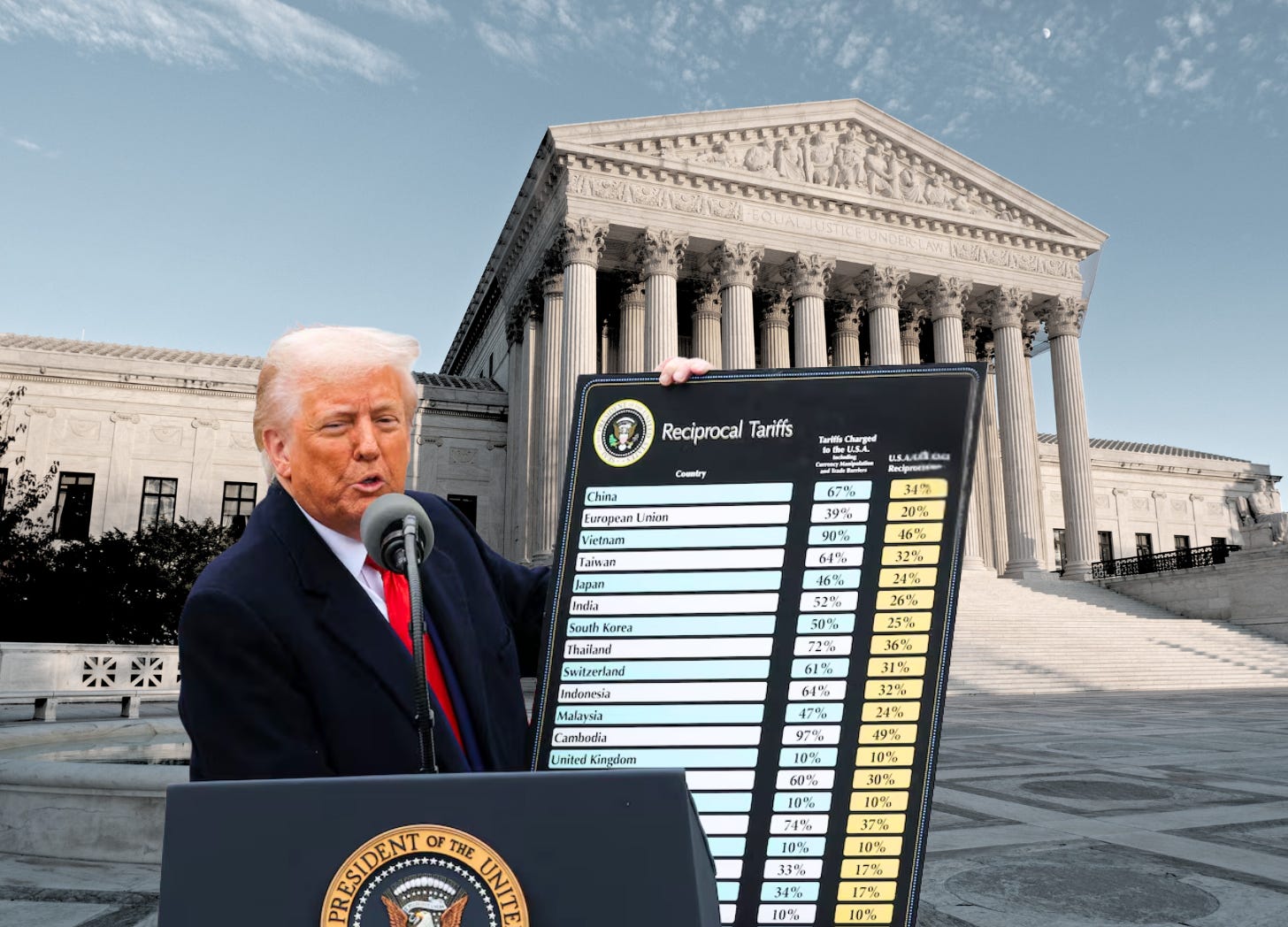
Earlier this year, the Supreme Court struck down Trump’s original tariff scheme. The administration’s response was not to go back to Congress or rethink the policy. Instead, it was to try again using a different legal justification.
That new justification leaned on an obscure provision from 1970s trade law. The idea was essentially to say, yes, we can still impose broad, across-the-board tariffs, just under a different authority.
A federal trade court has now said, no, you cannot do it that way either.
The key detail here is not just the tariffs themselves, but how the administration tried to implement them.
They didn’t go through Congress. And there’s a reason for that.
If this had gone through the legislative process, there is a very real possibility that even some Republicans would have blocked it. Blanket tariffs on everything are widely understood to have serious economic downsides.
So instead, the approach was to search through existing law and find a way to impose them unilaterally.
Courts confirming what was already obvious
Now, separate from the legal issue, there’s the economic reality.
These sweeping tariffs are a bad idea.
We didn’t need courts to tell us that. It’s been clear from the start that broad import taxes raise prices and create economic problems.
What the courts are doing is addressing something different. They’re saying the policy is not just bad, it’s illegal in the way it’s being implemented.
And as expected, Trump reacted the way he typically does when courts rule against him: attack the judges.
If a judge agrees with him, that’s great. If a judge rules against him, suddenly they’re a “radical left” judge.
That was the framing here as well.
And he made clear that the plan is not to stop, but to keep trying different approaches until something sticks.
Who actually pays tariffs?
There’s a basic misunderstanding, or misrepresentation, at the center of all of this.
Trump continues to claim that tariffs are money taken from other countries.
That is not how tariffs work.
American companies import goods. They pay the foreign supplier for the goods themselves. Then when the goods arrive in the United States, the American company (i.e., the importer) pays the tariff to U.S. authorities.
So when we talk about “hundreds of billions” in tariff revenue, that money is coming from American businesses, not from China or anyone else.
That leads to the broader point.
These tariffs function like a tax.
And not just any tax. They are a regressive tax, meaning they disproportionately impact lower-income Americans and smaller businesses that have less ability to absorb the added cost.
At the same time, Trump has spent years criticizing inflation and promising to bring prices down.
But putting an import tax on a wide range of goods does the opposite. It pushes prices higher.
This is not complicated economics.
The constitutional issue
Beyond the economics, there’s something more fundamental happening here.
After being told by the Supreme Court that he could not implement tariffs one way, and now being told by a trade court that he cannot do it another way, the response is to keep looking for a different route.
That reflects a mindset in which laws and courts are treated as obstacles to work around, rather than limits on executive power.
And that is not how the system is supposed to function.
There’s also a refund problem
There’s another consequence that could create problems for the administration.
If tariffs were collected under a policy that has now been ruled illegal, those funds may need to be refunded. And those refunds would go to American companies, not foreign governments, because American companies are the ones who paid the tariffs in the first place.
And Trump has already said it’s a great thing that some companies aren’t asking for the refunds, the latest signal that you’ve got to remain loyal.
He’s essentially telling companies: you paid tariffs that were illegally collected. You have the opportunity to get that money back, but you should choose not to, out of patriotism for Donald Trump.
But if you request the money back, you might just end up with a proverbial bag of coal at the end of the rainbow.
That’s a remarkable position when you consider what’s actually being discussed.
The bottom line
At this point, the pattern is clear.
Try a policy. Get blocked by the courts. Try again using a different justification. Get blocked again.
This isn’t just about tariffs anymore.
It’s about whether executive power is constrained by law, or whether it’s something to be tested over and over until a workaround or loophole is found.
And for now, at least, the courts are still enforcing those limits.
We’re reaching over 150 million people every month across YouTube, podcasts, Substack, and beyond. But algorithms can change. Platforms can fold. And when that happens, this newsletter is how we stay connected.
If you’re not yet a paid subscriber, please consider joining.
If you’re already paid on one platform, consider supporting us on both Substack and our website.
You can subscribe on our website and right here on Substack.
And if you’re really on fire, consider gifting a subscription—we’ve got thousands on our waiting list ready to read, watch, and fight back.
Let’s keep building.
—David
PS: Can’t contribute right now? No problem. You can support us for free by subscribing on YouTube, listening to our audio podcast on Spotify or Apple Podcasts, or become a free subscriber to this very Substack. Every bit counts.
We, and the courts, can be equally stubborn about the law.
David,
First , I'd like to thank you for the very credible program you put together to inform your audience. Next, I have a question/concern that I'd like you to address. Would you please share your thoughts regarding the impact of the gerrymandering efforts going on in many of the red states. I fear that it will have a significant impact on the 2026 midterm elections. It seems that the Republicans are following the example of their leader and his mindset of "cheat to win" no matter the cost. Thanks, I'll look forward to hearing your thoughts.