

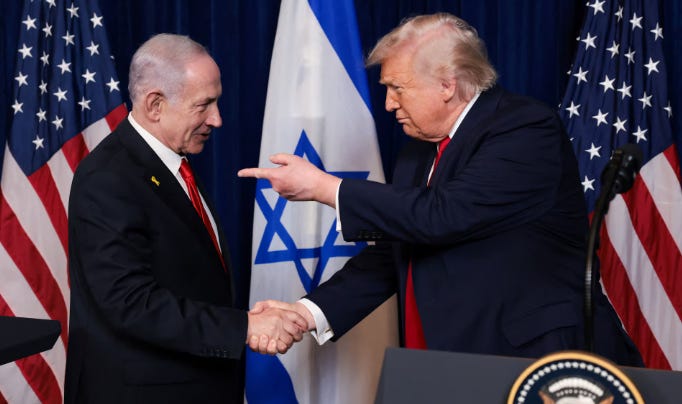
A revealing interview with former Secretary of State Antony Blinken sheds light on something important about the current conflict involving Iran. It also highlights a broader pattern in Donald Trump’s approach to foreign policy.
According to Blinken, both the Obama and Biden administrations spent years trying to avoid exactly the kind of war the United States now finds itself facing. Their strategy was based on a clear understanding of the risks involved in escalating toward direct military conflict with Iran.
Trump took a very different path.
And the difference may come down to a simple but uncomfortable question: why did Trump walk into a trap that previous administrations worked so hard to avoid?
The pressure to launch a preemptive war
Blinken explained that this dynamic goes back years.
During the Obama administration, Israeli leadership pushed aggressively for military action against Iran. There were repeated warnings that Israel might strike Iran itself if the United States did not act first.
President Obama refused.
Instead, his administration pursued a strategy built around diplomacy backed by severe international sanctions. That approach eventually produced the Iran nuclear agreement, an arrangement designed to limit Iran’s nuclear program without triggering a regional war.
Years later, the Biden administration faced a similar moment.
After the October 7 Hamas attacks in Israel, Israeli officials warned that Hezbollah might soon launch an attack from Lebanon. There was pressure for a preemptive strike.
According to Blinken, the United States came within about thirty minutes of a war in northern Israel based on what later turned out to be faulty intelligence.
Biden refused to support a preemptive escalation. His position was clear. The United States would help defend Israel if it were attacked, but it would not support starting a new war.
That distinction mattered.
Trump chose a different path
Now compare that record to what has happened under Donald Trump.
As Blinken pointed out, Benjamin Netanyahu has long tried to pull the United States into preemptive military action against Iran. Previous administrations resisted those efforts.
This time, the pressure appears to have worked.
Trump and his allies are framing the decision to escalate as a sign of strength. The talking point from Trump’s orbit has been simple. Previous presidents were too weak to act. Trump was strong enough to do what they would not.
But there is another interpretation.
Obama and Biden may not have avoided war because they were weak. They may have avoided it because they understood the strategic trap.
Trump may have stepped directly into it.
The asymmetry problem
One of the most important dynamics in this conflict has very little to do with battlefield strength. It has to do with cost.
Iran can wage this conflict far more cheaply than the United States.
For example, Iranian forces are deploying drones that cost roughly $20,000 each. The United States is often responding with Patriot missile interceptors that cost roughly $4 million per launch.
That imbalance creates a strategic problem.
Even a weaker country can drain the resources of a stronger one if the cost of defense is dramatically higher than the cost of attack. Over time, that asymmetry can become the decisive factor.
This is exactly the kind of dynamic that both Obama and Biden worked to avoid.
Markets may decide the war
Blinken made an observation that deserves attention.
The ultimate pressure point in this conflict may not be the battlefield. It may be the economic consequences.
The United States has overwhelming military power. American airstrikes can destroy infrastructure and cause enormous damage. No one disputes that.
But the question is how long the political system can tolerate the economic fallout.
Oil markets have already reacted sharply. Gasoline prices have surged to multi year highs. Energy markets are volatile. The longer the conflict continues, the greater the pressure on the global economy.
At some point, those pressures could become politically unsustainable.
That is why the duration of the conflict may be determined by two things: markets and munitions. Money and weapons.
A pattern of being manipulated
There is also a larger pattern here.
Trump has repeatedly shown a tendency to believe what foreign leaders tell him, particularly when those leaders flatter him or promise dramatic outcomes.
We saw this during Trump’s first term in Helsinki when he publicly sided with Vladimir Putin’s denial of Russian election interference over the conclusions of U.S. intelligence agencies.
We saw it again during Trump’s summit with North Korean leader Kim Jong Un. Kim made sweeping promises about denuclearization, the same promises North Korea had made to multiple American presidents before. Those promises never materialized.
The same pattern appears to be repeating itself.
Foreign leaders present Trump with scenarios that appeal to his instincts. They flatter him. They tell him he can achieve a historic breakthrough.
Trump believes them.
The possible endgame
Now the consequences are becoming clearer.
Iran appears prepared for a long conflict. The economic effects are already spreading through global energy markets. Gasoline prices are climbing, and geopolitical tensions are rising.
Behind the scenes, advisers around Trump are reportedly beginning to realize the danger.
The challenge now is simple but painful.
Either the United States commits to a prolonged and extremely costly conflict, or Trump reverses course and exits the situation. That kind of reversal would be politically humiliating.
Those are the two options now on the table.
And they are the kinds of choices that Obama and Biden spent years trying to avoid having to make in the first place.
We’re reaching over 150 million people every month across YouTube, podcasts, Substack, and beyond. But algorithms can change. Platforms can fold. And when that happens, this newsletter is how we stay connected.
If you’re not yet a paid subscriber, please consider joining.
If you’re already paid on one platform, consider supporting us on both Substack and our website.
You can subscribe on our website and right here on Substack.
And if you’re really on fire, consider gifting a subscription—we’ve got thousands on our waiting list ready to read, watch, and fight back.
Let’s keep building.
—David
PS: Can’t contribute right now? No problem. You can support us for free by subscribing on YouTube, listening to our audio podcast on Spotify or Apple Podcasts, or become a free subscriber to this very Substack. Every bit counts.
This is the most tragic part of Trump’s personality!! He believes anything and everything that anyone (I mean the “enemy” or who should be seen as the enemy) tells him, as long as it is said in a flattering way and not trying to let him know how gullible he is! He also can’t stand Obama and Biden, because they both accomplished tasks or projects that he does not have even the remotest chance of thinking about, let alone put into practice!! Like the old adage “the eyes are bigger than the stomach”, the size of Trump’s ego far surpasses his intellect. He needs to be removed from office as well as Hegseth, who has probably been drinking this whole time and that’s why he thinks it’s appropriate to offer his opinions about news agencies and reporters. I don’t care how long or short Hegseth’s time in the military was: he learned nothing!!!!!
Of note is that Trump surrounded himself with many men & women of wealth who don’t know a thing about how to govern, priorities, etc.