

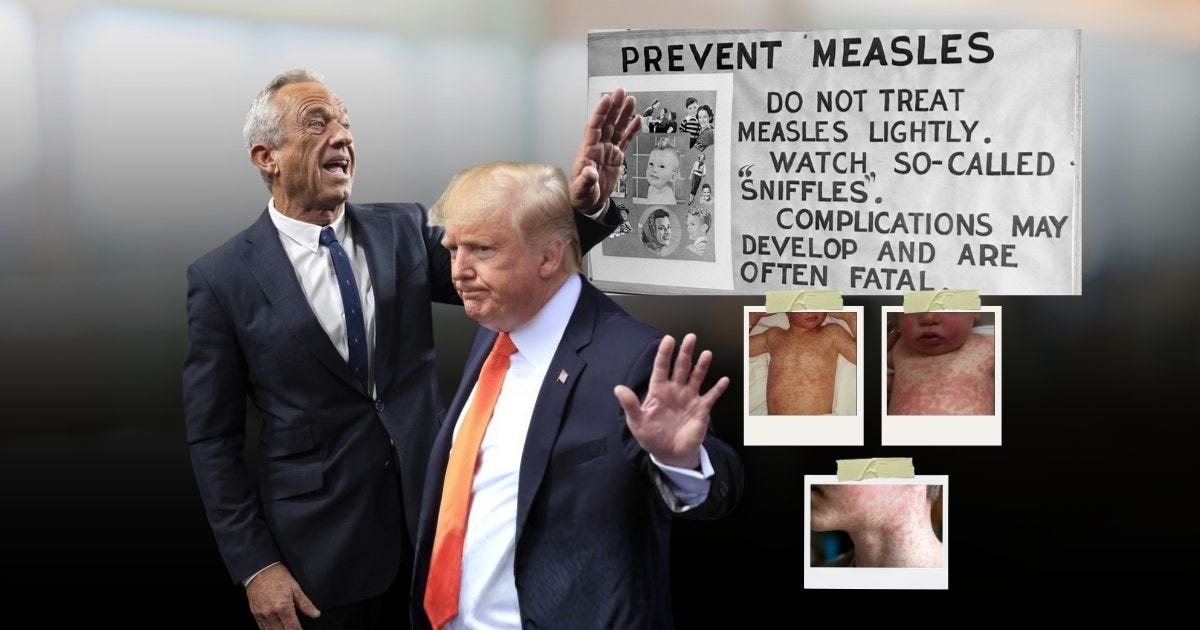
The U.S. eliminated measles. Politics brought it back.Trump said he would break records, and it seems that was true. Unfortunately, one of the records the United States is now setting has nothing to do with the economy, immigration, or any of the campaign slogans we heard. It is a record number of measles cases, a disease that the United States had effectively eliminated more than two decades ago.
That should stop all of us in our tracks.
Scientists still know exactly how to prevent measles. What has changed is public confidence in vaccines, eroded by politicians and public figures who found political value in promoting distrust. Now that rhetoric has real-world consequences, and children are paying the price.
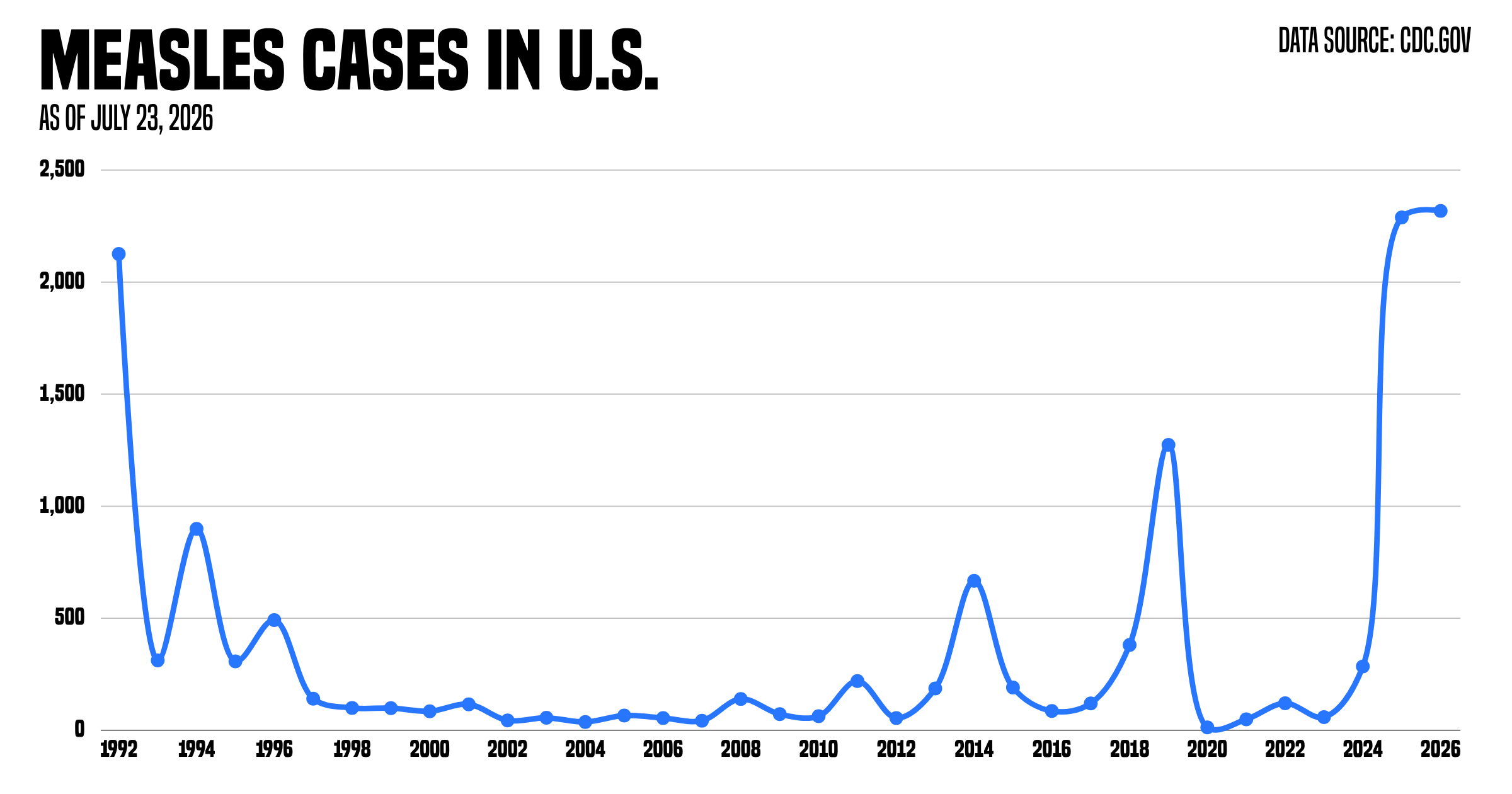
The United States has already recorded nearly 2,300 measles cases this year, the highest annual total in 35 years, and we’re only in July. We’ve already surpassed last year’s numbers with 5 months still to go. More than 90 percent of infections have occurred in people who were unvaccinated or whose vaccination status is unknown.
The consequences are serious. Many hospitalized patients require IV fluids because of severe dehydration. A majority need oxygen. Nearly one-third develop pneumonia. This is not the harmless childhood inconvenience that anti-vaccine activists often portray.
These are the predictable outcomes of declining vaccination rates.
The politics behind the outbreak
Donald Trump has spent years amplifying vaccine skepticism while personally receiving vaccines himself. That contrast is difficult to ignore. Public messaging and private behavior have not always matched, but politically, questioning vaccines has become useful.
Then Trump elevated Robert F. Kennedy Jr., perhaps the country’s most recognizable vaccine skeptic, to lead the Department of Health and Human Services.
Kennedy has spent decades promoting the repeatedly debunked claim that vaccines may cause autism. Could scientists investigate that possibility? Of course. In fact, they have. Repeatedly. The overwhelming body of evidence has found no causal link.
That is how science works. Claims are tested, challenged, replicated, and either supported or rejected by evidence. The problem is that in today’s political environment, many people no longer treat evidence as the deciding factor.
When misinformation reaches the doctor’s office
One of the more revealing examples involves comments Trump made suggesting parents separate the measles, mumps, and rubella vaccine into individual shots.
There’s just one problem.
Those separate vaccines are not available in the United States.
Pediatricians now describe parents arriving at appointments asking for exactly what Trump suggested, only to learn that the standard MMR vaccine is the approved, safe, and available option. A political talking point has become a real conversation happening in exam rooms across America.
Doctors shouldn’t have to spend valuable appointment time correcting misinformation that originated in campaign rhetoric.
Vaccination isn’t only about you
One of the most persistent misunderstandings about vaccines is the idea that they are simply a matter of personal choice.
Personal decisions do not exist in isolation when it comes to highly contagious diseases.
Someone carrying measles into a pediatrician’s office can expose a six-month-old infant who is too young to be vaccinated. They can expose a child undergoing chemotherapy. They can expose someone whose immune system cannot mount an adequate response even after vaccination.
Those people never agreed to accept that risk.
Community immunity only works when enough people participate. Once vaccination rates fall below that threshold, outbreaks become inevitable.
The backwards standard of proof
There is another striking feature of modern anti-vaccine politics.
Vaccines that have been safely administered hundreds of millions of times are expected to answer every hypothetical concern anyone can imagine. Every rumor, every speculative question, every viral Facebook post becomes grounds for endless skepticism.
Meanwhile, a YouTube video, a Facebook meme, or a thoroughly discredited claim from years ago is treated by some as sufficient evidence to reject decades of medical research.
It’s an extraordinary reversal of how evidence is supposed to work.
The irony many people miss
Perhaps the most frustrating argument is that measles is no longer especially dangerous because relatively few Americans die from it today.
That is true precisely because vaccines worked.
Before the measles vaccine became available in 1963, the disease infected between three and four million Americans every year. Roughly 50,000 people were hospitalized annually. About 1,000 developed brain swelling that could cause permanent neurological damage, and roughly 500 people died each year.
Vaccination reduced cases by more than 99 percent, and measles was declared eliminated in the United States in 2000.
Using today’s lower death rate as an argument against vaccination is like arguing that seatbelts are unnecessary because fewer people are being thrown through windshields. The reason those tragedies became less common is because the safety measure worked.
Politics is never as distant as it seems
People sometimes tell me they aren’t interested in politics because they don’t think politics affects their daily lives.
This story is a reminder that it absolutely does.
Elections determine who leads public health agencies. They determine who oversees disease surveillance, vaccine policy, emergency response, and scientific communication. Those decisions eventually find their way into doctors’ offices, emergency rooms, classrooms, and family kitchens.
The consequences are not abstract.
Children are being hospitalized with a disease that the country had largely defeated a generation ago. The United States now risks losing its measles elimination status because public confidence in one of medicine’s greatest achievements became another front in the culture wars.
That is what happens when misinformation escapes the internet and becomes public policy.
So here’s my question for you: Where should the line be between free political speech and accountability for its real-world consequences? Should public officials be held accountable when misinformation contributes to measurable public health harm? I’d love to hear what you think in the comments.
We’re reaching over 150 million people every month across YouTube, podcasts, Substack, and beyond. But algorithms can change. Platforms can fold. And when that happens, this newsletter is how we stay connected.
If you’re not yet a paid subscriber, please consider joining.
If you’re already paid on one platform, consider supporting us on both Substack and our website.
You can subscribe on our website and right here on Substack.
And if you’re really on fire, consider gifting a subscription—we’ve got thousands on our waiting list ready to read, watch, and fight back.
Let’s keep building.
—David
PS: Can’t contribute right now? No problem. You can support us for free by subscribing on YouTube, listening to our audio podcast on Spotify or Apple Podcasts, or become a free subscriber to this very Substack. Every bit counts.
Robert Kennedy should be tried and hopefully convicted for his mis information campaign.
Convict Trump has used every issue to divide Americans because of his hunger for power.
Over a decade ago Bernie Sanders laid out exactly how a fascist dictator could take over in the US and convict Trump did exactly what Bernie said.