

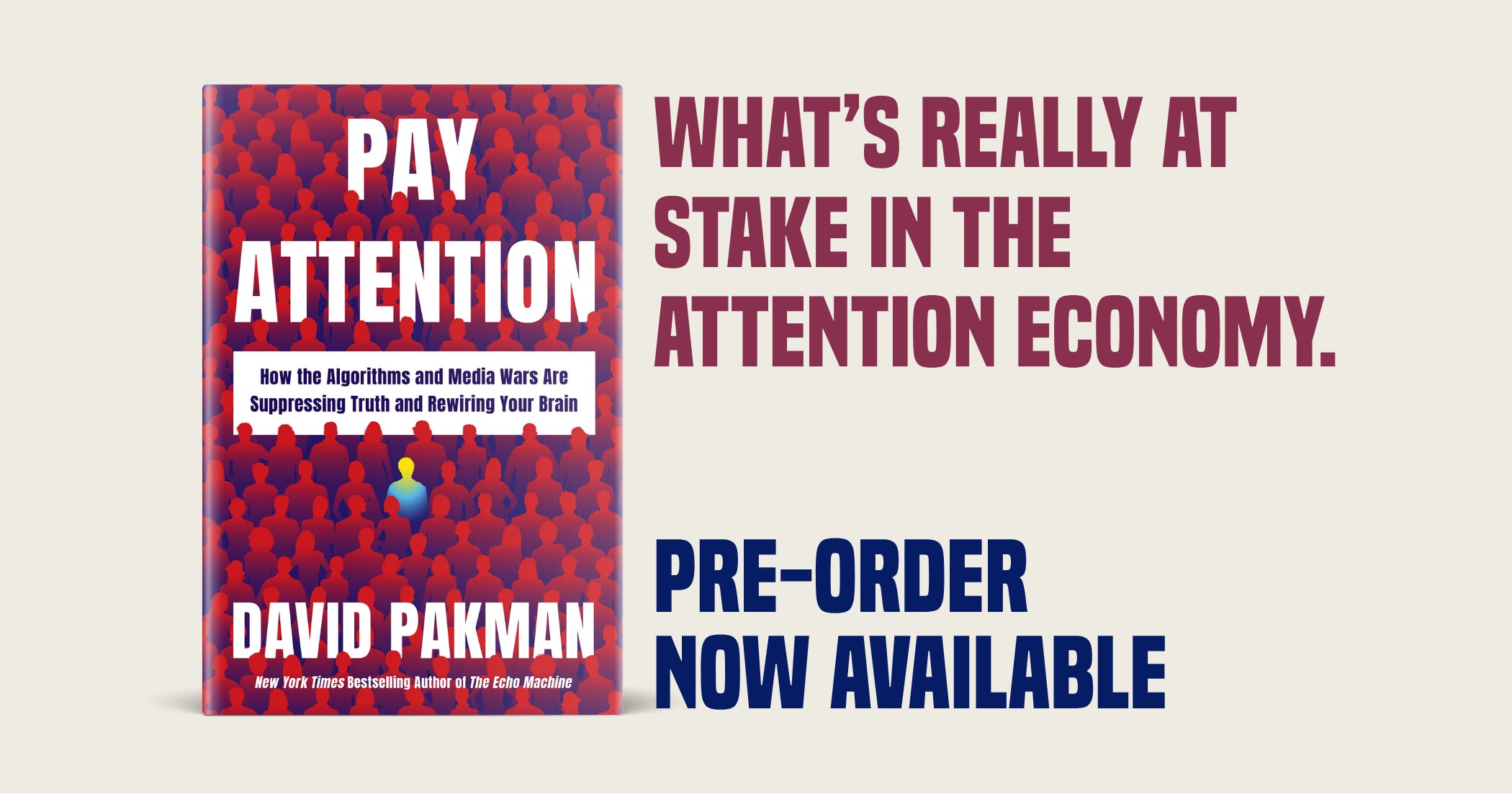
Today marks the official launch of the pre-order campaign for my new book, Pay Attention: How the Algorithms and Media Wars are Suppressing Truth and Rewiring Your Brain. We've been building toward this date for months.
Under normal circumstances, this would simply be an exciting milestone.
What I did not anticipate was that the pre-order campaign would begin just weeks after the Trump White House placed me on its official “media offenders” list.
The timing is striking.
Yet the book’s focus extends far beyond any one politician or administration.
Pay Attention examines something much larger: how digital platforms shape what we see, what we believe, and ultimately how we understand the world around us.
The timing could not be more revealing
Independent media is facing increasing pressure from the Trump administration.
Shows like mine are becoming more influential because millions of people are looking for something they often cannot find in traditional media: direct analysis, accountability, and coverage that is not filtered through corporate interests or political relationships.
People in power have noticed.
As a quick recap, a few weeks ago, the Trump White House published an official list of what it called “media offenders” on WhiteHouse.gov. I was included by name and even given my very own page on the White House’s official website.
Not because I committed a crime.
Not because I got facts wrong.
Not because I violated any journalistic standard.
I was included because I criticize the administration and because there is no corporate owner or executive suite that can be pressured into silencing me. The only people who determine whether this show continues are the people who choose to watch it.
That independence is exactly what makes this model powerful. It is also what makes it threatening to those who prefer loyalty over scrutiny.
This isn’t the first time
Some newer viewers may not know that this has happened before.
When my last book, The Echo Machine, was released, individuals connected to the Trump administration reportedly pushed Amazon to stop carrying books by a number of left-leaning authors. My book was among those singled out.
The goal was never to debate the ideas in the book or challenge the arguments on their merits.
The goal was to prevent people from reading it in the first place.
History offers plenty of examples of movements that attempt to ban books, restrict access to information, or narrow the range of acceptable viewpoints. It is not the behavior of people confident in their ideas.
Authoritarians do not want competition in the marketplace of ideas. They want fewer voices, less scrutiny, and more obedience.
Nevertheless, The Echo Machine still debuted on the New York Times Best Sellers list, thanks in large part to the support you, my audience, gave in the lead-up to its release.
Why I wrote Pay Attention
Pay Attention examines the digital systems we interact with every day and the ways those systems shape our beliefs, behavior, and politics.
This book is about how algorithms work. It is about recommendation engines, engagement incentives, outrage cycles, and the economic forces that reward emotionally charged content over thoughtful analysis.
If you use social media, if you have children who use social media, or if you teach students who spend their lives online, understanding these systems is no longer optional.
Many people believe they are simply consuming information when they scroll through their feeds.
In reality, they are interacting with systems specifically designed to maximize attention, reinforce existing beliefs, and keep users engaged for as long as possible.
Those design choices affect culture, but they also affect elections, public opinion, and ultimately who gains and maintains political power. If you have watched the rise of Trumpism, the explosion of conspiracy theories, or the radicalization pipelines that have become so familiar in recent years, you have already seen the outcomes.
This book explains the mechanics behind those outcomes.
And as someone who has been creating content on YouTube since 2005, I have seen the evolution of this firsthand. For example, if we want YouTube to show you our content, we have to use hyperbolic titles and thumbnails, even when the video itself is a calm, thoughtful deep dive. We’ve tested less emotional titles and thumbnails for years and time and again, they always flop. These algorithmic forces shape behavior on both sides of the screen, pulling creators and audiences alike into attention-driven cycles.
Why pre-orders matter
I’ll be honest: I’m excited about this book, but I’m also nervous.
When The Echo Machine came out, I was barely on the Trump administration’s radar. I was not appearing on official lists. Senior Trump allies were not attacking me on social media.
And despite that, there were still efforts to limit the book’s reach.
This time is different. The attacks are louder, more coordinated, and coming directly from people with significant political influence.
The last thing propagandists want is for people to understand the systems being used to manipulate them.
That is exactly why pre-orders matter.
Pre-orders send a signal to publishers, retailers, bookstores, recommendation systems, and media outlets that there is demand for independent ideas and independent voices.
They influence how many copies bookstores stock, whether major retailers prominently feature a title, and whether a book has a chance to reach bestseller lists.
In many ways, this is a direct competition between people trying to expose manipulation and those who benefit from it.
If you’ve found value in my show, if you believe independent media matters, or if you want to better understand how modern political persuasion works, I’m asking for your support.

I can't wait to read your latest book. The Echo Machine was very informative. I sure hate that they are coming after independent media like yours. They are out to silence everyone who has common sense.
Independent media is our only hope, so it is under deep attack. Here is where we are with the traitorous MSM:
From the Congressional Record January 27, 1917: JP Morgan, Steel, Shipbuilding, and “powder” interests hired 12 high-ranking newspaper execs to determine how to “control generally the policy of the daily press” throughout the entire country.
Answer: They found it was only necessary to purchase the control of 25 of the greatest papers. …the policy of the papers was bought, to be paid for by the month; an editor was furnished for each paper to properly SUPERVISE AND EDIT INFORMATION…. This policy also included the suppression of everything in opposition to the WISHES of the interests served.”
You can draw a straight line from this revelation over a century ago to this:
“Comcast owns NBC, MSNBC, CNBC, Universal Pictures, and dozens of cable channels. Disney owns ABC, ESPN, Pixar, Marvel, Lucasfilm, National Geographic, and just absorbed most of 21st Century Fox. Warner Bros Discovery owns CNN, HBO, the DC universe, and a sprawling empire of cable networks. Paramount Global owns CBS, Showtime, MTV, Comedy Central, and Nickelodeon. Sony controls a massive chunk of the music and film industry. And News Corp, the Murdoch empire, owns Fox News, the Wall Street Journal, the New York Post, and newspapers across three continents.
Your local news station that you think is independent? Probably owned by Sinclair Broadcast Group, which controls nearly two hundred television stations across America and forces them all to read the same scripted editorials.
https://substack.com/@tritorch/note/c-205834315
Your favorite newspaper? Bought up by a hedge fund or a billionaire who wanted a mouthpiece. Your streaming service? Owned by one of the six. Your social media feed? Curated by algorithms designed by Silicon Valley billionaires to keep you angry and engaged and clicking.”