


Republicans are walking straight into a political storm in 2026, and many of them don’t even realize it. If Democrats play their cards right, this midterm cycle could end up looking a lot like 2018 all over again. We’re not talking about some sophisticated strategy or a massive fundraising machine. We’re talking about something far simpler, something already hiding in the numbers.
And those numbers should terrify Republicans.
The Motivation Gap Republicans Don’t Want to Talk About
Right now, Democrats have a 12-point advantage among voters who are very or extremely motivated to vote next year. Seventy-two percent of Democrats fall into that category, compared to just 60% of Republicans. This is the exact kind of imbalance that historically precedes serious midterm trouble for a sitting president’s party.
Then there’s Trump’s approval rating, sitting at 37% in multiple recent polls including CNN’s. This is the worst approval of his second term so far. Presidential approval tends to go down, not up, and this number is identical to where he was in 2018 right before Republicans were wiped out.
That should sound familiar.
On the generic ballot, Democrats are leading by 8 in the latest NBC poll. That is the largest advantage either party has held since 2018 when Democrats flipped forty-one House seats. The structure of the cycle looks eerily similar, and this time Democrats are entering with even more voter motivation.
The Anti-Trump Vote Is Driving the Cycle
Forty-seven percent of voters say their vote next year will be a message opposing Donald Trump. Only twenty-one percent say they would be voting to support him.
That gap alone is devastating.
Some will say, “Democrats are unpopular too.” That’s true, but midterms are not a referendum on the unpopular out-party. They are a referendum on the current president. Trump is deeply unpopular.
Sixty-one percent of voters say he has gone too far in using presidential power.
Seventy-two percent say the economy is in bad shape.
Sixty-one percent believe Trump is making it worse.
The real danger for Republicans isn’t just opinion. It’s turnout collapse among Trump supporters.
Right now, voters who are likely to support Democrats are far more motivated than voters who would support Republicans. And Trump’s voters are historically notorious for staying home when he’s not on the ballot. That dynamic alone can swing dozens of House races.
2018 is the Blueprint
Look at what happened last time Republicans faced this political environment. From 2016 to 2018, Republican House votes dropped by twelve million. That is unheard of. Democratic turnout didn’t surge; it stayed flat. The shift came entirely from disillusioned or disengaged Trump supporters who simply didn’t show up.
Republicans keep telling themselves their base loves the president. But that love is conditional. They love him. They do not necessarily love the party, Republican candidates down-ballot, or the actual machinery of governing. And in 2026, Trump won’t be on the ballot.
Two things can be true at once. If Trump’s job performance looks disastrous to Republicans, some stay home. If Trump is not on the ballot at all, many stay home anyway.
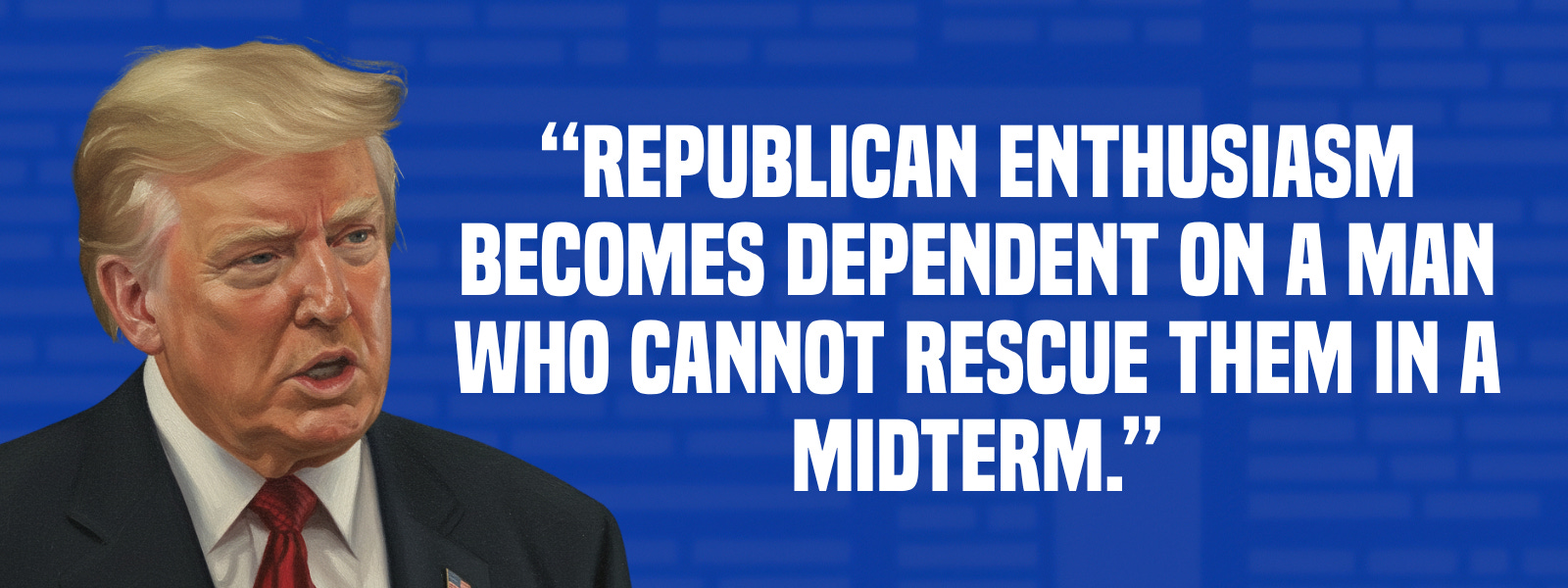
Either way, Republican enthusiasm becomes dependent on a man who cannot rescue them in a midterm.
Democrats Are Angry and Showing Up
Meanwhile, Democrats are fired up. They are furious about the government shutdown, the SNAP cuts, corruption scandals, the crypto mess, the hiding of Epstein files, all of it. Democratic voters don’t need Trump on the ballot to be motivated. The fact that he’s in power is enough.
We saw this energy in last week’s elections. Democrats showed up even as approval numbers for both parties remain low. This is what makes the midterm math so brutal for Republicans. A deeply unpopular president combined with a motivated opposition has almost always led to seat losses for the president’s party.
No modern president with an approval rating below fifty has avoided losing House seats. Trump is sitting at thirty-seven. That almost guarantees losses. The question is how many.
What 2026 Is Really About
This is shaping up to be a repeat of 2018, maybe even more pronounced. A historically unpopular president. A furious and energized opposition. A huge turnout gap. Those three variables together create midterm disasters.
Republicans may not realize how much trouble they’re in until it’s too late.
The question for Democrats is not “Can they win the House?” They absolutely can. The question is whether Democrats will do what needs to be done for the next 343 days to actually convert all of this into seats.
That’s the unknown. The math is there. The motivation is there. The moment is there.
Will Democrats capitalize on it?
We’re reaching over 150 million people every month across YouTube, podcasts, Substack, and beyond. But algorithms can change. Platforms can fold. And when that happens, this newsletter is how we stay connected.
If you’re not yet a paid subscriber, please consider joining.
If you’re already paid on one platform, consider supporting us on both Substack and our website.
You can subscribe on our website and right here on Substack.
And if you’re really on fire, consider gifting a subscription—we’ve got thousands on our waiting list ready to read, watch, and fight back.
Let’s keep building.
—David
PS: Can’t contribute right now? No problem. You can support us for free by subscribing on YouTube, listening to our audio podcast on Spotify or Apple Podcasts, or become a free subscriber to this very Substack. Every bit counts.
Break them for decades
And for 2028 the blueprint is 1932.