

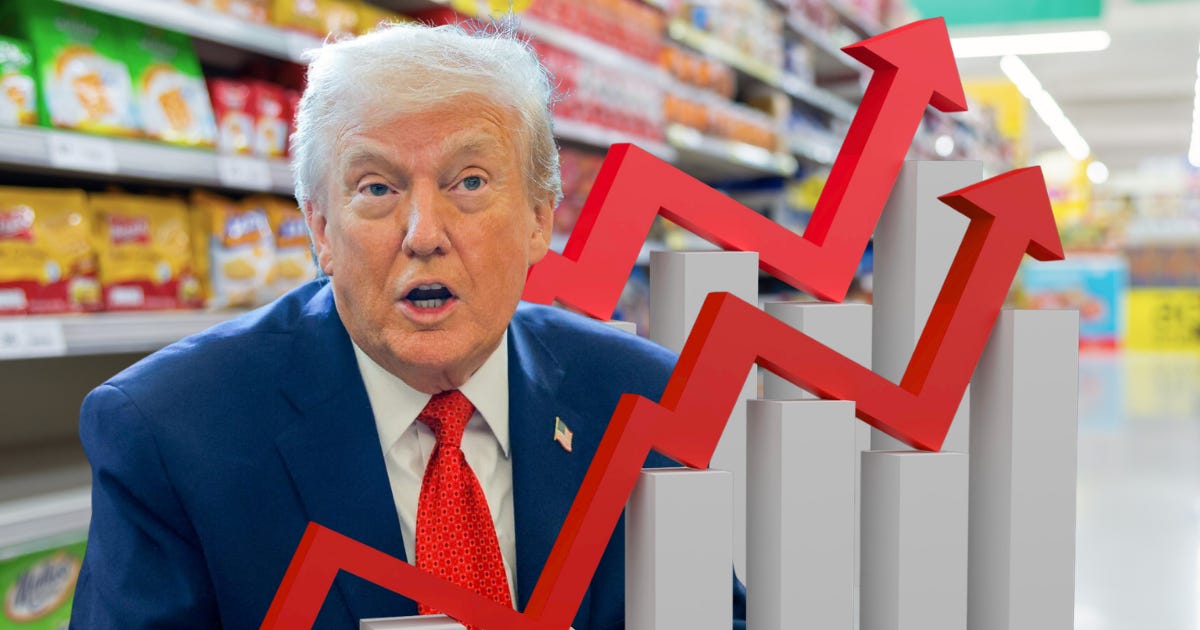
Donald Trump campaigned on a clear promise: he was going to bring prices down.
Not just inflation, but actual prices. Gas, groceries, energy, housing, and the everyday expenses Americans face each week were all supposed to cost less.
Affordability was one of the most effective messages of his campaign because it tapped into something real: people were frustrated by rising costs and wanted relief.
The latest inflation report tells a very different story.
Inflation has now climbed to 4.2 percent year over year, the highest level in more than three years. Energy costs have been a major driver, but they are not the whole story. Food prices continue to rise, and the broader trend is moving in exactly the opposite direction from what voters were promised.
There is an important way to understand just how significant this number is.
If we set aside the extraordinary inflation spike associated with the COVID pandemic, inflation today is higher than it has been at any point in more than a decade. That is not what Americans were promised when they were told that affordability would return on day one.
And the problem becomes even more serious when wages are factored into the equation.
Inflation is rising while purchasing power falls
One of the ways economists evaluate the impact of inflation is by looking at wages adjusted for rising prices.
If inflation is increasing but wages are growing even faster, consumers may still come out ahead because their purchasing power improves. That is not what is happening right now.
Real average hourly earnings have turned negative. Real weekly earnings have also turned negative. In other words, inflation is rising faster than wages.
For ordinary Americans, that means paychecks are buying less.
This is the distinction that often gets lost in political messaging. Inflation is not just an abstract number reported on financial news programs. It affects what people can afford at the grocery store, at the gas station, and when paying utility bills.
When prices rise faster than income, households feel it immediately.
What happened to “we solved inflation”?
The political challenge for the White House is that Trump’s own statements are now colliding with the economic data.
Earlier this year, Trump declared that inflation had effectively been solved. He claimed prices were coming down and that affordability had returned.
The numbers tell a different story.
Inflation is now more than double the Federal Reserve’s long-term target of 2 percent.
That creates a credibility problem.
Voters may disagree about the causes of inflation. They may disagree about the best solutions. But if a president repeatedly tells people that prices are falling while their bills continue rising, eventually people notice the disconnect.
This was not inevitable
Every president faces economic challenges that are largely outside of their control.
The COVID pandemic is a good example. Leaders around the world were forced to navigate a global crisis that disrupted supply chains, labor markets, and consumer demand. Some handled it better than others, but no political leader created the pandemic itself.
This situation is different.
Trump's defenders often point to global factors when discussing inflation. But many of the pressures Americans are experiencing today are tied to policy choices made by this administration. The tariffs Trump championed have increased costs throughout supply chains. The administration's involvement in Iran has contributed to rising energy prices.
These are not simply unavoidable economic forces. They are the consequences of decisions made by political leaders, and those decisions deserve scrutiny.
That distinction matters.
Different coverage, similar reality
CNN and Fox News approached the inflation story very differently this week.
CNN focused on what rising prices mean for ordinary households. The report highlighted increases in food costs and noted that wage growth is no longer keeping pace with inflation. When prices rise faster than paychecks, purchasing power shrinks. People find themselves relying more heavily on savings or credit cards just to maintain their standard of living.
Fox News covered the inflation report differently.
Their reporting emphasized energy prices and disruptions tied to events in the Middle East. That explanation is not entirely wrong. Energy costs have been a significant contributor to recent inflation, and supply chain disruptions can absolutely affect prices.
But there is an important distinction that often gets lost.
Fox News presents these developments as if they are simply external events that happened to the administration. In reality, many of the factors contributing to rising costs are connected to policy choices.
Tariffs are a policy choice.
Military escalation is a policy choice.
Trade restrictions are a policy choice.
When those decisions increase costs for businesses, consumers eventually feel the effects.
One example mentioned during Fox’s coverage was fertilizer. Rising fertilizer prices matter because they increase costs for farmers. Those higher costs eventually work their way through the supply chain and appear as higher food prices at the grocery store.
In other words, some inflationary pressures have not fully reached consumers yet.
Accountability cannot be selective
One of the most revealing aspects of this debate is how standards change depending on who occupies the White House.
When gas prices increased under Biden, many conservatives argued that presidents should be held responsible.
When groceries became more expensive under Biden, many conservatives argued that presidents should be held responsible.
When inflation rose under Biden, many conservatives argued that presidents should be held responsible.
Now inflation is rising under Trump, and the explanation has shifted. Suddenly it is regional conflicts, shipping disruptions, fertilizer costs, or broader market forces.
Some of those factors are real. Economic outcomes are rarely caused by a single person or a single policy.
But if voters were told during the campaign that the president has the power to bring prices down quickly, it is reasonable to ask whether that promise is being fulfilled.
So far, the trend is moving in the opposite direction.
What voters actually notice
Political messaging can only go so far.
People know what they are paying for groceries.
They know what their rent costs.
They know what their utility bills look like.
They know whether their paycheck stretches as far as it did a year ago.
No amount of partisan media coverage can completely override those experiences.
The central promise of Trump’s campaign was that affordability would improve. Whether voters believe that promise is being kept may become one of the most important political questions heading into the midterms.
The numbers are moving in the wrong direction.
The question is whether enough voters are willing to acknowledge it.
What do you think? If voters blamed Biden for high prices, should they apply the same standard to Trump now? Or do presidents get too much credit and too much blame for economic conditions in general?
We’re reaching over 150 million people every month across YouTube, podcasts, Substack, and beyond. But algorithms can change. Platforms can fold. And when that happens, this newsletter is how we stay connected.
If you’re not yet a paid subscriber, please consider joining.
If you’re already paid on one platform, consider supporting us on both Substack and our website.
You can subscribe on our website and right here on Substack.
And if you’re really on fire, consider gifting a subscription—we’ve got thousands on our waiting list ready to read, watch, and fight back.
Let’s keep building.
—David
PS: Can’t contribute right now? No problem. You can support us for free by subscribing on YouTube, listening to our audio podcast on Spotify or Apple Podcasts, or become a free subscriber to this very Substack. Every bit counts.
No one in the executive branch of this regime gives a rat's ass about how the rank and file Anerican people live or what they are able to afford.
He's the unaffordable president.