

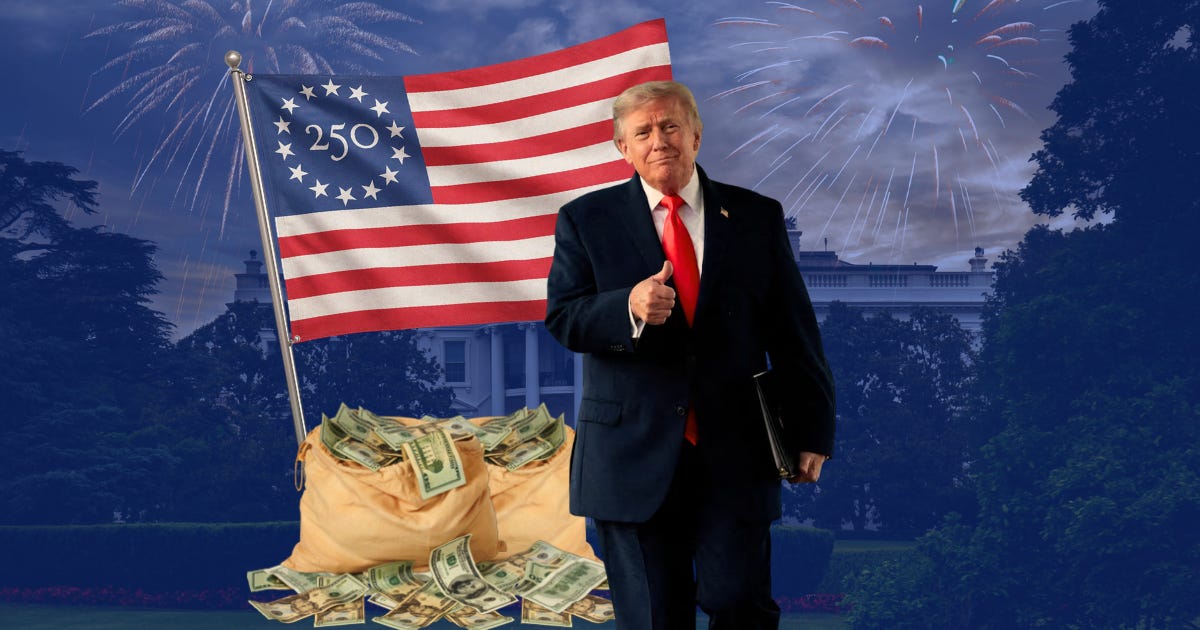
Donald Trump has faced countless allegations over the years, but the latest one is notable because it centers on something surprisingly straightforward: where donor money was actually being sent.
According to a new report from Democrats on the House Natural Resources Committee, donors who believed they were contributing to America 250, the congressionally chartered commission created to help commemorate the nation’s 250th anniversary, may instead have been directed to send money to Freedom 250, a separate White House-backed initiative created under the Trump administration.
If those allegations are accurate, this is not simply a story about confusing names or sloppy administration. It raises questions about whether donors were intentionally misled about who was receiving their money and whether that conduct crosses the line into wire fraud or charitable solicitation fraud.
Two organizations that are not the same
Understanding the allegations requires understanding that these are two entirely different organizations.
America 250 is a bipartisan commission established by Congress years ago to coordinate the country’s semiquincentennial celebration.
Freedom 250 is something else entirely. It is an executive branch public-private partnership operating under the Trump White House. While both focus on America’s 250th anniversary, they are separate entities with separate leadership, separate missions, and separate fundraising operations.
That distinction becomes important because the House report alleges that Freedom 250 blurred those lines by using branding and messaging that created confusion among potential donors. According to the report, fundraising efforts allegedly relied on similarities between the organizations, making it difficult for contributors to know exactly where their money was going.
If someone intends to donate to one organization but, because of misleading instructions or branding, ends up funding another, that is precisely the type of situation charitable solicitation laws are designed to prevent.
Why the allegations matter
This is not simply about whether two logos looked alike.
Federal law generally expects charitable fundraising to be transparent. Donors are supposed to know who is asking for money, where that money is going, and what organization will ultimately receive it.
The report suggests that those basic expectations may not have been met.
There are also questions about who would bear responsibility if any wrongdoing occurred. Political organizations and fundraising operations often involve multiple consultants, vendors, and outside firms. Those layers can make it difficult to determine exactly who approved particular marketing materials or donor communications.
That does not make the underlying allegations less significant. It simply makes accountability more complicated.
A familiar pattern
One reason this story stands out is that it fits into a broader pattern that has followed Trump for years.
Again and again, critics have accused Trump and people around him of creating structures that blur lines between public initiatives, private interests, political branding, and fundraising.
Whether those allegations ultimately result in criminal charges is a separate question. Recent history has understandably made many Americans skeptical that powerful political figures will ever face meaningful consequences.
But legal outcomes are only one part of the story.
There is also the question of trust.
The political movement that frequently presents itself as standing up for ordinary Americans and rooting out corruption now finds itself facing allegations that its own supporters may have been misled while trying to donate.
If true, that is a remarkable irony.
Even the celebrations struggled
Perhaps the most surprising part of the story comes after the fundraising.
For all of the promotion surrounding Freedom 250, many of its signature events reportedly struggled to generate the kind of turnout that had been promised.
The state fair reportedly attracted roughly 200,000 visitors over sixteen days, averaging around 12,000 attendees per day. Even the heavily promoted fireworks celebration drew a crowd that was far smaller than the grand rhetoric surrounding the event suggested.
Politics often rewards spectacle. Big promises generate headlines. Massive celebrations create photo opportunities.
But impressive branding cannot guarantee public enthusiasm.
The bigger question
Whether investigators ultimately determine that laws were broken remains to be seen. Allegations are not convictions, and those accused deserve the opportunity to respond.
Even so, the allegations highlight something that should concern everyone regardless of political affiliation. When organizations with nearly identical names are fundraising at the same time, transparency is not optional. People deserve to know exactly who is asking for their money before they click “donate.”
If these allegations are proven true, what consequences would you expect to see? And do you think stories like this receive enough media attention? Let me know your thoughts in the comments.
We’re reaching over 150 million people every month across YouTube, podcasts, Substack, and beyond. But algorithms can change. Platforms can fold. And when that happens, this newsletter is how we stay connected.
If you’re not yet a paid subscriber, please consider joining.
If you’re already paid on one platform, consider supporting us on both Substack and our website.
You can subscribe on our website and right here on Substack.
And if you’re really on fire, consider gifting a subscription—we’ve got thousands on our waiting list ready to read, watch, and fight back.
Let’s keep building.
—David
PS: Can’t contribute right now? No problem. You can support us for free by subscribing on YouTube, listening to our audio podcast on Spotify or Apple Podcasts, or become a free subscriber to this very Substack. Every bit counts.
The layering and transferring of funds reminds me of the dark money situation in elections. When the Dems take over in November, we need to revamp the FEC and pass laws over veto to stop big money from buying our elections.
It’s quite obvious that almost all the donations went into Deranged Don’s pockets. The Freeedom 250 fair was a cheap-ass dump that was slapped together by accomplices of the royal orange crime family with minimal planning and low budget.