

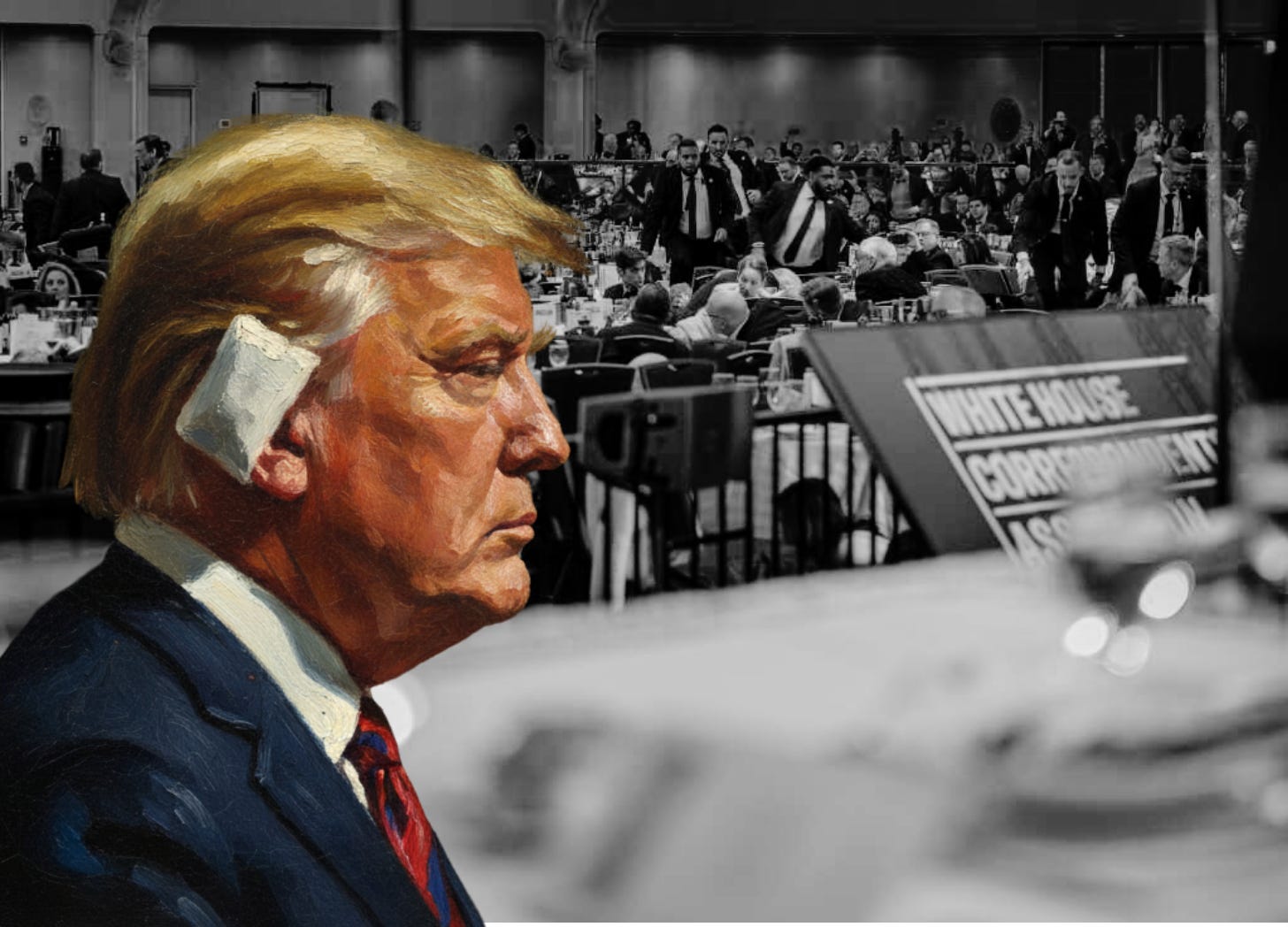
In the aftermath of the shooting at the White House Correspondents’ Dinner, social media did what it increasingly does after any shocking event: before facts had settled, millions were already debating whether the whole thing was staged.
I received emails saying, You’re not falling for this, are you? Others argued the security was too extensive for an attack to be real. Some pointed to Donald Trump almost immediately using the incident to justify his long-desired White House ballroom project as proof that the event must have been manufactured.
I don’t believe it was staged.
But whether that particular event was staged is almost beside the point.
What interested me much more was the reaction itself.
Because the real story is not one shooting, or one set of online rumors. The real story is what happens when conspiracy ceases to be a fringe response to isolated events and becomes a reflexive way of interpreting politics.
When that happens, something else follows.
Eventually, the conspiracy turns inward.
Suspicion has become the default setting
There are reasons people reached for conspiracy so quickly. There is widespread distrust of institutions, distrust of government, distrust of media, distrust of official explanations, often deservedly so, but increasingly in a generalized and untethered form. Add to that the social media incentive structure, where the most dramatic explanation often outruns the most plausible one, and you get what we saw almost immediately after the dinner shooting: people filling informational gaps with elaborate certainty.
There were claims the security should have made such an attack impossible. That is simply not true. I was in Washington that weekend and had been at the Hilton earlier. There was visible security everywhere, blocked streets, dogs, Secret Service, Capitol Police, layers upon layers of security out in the open. But visible security is not the same thing as perfect security. And importantly, the shooting did not happen inside the heavily secured ballroom itself. It happened in the lobby area. That also matters.
Likewise, yes, Trump opportunistically turned to the ballroom argument almost immediately. Of course he did. But opportunism is not evidence of orchestration. It is simply evidence of opportunism.
And yet once conspiratorial reasoning takes hold, those distinctions begin to disappear. Every coincidence becomes design. Every inconsistency becomes proof of a cover-up. That is the mechanism, and it does not stop with one event.
When conspiracy turns on its own creators
That brings us to Butler, because what we are now seeing around the 2024 assassination attempt against Donald Trump is in some ways even more revealing. Remember how Butler was framed in the immediate aftermath. For much of MAGA, it was treated as near-mythological, proof Trump was protected by providence, proof leftists were violent, proof he had been chosen and spared. It was folded almost instantly into political theology.
And now some of the very same ecosystem that elevated those narratives is raising suspicions that Butler itself may have been staged, manipulated, or concealed. Tucker Carlson is raising vague questions. Marjorie Taylor Greene is talking about “questions that deserve answers.” Influencers have begun suggesting something about the official story feels off.
And what is fascinating is not whether those claims have merit. I do not believe they do. It is what their emergence tells us. A movement that spent years teaching followers to treat suspicion as higher than evidence has created a dynamic where distrust can no longer be contained. It does not remain aimed at the FBI, or elections, or the so-called deep state. Eventually it points back at the movement itself.
That is the boomerang effect of conspiratorial politics.
Why conspiracy finds fertile ground
There is another layer to this worth considering, and it has to do with why conspiratorial thinking takes root so easily in certain political environments. There is a reason researchers who study cults, high-control groups, and authoritarian movements often point to similar psychological dynamics: a strong in-group identity, a persecution narrative, distrust of outside information, and charismatic figures who present themselves as singular sources of truth.
Those conditions do not automatically produce conspiracy thinking, but they make people more vulnerable to it. If you are trained to believe outsiders are lying, that institutions are corrupt by definition, and that only the movement can reveal what is really happening, conspiracies do not arrive as extraordinary claims. They instead arrive as common sense.
And that is part of what makes the MAGA media ecosystem distinct. It has spent years cultivating a kind of permanent epistemic emergency, a feeling that hidden forces are always operating behind events and that official explanations are almost inherently suspect. In that environment, conspiracy is not merely tolerated. It becomes socially rewarded.
That is where the comparison to politics organized around loyalty and social control becomes important. In those environments, belief is often reinforced not because evidence gets stronger, but because belonging depends on affirming the narrative. The more emotionally immersive the movement becomes, the easier it is for conspiratorial claims to circulate as identity markers rather than testable propositions.
And ironically, once that ecosystem normalizes conspiracy as a default interpretive lens, it becomes harder to contain. It does not only target perceived enemies. It can begin consuming allies, leaders, and even the movement’s founding myths.
The absence of evidence becomes evidence
It’s worth noting that conspiracy thinking differs from skepticism. Skepticism asks for evidence. Conspiracy often treats the absence of evidence as proof the conspiracy is even deeper. That creates a closed loop where challenging one layer of a theory simply produces another.
If the dinner shooting was staged, why leave the suspect alive? The answer becomes maybe he did not know he was part of it. If Butler was faked, where is the proof? The answer becomes the proof is hidden. Notice how this works. The theory cannot be falsified.
And if a theory cannot in principle be disproven, what you have is not an evidence-based claim but a belief system. That distinction matters enormously, because once political interpretation operates this way, every event becomes infinitely reinterpretable, not according to facts, but according to what serves the emotional or tribal needs of the moment.
That is a very different thing.
Narrative control replaces reality
And that may be the deeper crisis. What conspiratorial politics increasingly offers is not truth-seeking but narrative control. When Trump looked strong after Butler, the story was that he survived because he was chosen. As criticism of Trump mounts, some shift to suggesting maybe the whole thing was fake. Same event, different interpretation depending on present utility. That is not inquiry. It is narrative maintenance.
And once every event can be endlessly recoded this way, shared reality starts breaking down. That matters politically because democracies require some common standards of evidence. They do not require agreement on policy, but they do require at least some agreement about what counts as reality. When that erodes, suspicion begins outranking proof, and feeling outranks verification. Everything becomes provisional. Everything becomes potentially staged.
That is not healthy skepticism. That is epistemological instability.
The movement trained itself not to believe anything consistently
There was a line embedded in all of this that I think gets to the heart of it: the movement has trained itself not to believe anything consistently. Every belief is subject to abandonment if a new suspicion is more emotionally satisfying, and that eventually becomes self-destructive because there is no mechanism to close the loop.
Once standards of evidence are thrown out, suspicion metastasizes.
First it is the media lying.
Then elections are stolen.
Then perhaps even assassination attempts are manufactured.
And eventually the whole worldview begins consuming itself.
I think that is part of what we are watching now, not merely conspiracy theories spreading, but conspiratorial thinking starting to destabilize the very political movement that nurtured it. That is much bigger than the White House Correspondents’ Dinner. That is much bigger than Butler. That is about what happens when distrust becomes not a critique of power, but an ideology in itself.
Where this leads
And this is why I find the dinner shooting speculation notable, not because I think it reveals a hidden plot, but because it reveals how quickly many people now default to plot-thinking. The shooting becomes one more raw material for a larger habit of mind, and Butler becomes another. Different events, same pathology.
What emerges is a political culture in which evidence is negotiable and suspicion is endlessly renewable. That does not usually stabilize. It tends to radicalize, and then fracture, which may be exactly what we are seeing.
So I’m curious what you think: does conspiracy thinking eventually collapse under the weight of its own contradictions, or does it just keep mutating into new forms forever? And what happens to democratic politics when suspicion starts carrying more authority than evidence?
We’re reaching over 150 million people every month across YouTube, podcasts, Substack, and beyond. But algorithms can change. Platforms can fold. And when that happens, this newsletter is how we stay connected.
If you’re not yet a paid subscriber, please consider joining.
If you’re already paid on one platform, consider supporting us on both Substack and our website.
You can subscribe on our website and right here on Substack.
And if you’re really on fire, consider gifting a subscription—we’ve got thousands on our waiting list ready to read, watch, and fight back.
Let’s keep building.
—David
PS: Can’t contribute right now? No problem. You can support us for free by subscribing on YouTube, listening to our audio podcast on Spotify or Apple Podcasts, or become a free subscriber to this very Substack. Every bit counts.
I guess when you've been lied to 99 percent of the time, you end up believing nothing. Hence, I think it was staged despite your excellent interpretation.
I agree I don’t know what to believe anymore