

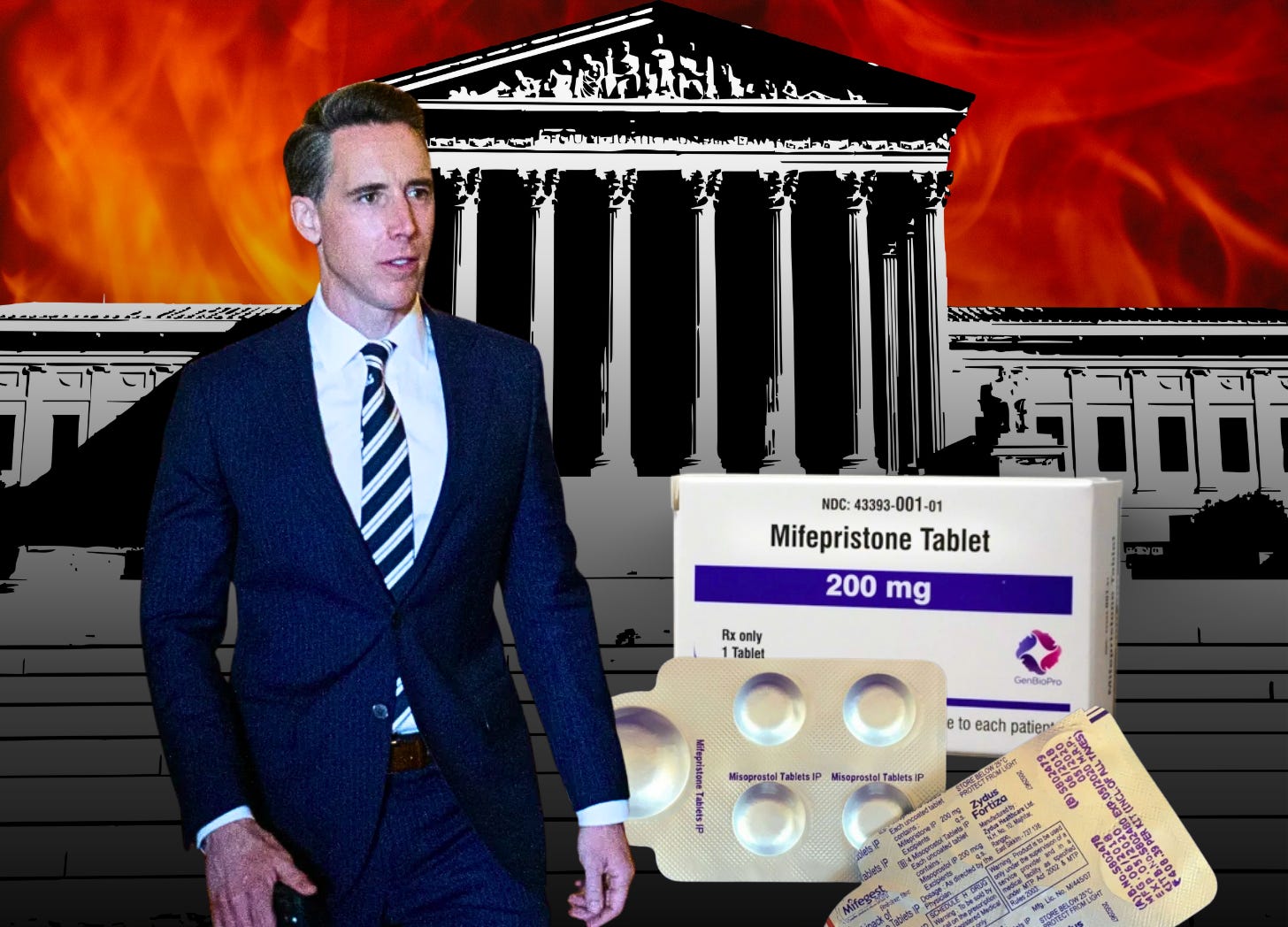
There have been several developments over the past month that point to something much bigger than any single headline. And if you haven’t heard much about it, that’s not an accident. It’s a failure of coverage.
We are now watching the next phase of the effort to restrict abortion access in the United States, and it is happening largely out of view.
Not only is this being underreported by mainstream media, it appears to be algorithmically suppressed by the very platforms that independent shows like mine rely on.
Just this week, I published a full breakdown of this story on YouTube to an audience of over 3.5 million subscribers. In the first 12 hours, it received 9,000 views. That is not just low. It is statistically implausible based on years of data from my channel.
Draw your own conclusions about that.
But the result is the same either way. Fewer people are seeing something that has enormous implications.
So let’s go through it carefully.
What we were told after the Dobbs decision
To understand what’s happening now, we have to go back.
In 1973, the U.S. Supreme Court decided Roe v. Wade, which established a constitutional right to abortion nationwide. For nearly 50 years, that ruling meant that access to abortion was protected at the federal level.
Then, in 2022, the Court issued another landmark decision in Dobbs v. Jackson Women’s Health Organization, which effectively overturned Roe. And in that decision, the argument was very specific.
This was not about a national ban. This was about returning the issue to the states. Different states would make different decisions, and that would be the framework moving forward.
The reassurance was that each state would get to decide whether or not to allow abortion. And for many states, including ones where trigger laws were in place to immediately ban abortion upon the Dobbs ruling, activists brought forth ballot initiatives allowing voters to decide their own state’s direction on this issue.
But what we are seeing now will impact access to abortion in all states, regardless of their laws.
The current focus: medication abortion
The most common form of abortion in the United States today is not surgical. It is medication-based, primarily involving a drug called mifepristone.
Data shows that in 2023, mifepristone supported roughly 63 percent of all abortions in the United States. By some more recent estimates, that number could be closer to 70 percent.
Mifepristone has been approved by the U.S. Food and Drug Administration, the FDA, since 2000, and until recent years, that has gone largely unquestioned. That has changed.
A coordinated, multi-front effort
What we are seeing now is not one isolated policy proposal. It is a coordinated strategy happening across multiple fronts at the same time.
1. Federal legislation
Republican Senator Josh Hawley has introduced legislation to remove FDA approval for mifepristone entirely.
If that happens, the impact would be immediate and nationwide. It would not matter whether you live in a red state or a blue state. Access would be severely restricted across the board. And keep in mind, this medication currently supports more than half of abortion cases nationwide. The shift would impact women seeking care and providers who would no longer have mifepristone as an option for care.
The justification for removing FDA approval relies on claims about safety that are not supported by credible, peer-reviewed evidence.
But again, this is not just about one claim.
2. Legal challenges
There are several legal challenges underway attempting to restrict telehealth prescriptions and the mailing of the medication.
On paper, this might sound procedural. In practice, these efforts create barriers. What was once accessible from home becomes a process requiring multiple in-person visits.
It’s not labeled a ban. But the effect starts to look very similar.
The Alliance Defending Freedom (ADF) is an organization worth noting. They are not only behind current legal efforts to restrict access to abortion, but they also played a central role in Dobbs v. Jackson Women’s Health Organization, the landmark case that overturned Roe v. Wade.
The ADF is strategic, well-funded, and has a track record for high-profile Supreme Court cases that have successfully restricted rights.
They recently brought the mifepristone issue to the Supreme Court under FDA v. Alliance for Hippocratic Medicine. In this case, the Court did not uphold the challenge, but it also did not settle the issue. The case was dismissed on standing, not on the merits.
So, they’ve tried again. This time, in Louisiana v. FDA, the Alliance Defending Freedom has a different plaintiff but the same overall objectives: restrict telehealth prescriptions and the mailing of mifepristone.
This case could reach the Supreme Court as early as next week. On May 4, an appeals court ruled against the FDA, effectively blocking the mailing of mifepristone. Days later, the Supreme Court placed a pause on that lower court’s ruling to give them time for next steps. That pause is set to expire on May 11.
3. Regulatory pressure
There are also broader efforts to challenge or influence the FDA’s approval of the drug itself.
Taken together with legislation and litigation, this becomes a layered approach. Multiple paths, all leading toward the same outcome.
As described in the original breakdown, this is not random or disconnected. It is strategic, coordinated, and happening in parallel.
Why this matters in every state
One of the most important misconceptions here is that this only affects certain states.
It doesn’t.
If FDA approval is removed, or if access is restricted at the federal level through regulation or court rulings, the impact is nationwide.
And this goes beyond one specific issue.
Mifepristone is also used in miscarriage care. In states with strict abortion bans, there are already documented cases of women being denied treatment until conditions worsen. They are told to wait. They are sent home during medical emergencies.
These are not hypothetical concerns. They are already happening.
So even if someone approaches this issue from a purely medical or safety perspective, the implications are significant.
And the goal is a nationwide ban, led by Senator Josh Hawley, whose wife holds an “of counsel” role with Alliance Defending Freedom.

The long game
It’s important to understand the broader context.
The effort to overturn Roe v. Wade took decades. It involved legal strategy, judicial appointments, and sustained coordination.
That effort succeeded.
What we are seeing now is not a new fight. It is the continuation of the same one, entering its next phase.
There are now multiple simultaneous efforts aimed at restricting access to the most common form of abortion in the country.
And it is happening much more quietly.
Why you may not be hearing about it
We can talk about editorial decisions in mainstream media. We can talk about what gets prioritized and what doesn’t.
But there is also the reality of platform dynamics.
When a video to millions of subscribers performs at a tiny fraction of expected reach, it raises questions. When certain topics consistently struggle to gain traction, it becomes harder to ignore the pattern.
Whatever the cause, the outcome is clear. Fewer people are informed about an issue that has massive implications.
This is exactly why I emphasize direct connection.
If you’re reading this, it’s because you are receiving information without it being filtered through algorithms deciding whether it’s worth showing you.
If you are not yet subscribed to our email list, this is the time.
If you are already subscribed, thank you. And consider sharing this with a few people. Because awareness is a prerequisite for any meaningful conversation about what’s happening.
As an independent show, we are going to continue covering these stories regardless of how they perform on any given platform.
We’re reaching over 150 million people every month across YouTube, podcasts, Substack, and beyond. But algorithms can change. Platforms can fold. And when that happens, this newsletter is how we stay connected.
If you’re not yet a paid subscriber, please consider joining.
If you’re already paid on one platform, consider supporting us on both Substack and our website.
You can subscribe on our website and right here on Substack.
And if you’re really on fire, consider gifting a subscription—we’ve got thousands on our waiting list ready to read, watch, and fight back.
Let’s keep building.
—David
PS: Can’t contribute right now? No problem. You can support us for free by subscribing on YouTube, listening to our audio podcast on Spotify or Apple Podcasts, or become a free subscriber to this very Substack. Every bit counts.
If America was a democracy, a true democracy and not the bullshit corporate version of bullshit democracy there would be referendums at the national level.
The referendum would be should abortion be legal and a human right?
Let the people decide. Maybe it should be exclusively women who decide because they’re the ones that get pregnant and suffer the agony of being pregnant because pregnancy is a shit condition that causes health problems for women the rest of their lives and causes premature death.
The Bible assholes can’t even find anything in the Bible that forbid abortion. The truth is the God of the Bible is a baby killing machine. When God goes on his killing spree he doesn’t spare pregnant women. He kills them too because God is an asshole fictional character.
When it comes to abortion Christians are full of shit but so is anyone who believes that there is a God that is benevolent.
Maternal mortality rate has tripled in the US since 1985.
Imagine if I was of child bearing age at this time. At 18 years of age I had an ectopic pregnancy, collapsed on my bathroom floor and had to be rushed into emergency surgery. Doctors did their job and save my life. In today’s environment I would be a dead duck!!! Thank God it was then and not now.