

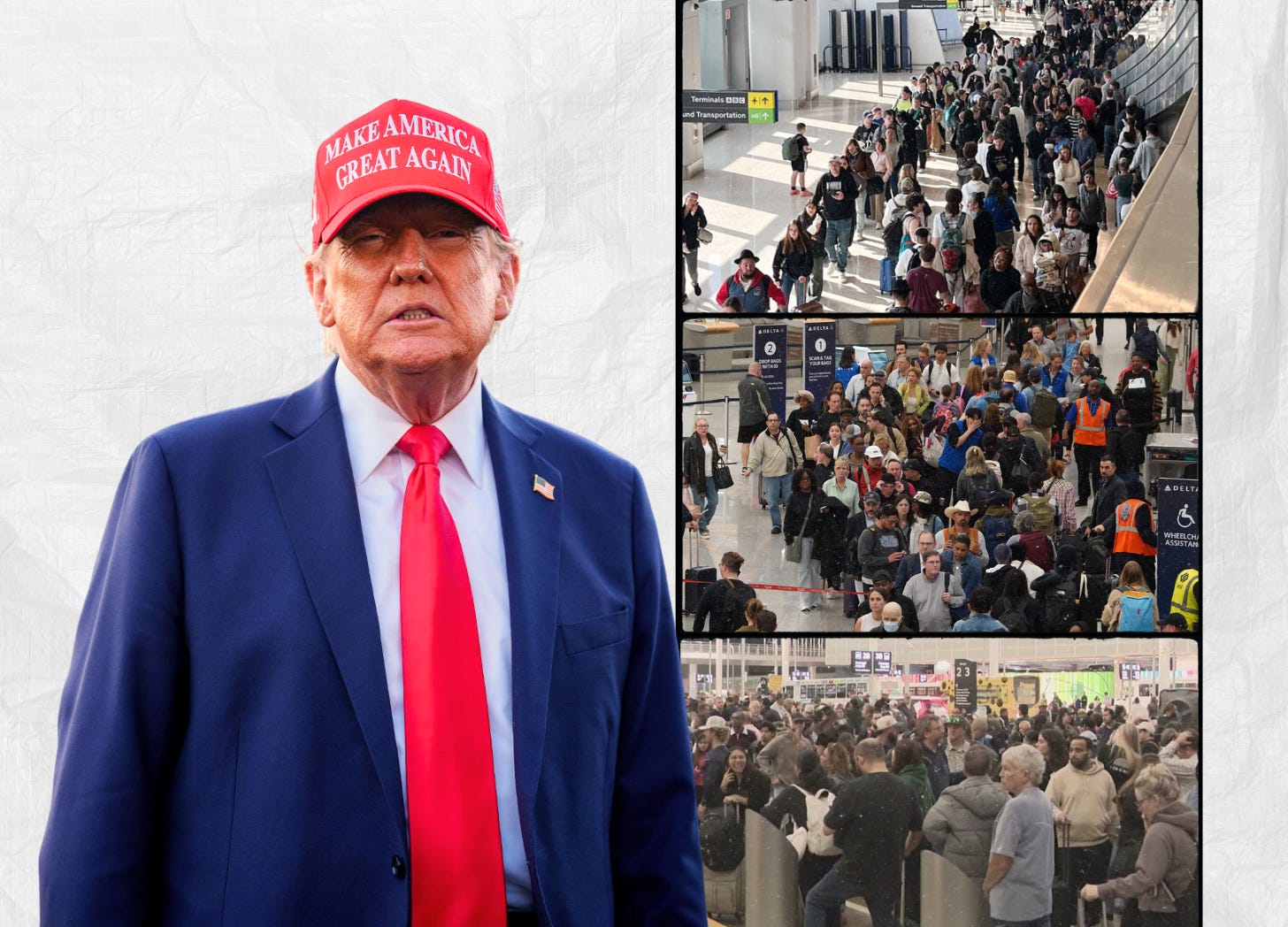
There was a narrative being pushed that Democrats were responsible for TSA agents not getting paid, for long airport lines, and for the chaos travelers experienced.
That narrative did not hold up even before TSA workers got their back pay.
And now, with new reporting confirming what happened after, it looks even weaker.
The admission that changed everything
Republican Senator John Kennedy went on Fox News and explained that there was a plan to end the shutdown and get TSA workers paid.
It was straightforward.
Reopen most of the government immediately, including the Department of Homeland Security, and deal separately with immigration funding through reconciliation. That second step would not require Democratic votes.
In other words, Republicans could have secured their immigration priorities while also restoring paychecks to TSA workers.
According to Kennedy, that plan was brought directly to Donald Trump.
Trump said no.
What we now know
The shutdown will eventually end. We are seeing the beginning stages now.
TSA workers were finally paid after 44 days.
But the new reporting makes something clear: the damage did not simply disappear once paychecks resumed.
Workers had already missed weeks of income. Financial strain had already set in. Some had called out. Some had left entirely.
And the system will not immediately recover.
The real-world consequences did not reset
Even after pay resumed, airports continued dealing with staffing shortages and operational strain.
That is the part that often gets lost.
Policy decisions do not just flip on and off like a switch. When you remove pay from thousands of workers for weeks, you create instability that lingers.
Missed paychecks lead to missed bills, stress, and in some cases, people leaving the job altogether.
That ripple effect doesn’t end the moment the shutdown ends or the direct deposit finally arrives.
This was not gridlock
This still is not a story about both sides being stuck.
There was a viable path to reopen DHS and pay TSA workers quickly. It was identified. It was explained. And then it was rejected.
That means the consequences we saw, and the aftereffects we are still seeing, came from a decision.
Not confusion or process. A decision.
The messaging versus reality gap
Despite all of this, the messaging remained the same.
“Democrat shutdown.”
But that claim runs into two separate problems now.
First, a Republican senator publicly described a solution that was rejected.
Second, we have the aftermath. Workers unpaid for weeks. Lingering disruptions. A system that did not simply snap back to normal.
At some point, messaging has to contend with outcomes.
Holding paychecks hostage
There is also the matter of what the shutdown has been tied to.
Trump pushed to link reopening the government to the Save America Act, a bill that did not have the votes to pass in the Senate.
So even as an alternative path existed, the chosen path depended on something that could not realistically clear Congress.
That is not leverage. This is nothing more than a delay tactic at the expense of federal workers.
What voters actually saw
This is where the political impact becomes clearer.
Travelers did not experience a talking point. They experienced long lines, delays, and uncertainty.
TSA workers did not experience messaging. They experienced missing paychecks.
And now, even after the checks cleared, the story did not resolve cleanly. The shutdown persists and the effects linger.
That makes it harder to rewrite.
The broader problem
This is about credibility.
When people are told one thing, but experience another, they notice.
When they then learn that there was an alternative that could have avoided the worst of it, that matters.
And when the consequences continue even after the official “end of the crisis,” it reinforces the reality of what happened.
Where this goes next
The consequences of this will be felt long-term.
That is the part that matters politically.
Because the next time voters are told to ignore what they are seeing and instead accept a cleaner, simpler narrative, they will be doing so with this example in mind.
The question is no longer just who caused the shutdown.
It is whether the explanation matches the reality people lived through.
We’re reaching over 150 million people every month across YouTube, podcasts, Substack, and beyond. But algorithms can change. Platforms can fold. And when that happens, this newsletter is how we stay connected.
If you’re not yet a paid subscriber, please consider joining.
If you’re already paid on one platform, consider supporting us on both Substack and our website.
You can subscribe on our website and right here on Substack.
And if you’re really on fire, consider gifting a subscription—we’ve got thousands on our waiting list ready to read, watch, and fight back.
Let’s keep building.
—David
PS: Can’t contribute right now? No problem. You can support us for free by subscribing on YouTube, listening to our audio podcast on Spotify or Apple Podcasts, or become a free subscriber to this very Substack. Every bit counts.
Ya, what a fucking shyster.
Just like when Trump lied about the severity of COVID when over a million people in the US died. Everyone could see with their eyes that it was very serious. He is doing the same thing with the Iran war.