

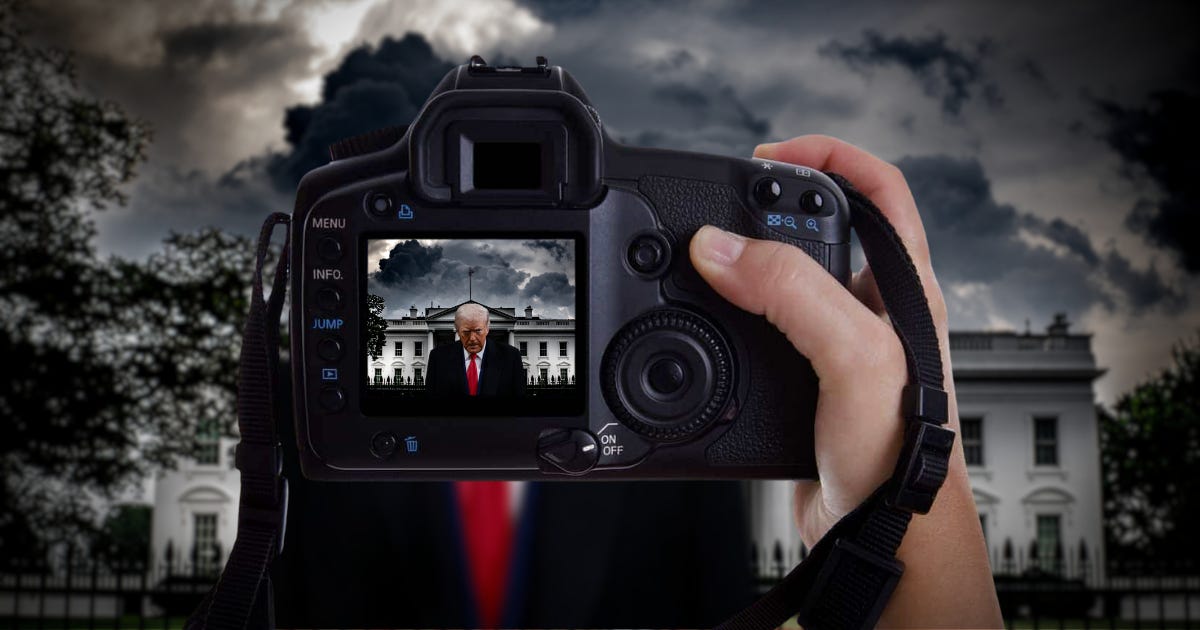
There is a difference between a politician responding to criticism and a government trying to raise the cost of being a critic.
The Trump White House appears to have decided that criticizing the president should come with consequences. And increasingly, those consequences aren’t limited to responding with words. They involve publicly targeting critics, encouraging coordinated attacks, and raising the cost of speaking out.
Over the last several months, I’ve been targeted by the White House’s so-called “media offenders” list. There have been attempts to interfere with my first book, what I believe are attempts to undermine my forthcoming second book, and public smears amplified by figures including Donald Trump Jr., Karoline Leavitt, and Steven Cheung.
I don’t want to spend time relitigating each individual incident. Focusing only on the latest outrage risks missing the larger story. The concern is the system that appears to be taking shape around these attacks.
Raising the cost of dissent
It often starts with identifying a public enemy.
Once someone is labeled as disloyal, dangerous, or somehow outside the acceptable boundaries of public discourse, that label travels far beyond politics. Millions of supporters see it. Businesses see it. Publishers see it. Advertisers see it. Tech platforms see it.
The message doesn’t have to be explicit. The implication is enough: this is someone you may not want to associate with.
The next step is to attach something more sinister to the target. Maybe they’re accused of being communist. Maybe they’re called anti-American. Maybe they’re portrayed as sympathetic to terrorists or guilty of treason. The specific accusation is almost secondary. Accuracy isn’t the objective. Creating hesitation is.
If enough people begin wondering whether it’s worth the risk to work with someone, the campaign has already accomplished much of what it set out to do.
Fear does the work
One of the most effective forms of censorship doesn’t require banning speech.
Instead, people begin censoring themselves.
A journalist may decide not to pursue a story. A publisher may think twice before signing an author. A guest may decline an interview. A creator may soften criticism because the personal and professional costs suddenly seem much higher than they were before.
The government never has to issue a formal prohibition if enough people conclude that staying quiet is simply easier.
History offers plenty of examples of this process. In Vladimir Putin’s Russia, independent journalists have been branded as “foreign agents” before legal and financial pressure followed. In Hungary, Viktor Orbán’s government has marginalized critical media while directing state resources toward friendly outlets, gradually reshaping the information landscape in its favor.
The United States has stronger institutions than many of those countries. But institutions remain strong only if people recognize these warning signs before they become normalized.
Authoritarianism rarely arrives all at once
People often imagine democratic backsliding as a single dramatic event. The reality is more similar to a long series of smaller decisions.
More often than not, this happens through accumulation. It starts with a blacklist. Then comes economic pressure. Maybe there's a questionable investigation or a threatening legal letter that forces someone to spend time and money defending themselves. Layer enough of those tactics together, and critics inevitably begin asking themselves whether speaking out is really worth the cost.
Each individual step may appear manageable. Together, they can fundamentally change how freely people feel they can express themselves.
That is why these moments deserve attention before they become routine.
Support independent voices before they disappear
This isn’t just about me.
I certainly hope people support my work, subscribe to this program, and preorder my upcoming book. But the principle extends far beyond any one creator.
Independent journalists, local reporters, authors, whistleblowers, and smaller creators often don’t have teams of lawyers or millions of followers to absorb coordinated attacks. They are usually the most vulnerable when political pressure begins to build.
If there is one way to discourage these tactics, it is to make them backfire.
When independent voices are attacked, they should gain readers rather than lose them. Their books should sell more copies. Their reporting should reach larger audiences. Their communities should become stronger instead of retreating.
Making intimidation ineffective is one of the strongest defenses against it.
Don’t wait until it’s obvious
One of the ideas I explore in my new book is how propaganda and information overload make it difficult to recognize these patterns while they are unfolding. By the time many people realize what has happened, the landscape has already changed.
It’s easy to look back years later and wonder how a country drifted so far from its democratic norms. The harder challenge is recognizing those incremental changes while they are still happening.
That’s why these conversations matter now, not years from now.
So I’ll leave you with this: At what point do attacks on critics stop looking like ordinary political fights and start looking like an attempt to discourage criticism itself? And how should the public respond before that line is crossed?

We’re reaching over 150 million people every month across YouTube, podcasts, Substack, and beyond. But algorithms can change. Platforms can fold. And when that happens, this newsletter is how we stay connected.
If you’re not yet a paid subscriber, please consider joining.
If you’re already paid on one platform, consider supporting us on both Substack and our website.
You can subscribe on our website and right here on Substack.
And if you’re really on fire, consider gifting a subscription—we’ve got thousands on our waiting list ready to read, watch, and fight back.
Let’s keep building.
—David
PS: Can’t contribute right now? No problem. You can support us for free by subscribing on YouTube, listening to our audio podcast on Spotify or Apple Podcasts, or become a free subscriber to this very Substack. Every bit counts.
I admire your bravery for continuining to post the truth and not backing down to pressure.
This administration is insane. Trump is the biggest bully ever. He has no room to tell people what to think or say.