

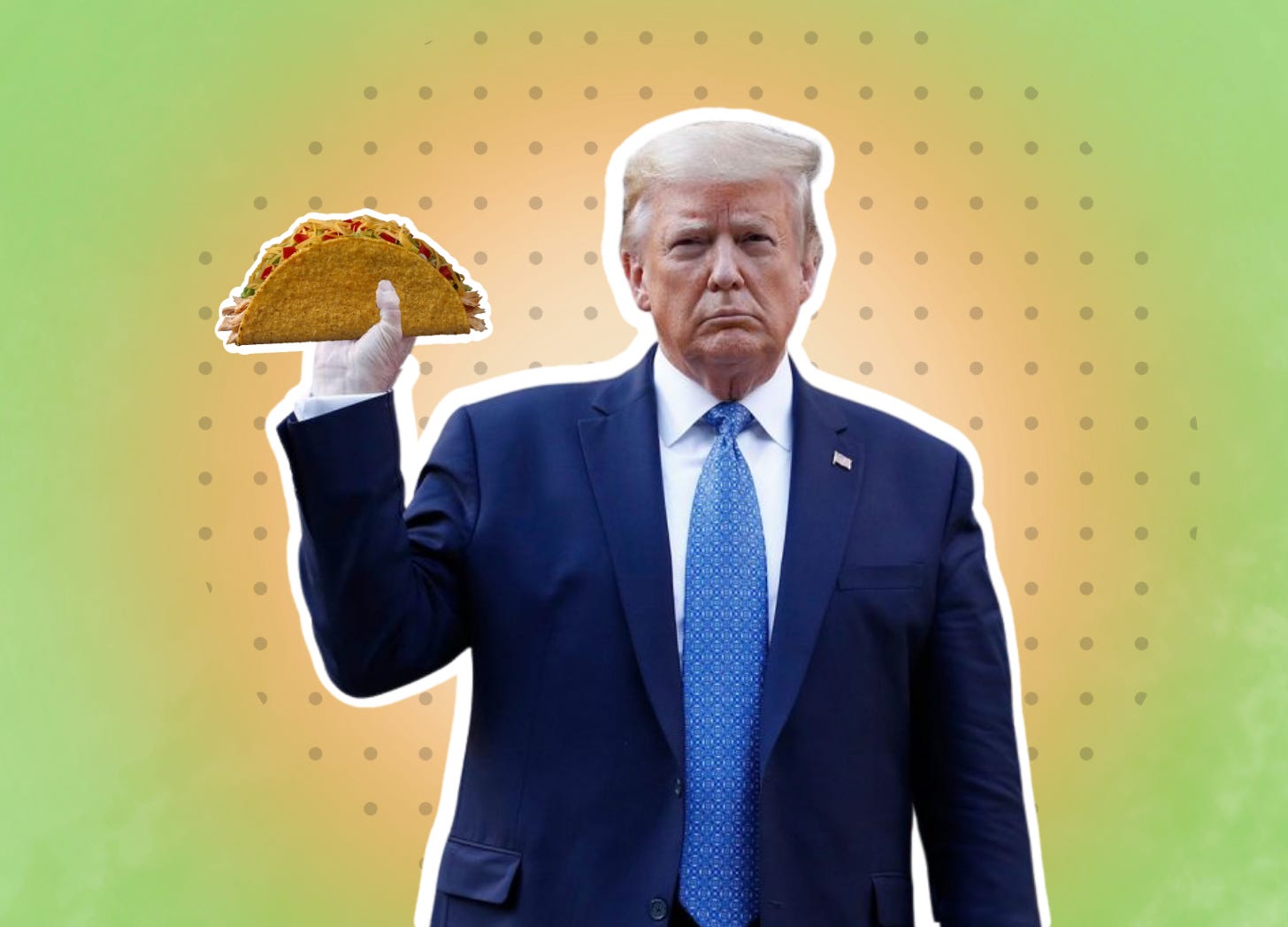
Why does Donald Trump keep backing off his own decisions?
There’s a phrase that’s been circulating to describe it: “TACO,” short for “Trump Always Chickens Out.”
While the acronym may often be said in jest, this isn’t random. It’s a pattern. And once you see it, you can’t unsee it.
The cycle repeats over and over again. It starts with a big, confident announcement, sweeping promises, and total certainty.
Then confusion sets in, consequences emerge, and the inevitable walkback begins.
It’s not always a full reversal. Sometimes it’s softer language, sometimes policy tweaks, and sometimes a quiet rhetorical retreat.
But the pattern is consistent.
The pattern is not random
Let’s start with tariffs.
Trump announces massive, sweeping tariffs with total confidence. Markets react immediately. Businesses panic. And then, almost on cue, the carve-outs begin.
We’re going to pause some, reduce others. There are some exemptions. We’re negotiating. Actually, we’re escalating on China. But also de-escalating elsewhere.
It becomes on-again, off-again policymaking in real time.
Why? Because the economic consequences show up quickly. And when they do, the tough guy posture suddenly runs into reality.
The same thing plays out in foreign policy.
Look at the escalation with Iran: strikes are launched, markets react, oil spikes, gas prices rise, and global uncertainty kicks in.
Then almost immediately, the tone shifts.
“We’ve basically achieved our objectives. It’s almost done. Everything is under control!”
Except it isn’t. Because the escalation often continues even as the messaging pivots toward calm.
Within days, sometimes within hours, you get both escalation and de-escalation happening at the same time.
This has been happening for years
This ‘chickening out’ trend isn’t new either.
Let’s go back to healthcare.
Trump promised to repeal and replace the Affordable Care Act with something better. A plan was introduced that would have left tens of millions without coverage over time.
The reaction was immediate. Political pressure built. Then the entire effort collapsed.
No replacement. No follow-through. The promise just… disappeared.
Or take the so-called “Muslim ban.”
A sweeping announcement. Immediate legal chaos. Judicial challenges. Revisions. Scaling back. And more legal fights.
The same pattern again.
It was a big move with immediate consequences followed by a partial retreat.
Even with troop withdrawals, immigration policies, trade negotiations. The details change, but the structure stays the same.
Strategy or incompetence
So what is this? Is it a deliberate strategy, or is it disorganization?
The answer is both.
There is a level of impulsivity. Decisions are often made quickly, framed as instinct.
But “instinct” in this context often means reacting to whoever had the president’s attention last.
There’s also a lack of the kind of process you would normally expect..
In a typical administration, major decisions are tested before they’re announced. Legal reviews happen. Economic impacts are modeled. Political risks are assessed.
With Trump, the announcement often comes first and the consequences come second.
The real problem is what happens after
The biggest issue isn’t even the initial decision.
It’s what happens next.
When policy is announced before it’s fully thought through, the system ends up reacting in real time. Markets, courts, allies and businesses all react in real time.
Then the administration is forced into a position where it has to adjust on the fly which creates instability and confusion.
And this creates a situation where no one is entirely sure what the actual policy is at any given moment.
What you end up with is a style of governance that is reactive rather than deliberate.
Announce first, adjust later. Escalate, then soften. Project certainty, then quietly recalibrate.
And because this happens repeatedly, it stops looking like isolated incidents and starts looking like a governing approach.
One that prioritizes immediate impact over long-term consistency.
Why this matters
There’s a political dimension to this, but there’s also a structural one.
Markets don’t like uncertainty. Businesses don’t like unpredictability. Allies don’t like mixed signals.
When policy shifts rapidly, it becomes harder for anyone to plan around it.
And when the pattern repeats often enough, the credibility of the initial announcement starts to erode.
If every bold move is followed by a retreat, people begin to expect the retreat.
And that changes how the entire system responds.
The bottom line
This isn’t about one policy or one moment.
It’s about a recurring cycle.
Big announcement. Immediate fallout. Partial walkback.
Over and over again.
At some point, the question stops being, “Why did this happen this time?”
And becomes, “Why does this keep happening at all?”
Because once a pattern is established, it’s no longer a surprise.
It’s the system.
We’re reaching over 150 million people every month across YouTube, podcasts, Substack, and beyond. But algorithms can change. Platforms can fold. And when that happens, this newsletter is how we stay connected.
If you’re not yet a paid subscriber, please consider joining.
If you’re already paid on one platform, consider supporting us on both Substack and our website.
You can subscribe on our website and right here on Substack.
And if you’re really on fire, consider gifting a subscription—we’ve got thousands on our waiting list ready to read, watch, and fight back.
Let’s keep building.
—David
PS: Can’t contribute right now? No problem. You can support us for free by subscribing on YouTube, listening to our audio podcast on Spotify or Apple Podcasts, or become a free subscriber to this very Substack. Every bit counts.
Basically he doesn’t know what he’s doing…besides that I don’t believe he is the one calling the shots.
🌮