

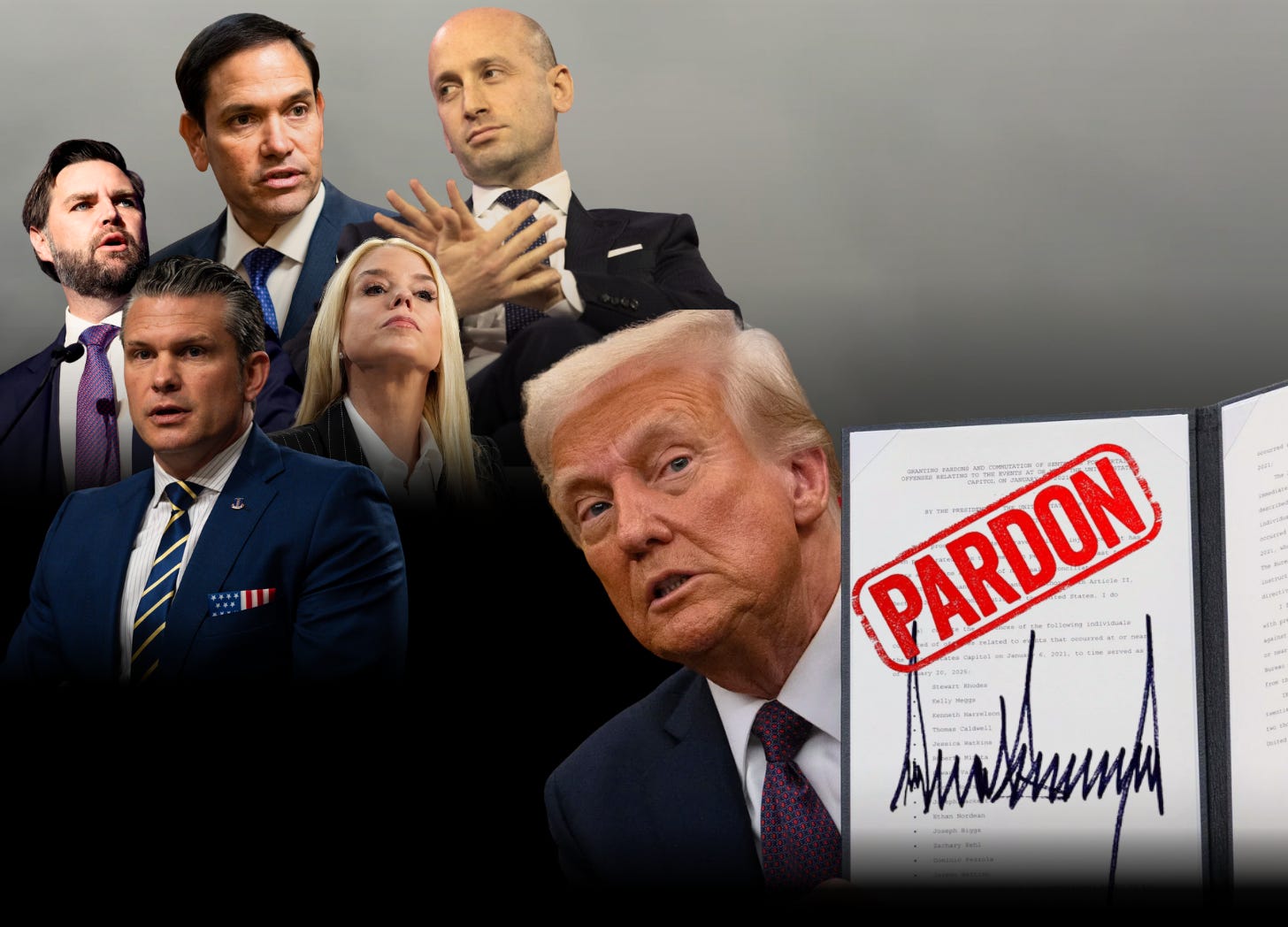
Donald Trump is reportedly planning something that goes far beyond the already controversial use of presidential pardons. And if the reporting is accurate, it should raise serious concerns not just about Trump, but about the structure of the pardon power itself.
According to new reporting, Trump has been privately telling people in his inner circle that he intends to issue sweeping, blanket pardons before leaving office. Not targeted pardons or case-by-case reviews. Something much broader.
At one point, Trump reportedly framed it this way: if you were within a certain physical distance of the Oval Office, you would get a pardon. The exact number of feet may change depending on how he tells the story, but the message is consistent. Proximity to Trump equals protection.
The pardon power was never meant for this
The presidential pardon power is extremely broad. That much is true. But there is a difference between something being legally permitted and something being used in a way that aligns with its intended purpose.
Historically, pardons have been justified as a tool for correcting injustice. A president might review a case, consider the facts, and determine that a punishment was excessive or that a miscarriage of justice occurred. That is the theory behind it.
What is being described here is something else entirely.
This is not about reviewing individual cases. This is not about justice or fairness. This is a preemptive, blanket promise of protection, disconnected from any specific wrongdoing. The message being sent is simple: do what needs to be done, and legal consequences will not be a problem later.
That fundamentally changes behavior.
When accountability disappears, behavior changes
If people believe they are going to be pardoned regardless of what they do, they are going to act differently. That is not speculation, it is basic incentive structure.
When the consequence for wrongdoing is removed, or at least perceived to be removed, the barrier to engaging in that wrongdoing gets lower. Former Justice Department officials have warned that this kind of messaging encourages more aggressive and legally questionable behavior. That should not be surprising.
It is exactly what you would expect.
And this is not happening in a vacuum. Trump has already issued a significant number of clemency grants, many of which involve allies, donors, or individuals connected to him politically. That context matters because it shows a pattern.
What we are seeing now is not a one-off idea. This is an escalation.
The political timing matters
There is also a strategic element here that should not be ignored.
If Democrats take control of the House, oversight and investigations are going to follow. That is not controversial or conspiratorial, it is how the system is supposed to work. Congressional oversight is a core function, especially when there are credible concerns about misconduct.
The reporting suggests that Trump’s discussion of blanket pardons is happening alongside concerns from aides about potential legal exposure. In other words, when people around him express worry about investigations, the response is not reassurance based on innocence. It is reassurance based on future pardons.
That is a very different kind of signal.
There is even discussion of a potential public announcement, possibly framed as a major event, where large groups of pardons would be issued all at once. At that point, it stops being a legal mechanism and becomes something closer to a political spectacle.
This is why pardon reform matters
This brings us to a broader issue that goes beyond Trump.
The pardon power, as currently structured, is a vulnerability. Not because every president abuses it, but because the system allows for abuse without meaningful guardrails.
There is a reasonable middle ground here. Reform does not have to mean eliminating the pardon power entirely. It can mean introducing transparency and oversight focused specifically on corruption.
One proposal that has been discussed is the creation of an independent review board. Not to override the president’s judgment on the facts of a case, but to assess whether a pardon appears to involve corruption. Is there a quid pro quo? Is there a personal or political benefit tied to the decision?
That is a different question than whether someone deserves clemency.
A properly structured review process could preserve the legitimate use of pardons while making it much harder to use them as tools of personal protection or political reward.
The limits of federal pardons
There is one important limitation worth keeping in mind.
Presidential pardons apply only to federal crimes. They do not extend to state-level offenses. That means that even if broad federal pardons are issued, they would not necessarily shield individuals from state investigations or prosecutions.
If congressional investigations lead to referrals at the state level, those cases would still move forward independently.
That does not eliminate the concern entirely. But it does mean the situation is not as absolute as it might initially appear.
Where this is headed
Even if nothing changes in the short term, this is a moment that should force a serious conversation about the structure of executive power.
The issue is not just what one president might do. It is what any president could do under the current system.
If the standard for receiving a pardon becomes personal proximity to power rather than any consideration of justice, then the entire concept of accountability starts to erode. Once that erosion begins, it does not stay contained to one administration.
The broader question is whether there is political will to address it.
Because if this is not the moment when reform becomes part of the conversation, it is not clear when that moment would come.
We’re reaching over 150 million people every month across YouTube, podcasts, Substack, and beyond. But algorithms can change. Platforms can fold. And when that happens, this newsletter is how we stay connected.
If you’re not yet a paid subscriber, please consider joining.
If you’re already paid on one platform, consider supporting us on both Substack and our website.
You can subscribe on our website and right here on Substack.
And if you’re really on fire, consider gifting a subscription—we’ve got thousands on our waiting list ready to read, watch, and fight back.
Let’s keep building.
—David
PS: Can’t contribute right now? No problem. You can support us for free by subscribing on YouTube, listening to our audio podcast on Spotify or Apple Podcasts, or become a free subscriber to this very Substack. Every bit counts.
They want all the power, and zero responsibility.
This will not fly.
Is he planning to leave power soon?