

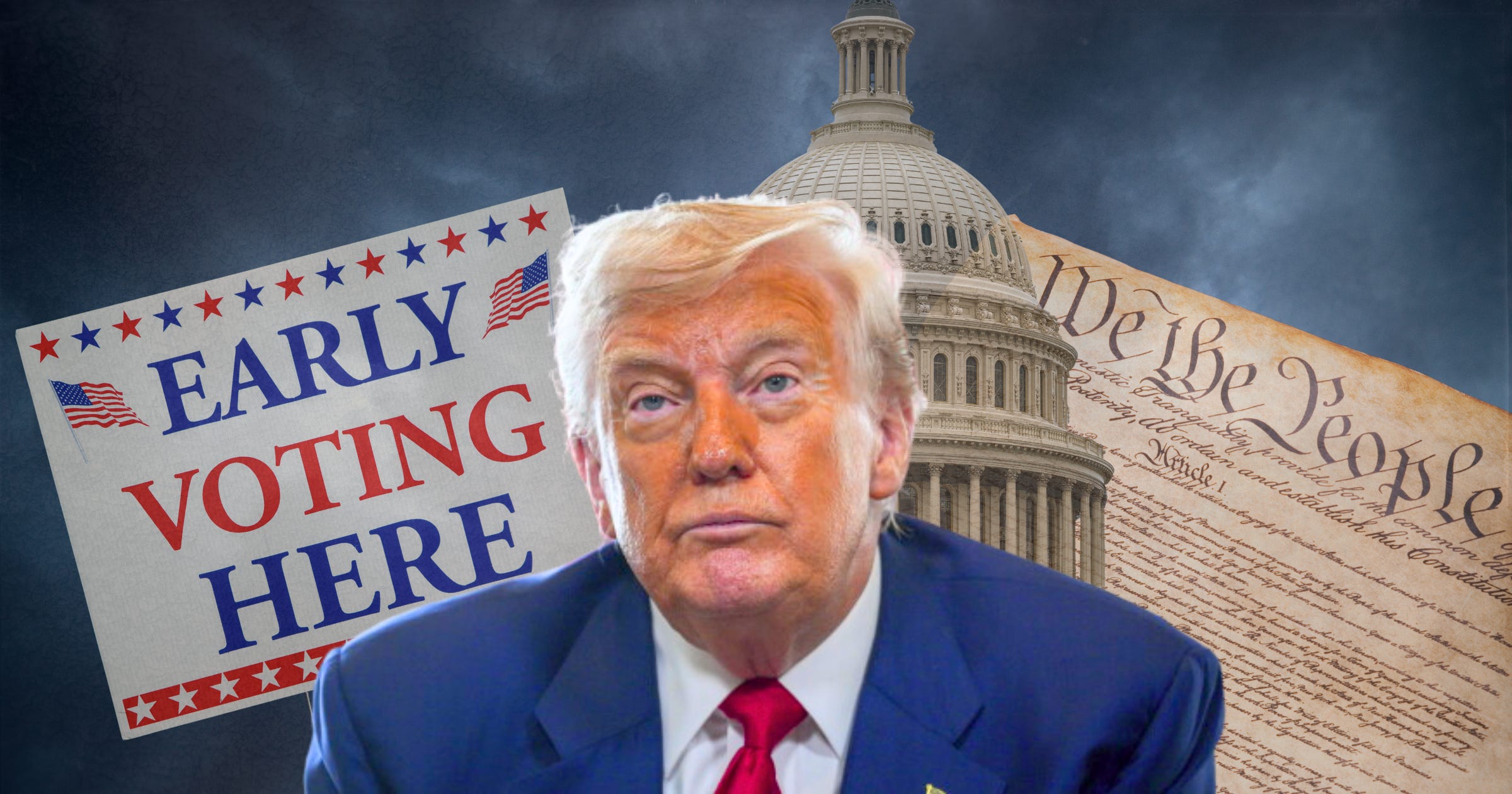
Donald Trump may have just tipped his hand about what he is considering for the November election.
And what is incredibly troubling is that millions, if not tens of millions, of Americans probably have no idea this conversation is even happening.
Trump appeared this week on The Wayne Allyn Root Show, where he was presented with a remarkable proposal: If Congress does not pass the election legislation he wants, declare a national security emergency and use it to impose new voting rules from the White House.
Root suggests Trump can simply require photo ID, require proof of citizenship, limit mail-in ballots, restrict early voting, and do it regardless of what state law says.
Trump could have immediately shut this down. He could have said the president does not have the authority to do that. He could have said election laws cannot simply be rewritten by presidential decree.
Instead, Trump responded with what sounded very much like a wink and a nod.
“Let me just say that stranger things have happened. Okay, I’ll leave it at that.”
That response deserves far more attention than it is getting, because Trump is being encouraged to use emergency powers to interfere with the November election, and rather than rejecting the idea, he appears to be entertaining it.
We have become so desensitized to the insanity of American politics that it is tempting to hear something like this and think, Yeah, yeah, Trump is threatening to do another crazy thing. Give me a break.
But look at what is actually being proposed here.
Root was not asking Trump to support a bill changing federal election law. Congress is already debating the SAVE America Act, legislation that would impose new documentary proof-of-citizenship and photo-ID requirements for federal elections. The House passed the legislation earlier this year, but it has stalled in the Senate.
Root was suggesting that if Congress does not give Trump what he wants, Trump should go around Congress.
Forget the legislative process. Forget state election laws. Forget governors and state attorneys general. Just declare an emergency and start imposing election rules from Washington.
That is an extraordinary power grab.
And when Trump was given the opportunity to shut the door on the idea, he left it very conspicuously open.
His answer had the unmistakable feel of a trial balloon: I’m thinking about it. Keep talking about it. Let’s see how people respond.
That is often how radical ideas become normalized. Someone floats the proposal. Political allies repeat it. Supporters start debating whether it might actually be necessary. Before long, the conversation has moved from This would be outrageous to Well, it is certainly one option.
Trump’s response helps move that process along.
The president does not get to rewrite election law
There is a fairly important obstacle to this plan called the Constitution.
For congressional elections, the Elections Clause gives states the initial responsibility for determining the “Times, Places and Manner” of elections while expressly giving Congress the power to alter those regulations. The president is conspicuously absent from that arrangement.
A presidential emergency declaration does not magically transfer that constitutional authority to the Oval Office.
Trump can declare emergencies that activate powers Congress has already granted to the executive branch. He cannot simply announce an emergency and invent an entirely new presidential power to dictate how states administer elections.
We have already seen courts push back against Trump’s attempts to do this through executive action. His administration has pursued orders involving citizenship verification and mail-in voting, and federal courts have blocked portions of those efforts on the grounds that the executive branch does not possess the authority it is claiming. As recently as this week, a federal judge again blocked the administration from implementing parts of an executive order aimed at restricting mail-in voting.
If Congress wants to change federal election law, Congress can pass legislation. Trump does not get to take that power because he used the word “emergency.”
An illegal order can still create chaos
Here is where this gets more concerning. An unlawful presidential order can still create enormous confusion.
Imagine Trump sitting in the Oval Office shortly before Election Day and announcing that because of some supposed national security threat, he is imposing new restrictions on voting or attempting to postpone some part of the election.
Legally, saying it does not make it so.
But politically and practically? Now you have emergency lawsuits. Election officials are trying to determine what they are supposed to do. Trump-aligned state officials may decide they want to follow his directive even if they are not legally obligated to. Voters suddenly have competing messages about whether the rules have changed.
The resulting chaos could itself damage confidence in the election.
And I can absolutely imagine some Republican attorney general somewhere saying, “Maybe the president can’t force us to do this, but we agree with him, so we’re going to try.”
That is the danger of a president publicly entertaining powers he does not actually possess.
How an extreme idea starts sounding reasonable
There is another piece of this that connects directly to something I have been talking about for years, including in my forthcoming book, Pay Attention.
Most people do not actively choose everything they learn about politics.
Algorithms watch what gets your attention, what makes you angry, what scares you, and what you share. Then they give you more of it.
They are not optimizing for constitutional law. They are optimizing for engagement. And that creates wildly different information environments.

Someone watching my show has probably heard repeatedly that Trump and people around him have been discussing aggressive federal intervention in the 2026 election. They have heard the warnings. They know this conversation is taking place.
Millions of other Americans may encounter an entirely different story.
Their feeds might be filled with stories about undocumented immigrants, sensational crime videos, and claims of widespread illegal voting. They may hear very little about Trump’s allies simultaneously encouraging him to seize powers presidents do not have.
Then imagine Trump actually declares an election emergency.
To someone living inside that information environment, the announcement may suddenly sound logical.
Of course he had to do it. Look at everything I’ve been seeing.
Meanwhile, someone consuming a completely different set of information sees the same presidential announcement and thinks, This is exactly the authoritarian power grab we were warned about.
Same country. Same president. Same announcement. Completely different perceived realities. That is an incredibly dangerous environment in which to conduct an election.
The warning is happening now
The easiest time to recognize an abuse of power is after it happens.
The harder and more important time is while the idea is still being tested.
That is where we are.
Trump has not declared a national election emergency. He has not successfully seized control of state elections. The legal framework still puts election administration primarily in the hands of states, subject to congressional authority over federal election rules.
But someone close to the MAGA information ecosystem just went on the air and encouraged the president of the United States to use emergency powers to circumvent that framework.
Trump could have responded with five simple words: I cannot legally do that.
Instead, he told the audience, “Let me just say that stranger things have happened. Okay, I’ll leave it at that.”
That deserves attention now, rather than the morning after some attempted executive order throws election administration into chaos.
Because once everyone is arguing about injunctions, emergency Supreme Court filings, conflicting instructions to election officials, and whether some Republican state is going along with Trump’s decree, we will already be several steps further down the road.
Being informed is step one.
So what do you make of Trump refusing to shut this idea down? Do you see this as another Trump trial balloon that will disappear, or something Americans should be taking very seriously before November? Tell me your thoughts in the comments.
We’re reaching over 150 million people every month across YouTube, podcasts, Substack, and beyond. But algorithms can change. Platforms can fold. And when that happens, this newsletter is how we stay connected.
If you’re not yet a paid subscriber, please consider joining.
If you’re already paid on one platform, consider supporting us on both Substack and our website.
You can subscribe on our website and right here on Substack.
And if you’re really on fire, consider gifting a subscription—we’ve got thousands on our waiting list ready to read, watch, and fight back.
Let’s keep building.
—David
PS: Can’t contribute right now? No problem. You can support us for free by subscribing on YouTube, listening to our audio podcast on Spotify or Apple Podcasts, or become a free subscriber to this very Substack. Every bit counts.
By the constitution he has NO power in elections by design of the founders. Any thing else is treason in the eyes of the constitution!
Dear criminal felon, sexual assaulter, pedophile protector, Democracy despiser, Constitution abhorer, and all-around America hater,
Keep your filthy grubby tiny hands off of our elections!!
-The American people