

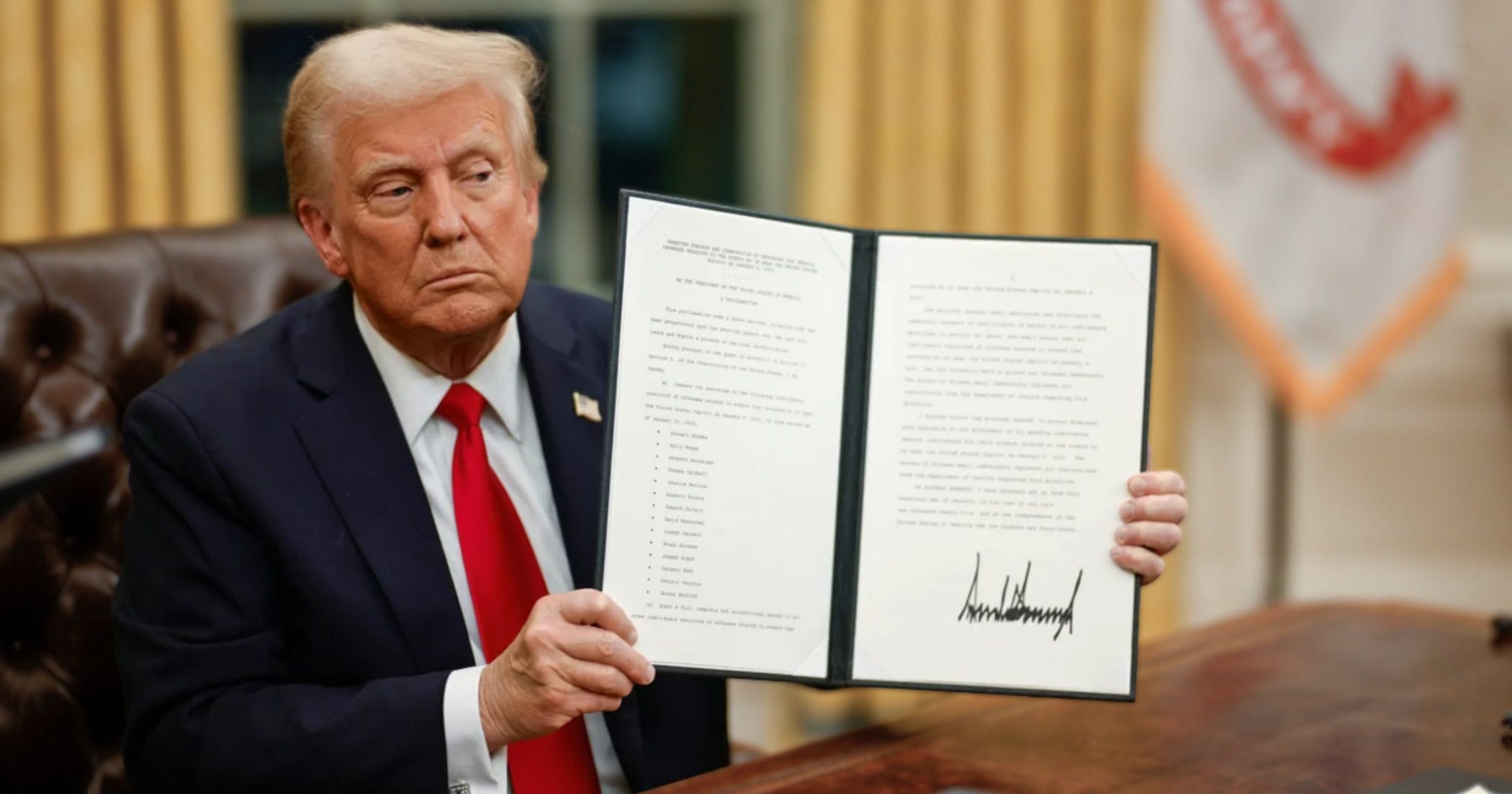
Donald Trump has now reached the point where he is announcing that certain words will no longer be allowed because he personally doesn’t like them.
Yes, we are apparently at the stage of the Trump presidency where the president of the United States believes he can dictate which words Americans are permitted to use. And while the specific terminology involved in this latest controversy is almost comically ridiculous, the underlying issue deserves considerably more attention.
Controlling language has long been a feature of authoritarian governments. The ability to determine which words are acceptable, which descriptions are legitimate, and which people are considered enemies for refusing to comply is a powerful tool for shaping public discourse.
And Trump is now attempting to exercise that kind of control over something as ordinary as the term “artificial intelligence.”
Trump’s latest obsession with language
In a recent Truth Social post, Trump complained about The Wall Street Journal continuing to use the term “artificial intelligence,” which he described as inaccurate. He insisted that the technology should instead be called “super intelligence,” claiming that virtually everyone was already using his preferred terminology or soon would be.
Then came the remarkable announcement. Trump declared that his administration would be “officially banning” the term artificial intelligence from relevant government documents and other uses.

There are several problems here, beginning with the obvious fact that virtually nobody has adopted Trump’s preferred terminology. Artificial intelligence has been an established scientific term since the 1950s. It is used by researchers, technology companies, universities, journalists, and governments around the world.
Trump appears to have decided that the word “artificial” sounds negative, perhaps because it suggests something fake or inferior. So he prefers “super intelligence,” which presumably sounds bigger, better, and more impressive.
But the terminology actually matters in this field. Artificial intelligence describes a broad category of technologies capable of performing tasks associated with human intelligence. Super intelligence, meanwhile, generally refers to a hypothetical system that surpasses human intelligence across a wide range of capabilities.
These are two different concepts with two different meanings. Changing the terminology because the president likes one word better doesn’t make the underlying technology any different.
And yet, Trump has decided that his personal preference should become official government policy.
When using the wrong word makes you an enemy
The situation becomes more disturbing when we consider how Trump describes those who refuse to adopt his preferred language. Earlier this month, he reportedly declared that the White House considers people who continue using “artificial intelligence” instead of “super intelligence” to be enemies.
Think about that. A scientist, journalist, or programmer could be labeled an enemy simply for using an established scientific term.
According to The Independent, Trump has also signed an executive order directing the federal government to adopt his preferred terminology. While presidents can establish language guidelines for federal agencies, they cannot dictate what words private citizens, journalists, or businesses are allowed to use.
But Trump seems to expect everyone to fall in line, regardless of his actual authority. And those who refuse risk being branded enemies.
The authoritarian history of controlling language
There is a reason this kind of behavior should concern us, even when the immediate subject seems absurd.
George Orwell explored the relationship between language and political control in his novel 1984. One of the central concepts in the book is Newspeak, a deliberately restricted language designed to narrow the range of ideas people can express and, eventually, even think about.
The basic principle is that controlling language can become a means of controlling political thought.
History provides plenty of examples of authoritarian governments manipulating terminology to shape how the public understands events.
Nazi Germany employed euphemisms such as “special treatment” to conceal the reality of mass murder. The Soviet Union routinely characterized political opponents as “enemies of the people,” transforming disagreement with the government into a supposed betrayal of society itself.
The Chinese Communist Party continues to exercise extensive control over politically sensitive terminology and public discussion of historical events.
Obviously, Trump’s attempt to rename artificial intelligence is nowhere near equivalent to the atrocities or repression associated with those regimes. But the underlying authoritarian instinct, the belief that political leaders should determine which language is acceptable and punish those who refuse to comply, is recognizable.
And this has become a recurring feature of Trump’s political approach.
Journalists who ask difficult questions become enemies of the people. Elections that Republicans lose become rigged elections. Judges who rule against Trump become corrupt judges. Investigations into his conduct become political witch hunts.
Now, apparently, someone using a perfectly ordinary scientific term can also become an enemy.
The pattern is increasingly difficult to ignore. Trump wants to determine which descriptions of reality are legitimate, and he expects the public to accept his definitions.
Real problems are being ignored
Perhaps the most frustrating aspect of this entire controversy is that artificial intelligence presents enormous challenges that actually deserve presidential attention.
We are facing serious questions about how AI will affect employment, economic inequality, privacy, misinformation, national security, and public safety. Governments around the world are trying to understand how rapidly advancing technology should be regulated and what protections might be necessary.
These are complicated issues with potentially enormous consequences for millions of people.
And the president of the United States is spending his time arguing with The Wall Street Journal about an acronym.
Even the proposed replacement creates unnecessary confusion. Super intelligence already has an established meaning within the field, and the abbreviation “SI” is used in numerous other contexts.
None of that seems to concern Trump.
What appears to matter most is whether institutions will adopt his preferred language simply because he demands it. Accuracy becomes secondary to compliance, and a disagreement over terminology becomes another opportunity to test whether people will fall in line.
We have seen this dynamic repeatedly throughout Trump’s political career. He makes an extraordinary demand, his supporters defend it, and institutions are pressured to accommodate something that would have been considered completely unreasonable under almost any other president.
Eventually, the absurdity itself becomes normalized.
The danger of dismissing everything as Trump being Trump
I am increasingly tired of hearing that these incidents should simply be dismissed as Trump being Trump.
We are told that he is exaggerating, that he doesn’t really mean what he says, that he is trying to provoke liberals, or that everyone is overreacting to another outrageous social media post.
That explanation has become an excuse for avoiding serious scrutiny of presidential behavior.
We should be able to recognize that Trump’s proposed terminology change is ridiculous while also understanding that his broader desire to control public discourse is concerning.
Consider the different institutions over which Trump has sought greater influence. He wants control over the courts and judicial outcomes. He wants influence over federal prosecutions through the Justice Department. He attacks media organizations that publish unfavorable coverage. He challenges election results and seeks greater control over election administration.
He also wants to determine which journalists can question him, which questions are acceptable, and how the public should interpret his actions.
Now that same desire for control is extending to the words people use.
Each individual controversy can be treated as another strange episode in an already strange presidency. But taken together, they reveal a consistent approach to political power in which the president expects institutions, individuals, and even established facts to accommodate his personal preferences.
The concern is what happens when enough people begin treating those demands as normal.
The bigger picture
There is something almost surreal about the possibility that continuing to say “artificial intelligence” could be interpreted as an act of political resistance.
A term that has existed for roughly seven decades has suddenly become controversial because the president has decided he prefers something else.
But Americans have no obligation to pretend that Trump possesses authority over the English language. Scientists should continue using accurate scientific terminology. Journalists should continue describing the world as it exists. And private citizens should feel absolutely no pressure to adopt the president’s preferred vocabulary.
More broadly, we need to stop accepting the idea that every new attempt to expand presidential control is simply another personality quirk that should be laughed off.
There are meaningful limits to presidential authority, and those limits only remain effective when institutions and the public are willing to defend them.
With next week’s election approaching, voters have an opportunity to begin pushing back against the broader political environment that has allowed this behavior to become so routine.
Because if we reach a point where a president can declare ordinary words unacceptable and label people enemies for using them, we should be asking some serious questions about the direction of the country.
What do you think? Is this another ridiculous Trump distraction, or are we becoming too comfortable with a president who thinks he should get to decide what words we’re allowed to use?
We’re reaching over 150 million people every month across YouTube, podcasts, Substack, and beyond. But algorithms can change. Platforms can fold. And when that happens, this newsletter is how we stay connected.
If you’re not yet a paid subscriber, please consider joining.
If you’re already paid on one platform, consider supporting us on both Substack and our website.
You can subscribe on our website and right here on Substack.
And if you’re really on fire, consider gifting a subscription—we’ve got thousands on our waiting list ready to read, watch, and fight back.
Let’s keep building.
—David
PS: Can’t contribute right now? No problem. You can support us for free by subscribing on YouTube, listening to our audio podcast on Spotify or Apple Podcasts, or become a free subscriber to this very Substack. Every bit counts.
Fuck you trump! I say what I want! How about that for word choice?
We’ve all become too intelligent to become little sycophants, haven’t we⁉️😡