

Donald Trump just detonated his own narrative.
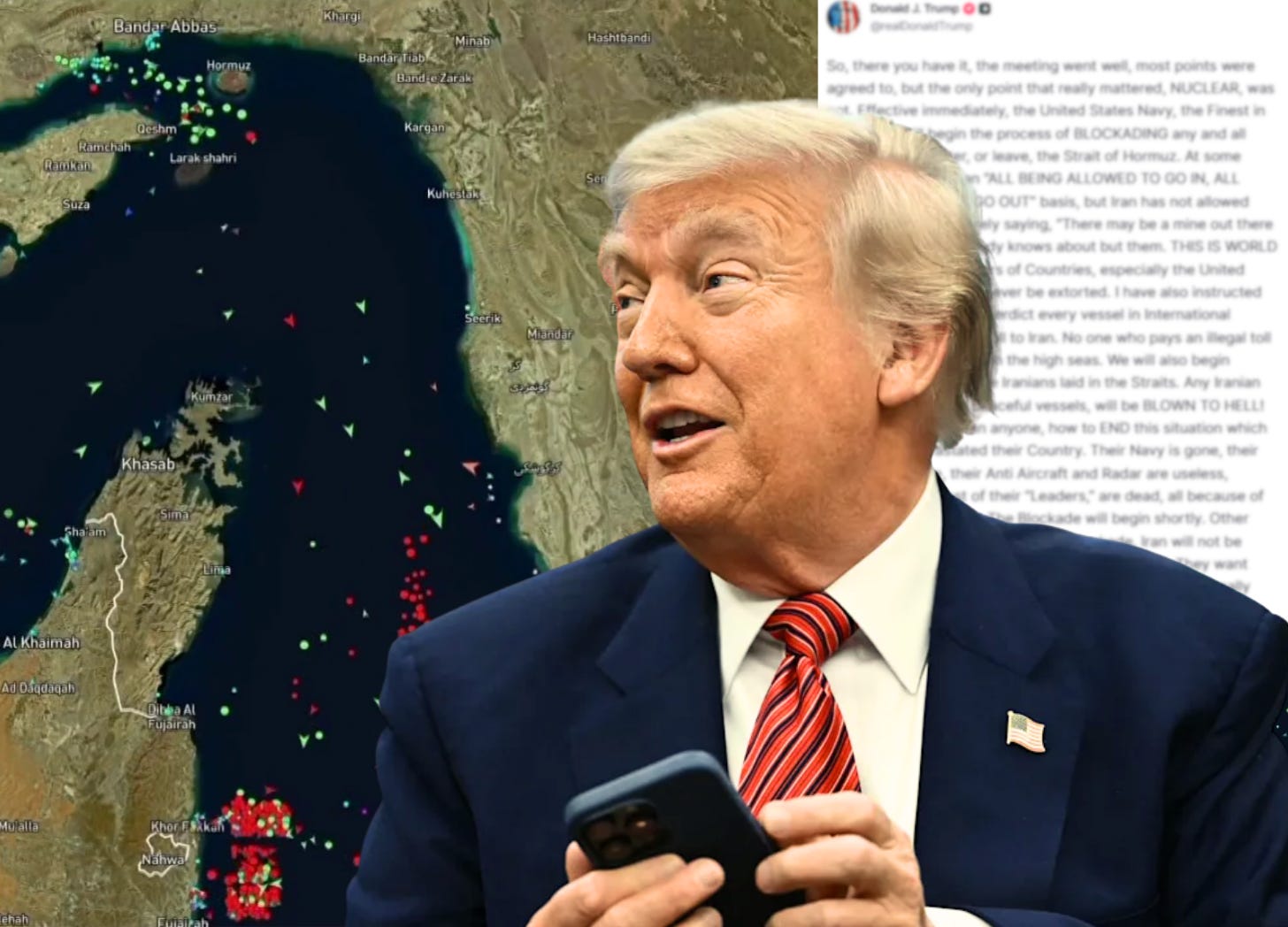
Days after claiming success in getting Iran to “open” the Strait of Hormuz, Trump is now announcing that the United States will effectively close it. Not metaphorically or diplomatically. Militarily.
If that sounds contradictory, it’s because it is.
And it’s not a minor inconsistency. It goes directly to the question of whether there was ever a strategy here at all.
The victory that wasn’t
Let’s start with what Trump already told us.
According to the White House, the Strait of Hormuz situation had been resolved. Trump declared victory. Iran, we were told, had backed down. The waterway was open. Crisis over.
Except none of that actually happened.
There was no verified reopening tied to Trump’s actions. The Strait was already functioning before the conflict escalated. The idea that this was some major diplomatic or military win never matched reality.
But the messaging kept coming anyway. The problem was “solved.” The deal was “done.” Everything was “under control.”
Until suddenly, it wasn’t.
Now he’s closing it
In a lengthy Truth Social post, Trump pivoted hard.
The negotiations led by JD Vance, which he previously framed as productive, are now being described as ineffective. The key issue, nuclear concessions, was not achieved.
So what is the response?
A U.S. naval blockade.
Trump says the United States Navy will begin stopping any and all ships attempting to enter or leave the Strait of Hormuz. He also suggests interdicting vessels in international waters that have paid tolls to Iran.
This is not symbolic. This is escalation.
And it raises a very simple question: If the Strait was already “open,” why are we now blockading it?

The logic collapse
This is where the entire narrative falls apart.
You cannot claim that the problem is solved, victory has been achieved and the Strait is open. To then, days later announce a blockade, say Iran never complied, and escalate militarily to force an outcome
Those positions do not coexist. They cancel each other out.
What we are seeing is a breakdown in coherence.
First, the administration insisted the deal was done. Then it became unclear whether any deal existed. Now the president is openly acknowledging that Iran never actually agreed to the terms being claimed.
And instead of recalibrating or explaining, the response is to escalate.
What this really means
The Strait of Hormuz didn’t suddenly become a problem overnight.
It became a problem when the conflict escalated. It became a talking point when the administration needed a win. And now it is being used to justify a new phase of confrontation.
Closing a global shipping lane in an attempt to prove that you had opened it is not strategy. It is improvisation under pressure.
And the consequences are not theoretical.
This is one of the most critical energy chokepoints in the world. Any disruption carries real economic and geopolitical risk. Markets react. Oil prices react. Allies react.
This is not a messaging error. It’s policy being made in real time, with no consistent throughline.
Where this leaves us
So what’s the actual status of the Strait of Hormuz right now?
Was it open?
Was it never closed?
Is the United States now closing it?
And if so, what exactly are we trying to achieve?
Those are not rhetorical questions. They are the baseline facts that should be clear before any military escalation.
Instead, we are getting shifting claims, retroactive justifications, and a narrative that changes depending on the day.
That’s not how you manage a geopolitical crisis.
And it’s certainly not how you declare victory.
We’re reaching over 150 million people every month across YouTube, podcasts, Substack, and beyond. But algorithms can change. Platforms can fold. And when that happens, this newsletter is how we stay connected.
If you’re not yet a paid subscriber, please consider joining.
If you’re already paid on one platform, consider supporting us on both Substack and our website.
You can subscribe on our website and right here on Substack.
And if you’re really on fire, consider gifting a subscription—we’ve got thousands on our waiting list ready to read, watch, and fight back.
Let’s keep building.
—David
PS: Can’t contribute right now? No problem. You can support us for free by subscribing on YouTube, listening to our audio podcast on Spotify or Apple Podcasts, or become a free subscriber to this very Substack. Every bit counts.
I don’t understand how the US navy is blocking Iranian ports and they’re not being attacked. Seems like another inflated lie by the u s.
Dude makes shit up, what can we say