

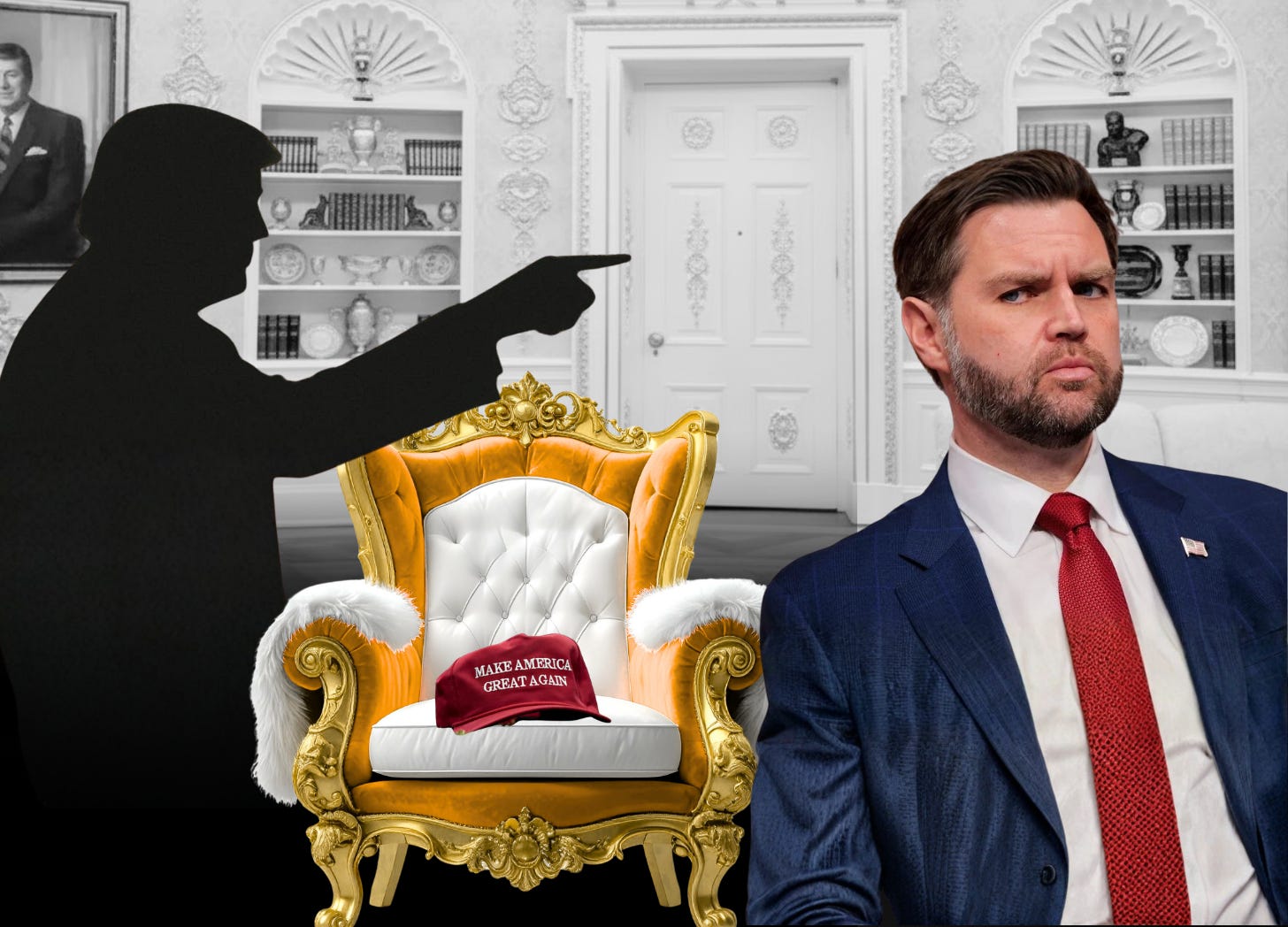
There is new reporting suggesting that JD Vance may already be reconsidering the most obvious political trajectory available to him: becoming Donald Trump’s heir apparent in 2028.
If that sounds surprising, it should.
Vice presidents are generally not random side characters in presidential administrations. The traditional model is fairly straightforward. The president selects someone who can help broaden the coalition, remain loyal, and ideally stand ready as the natural successor. If supporters like the current administration, the vice president becomes the logical continuation of that political project.
That is the theory, anyway.
But what happens when the president does not seem particularly interested in naming an heir, the movement itself becomes increasingly unstable, and the vice president starts to look less like the future and more like an awkward placeholder?
That appears to be where JD Vance may find himself.
The heir apparent who may not actually be heir apparent
For a long time, Vance was treated as the obvious next chapter of Trumpism.
He had the ideological credentials. He had deep-pocketed allies like Peter Thiel. He was young enough to present himself as a generational handoff rather than a continuation of an aging political brand. The assumption in many political circles was that Vance would inherit MAGA and attempt to modernize it into something slightly more polished, more intellectualized, maybe even more technologically fluent.
But that assumption depends on Donald Trump actually wanting succession planning.
And Trump does not exactly operate that way.
Instead, Trump increasingly treats political advancement the way he treats casting decisions on reality television. One day it is Vance. Another day it is Marco Rubio. Then someone floats Donald Trump Jr. because why not.
That kind of ambiguity is not great if you are the vice president trying to build legitimacy.
If Trump is not clearly signaling that Vance is the future, Vance has a problem.
The bigger problem may be MAGA itself
There is another possibility here, and it may be even more politically revealing.
What if Vance does want to be president, just not next? That would be a striking calculation, but not an entirely irrational one. Because by 2028, Democrats would have a very simple argument if Vance becomes the Republican nominee: this is Trump, just younger. Whether that message would be fair is almost secondary, but it is the obvious framing.
If inflation remains painful, if foreign policy becomes more chaotic, if the Trump years continue to carry political baggage, Vance would inherit all of it. He would not be presented as a fresh face. He would be presented as an extension.
And Vance is young. If he believes Trumpism is entering a politically toxic phase, waiting could be the smarter move. He could sit out 2028, let someone else absorb the fallout, and re-emerge in 2032 or later with more distance.
Politicians are not generally known for delayed gratification, but strategically, it would make sense.
What exactly does Vance represent anymore?
This is where the ideological confusion gets interesting.
For years, MAGA sold itself as the anti-interventionist version of Republican politics: skeptical of wars, nation-building, and the old George W. Bush foreign policy model.
Vance fit neatly into that version of the movement.
But if Trump’s current political identity is increasingly more interventionist, more militarily aggressive, and more aligned with a traditional hawkish Republican posture, then where exactly does that leave Vance?
If the internal reporting is accurate, some of Vance’s closest ideological allies are already disappearing from the administration. That is not just staffing drama; it suggests that his faction may be losing relevance. And if that faction is losing relevance, what exactly is the political lane for Vance?
The anti-war MAGA candidate inside a movement that no longer seems especially anti-war? That becomes a difficult pitch.
Meanwhile, Marco Rubio exists
It is also impossible to ignore Marco Rubio’s positioning here. Rubio increasingly looks like someone Trump is comfortable elevating, particularly as foreign policy becomes a more central part of the political conversation.
That does not automatically make Rubio the frontrunner, but it does make Vance’s presumed inevitability look much less inevitable. And politics changes fast.
A few months ago, Vance looked like the obvious future. Now the conversation is far messier. Rubio is getting attention. Other names occasionally surface. The certainty around Vance has weakened.
That alone is politically significant.
The movement matters more than the nominee
The larger point is that even if Vance fades, the broader Republican political playbook probably does not.
The messaging framework remains familiar: portray Democrats as dangerous, frame elections as suspect when politically useful, promise safety, identify scapegoats, manufacture existential stakes. Candidates may change, but the operating system often does not.
Which is why succession speculation is interesting, but not the whole story.
Because the real question may not be whether JD Vance becomes Trump’s heir. It may be whether Trumpism actually needs a single heir at all.
Imagine being the vice president and already thinking, “Maybe I’ll sit this one out.” Smart move, or political red flag?
We’re reaching over 150 million people every month across YouTube, podcasts, Substack, and beyond. But algorithms can change. Platforms can fold. And when that happens, this newsletter is how we stay connected.
If you’re not yet a paid subscriber, please consider joining.
If you’re already paid on one platform, consider supporting us on both Substack and our website.
You can subscribe on our website and right here on Substack.
And if you’re really on fire, consider gifting a subscription—we’ve got thousands on our waiting list ready to read, watch, and fight back.
Let’s keep building.
—David
PS: Can’t contribute right now? No problem. You can support us for free by subscribing on YouTube, listening to our audio podcast on Spotify or Apple Podcasts, or become a free subscriber to this very Substack. Every bit counts.
I think JD knows his wife would be tormented by the MAGAs. And it would be hard on his children too. He might have to step in if Trump passes, but I bet Thiel, et al, are telling him to step down in 2028..
I think we should focus on turning out Democratic voters -- especially those who stayed home in the last presidential election -- by developing a platform for improving Americans' healthcare, education, the economy, jobs, and affordability by taxing the ultra-wealthy to pay for it. I don't give a hoot which subservient, do-nothing, enabling Republican runs. We should not spend time or energy speculating about it.